Virginia SOL S.3.a
The Standard
- S.3
- The student will apply history and social science skills to the content by
analyzing and interpreting information sources including, but not limited to artifacts, primary and secondary sources, charts, graphs, and diagrams
Virginia Standards of Learning for History and Social Science
Teacher's field guide
What This Standard Means
What Students Need to Do
- Students examine objects, documents, images, and visual data to find facts and clues. They explain what a source shows, who created it, and which conclusions the evidence supports.
What Mastery Looks Like
- Students separate what they observe from what they infer. They use titles, labels, dates, and source details to answer questions and support conclusions with evidence.
Common Misconceptions
- Students may treat guesses as facts or overlook chart titles and labels. They may think every old item is a firsthand account or assume one source tells the whole story.
How to Assess It
- Give students a historical photograph and ask, “Write two details you observe and one conclusion. Which observed detail supports your conclusion?”
Lesson moves
Ways to Teach It
Set up stations with a coin, postcard, button, and tool, then have students record observations and supported inferences about each object.
Compare a diary excerpt with a textbook paragraph, then ask students to explain how the two accounts differ and why.
Play Source Sort using cards showing a letter, graph, map, artifact, photograph, and textbook page, with students explaining each placement.
Use a class snack survey bar graph, then ask students to identify the most popular choice and cite the data supporting it.
Free download
Printable S.3.a Worksheet
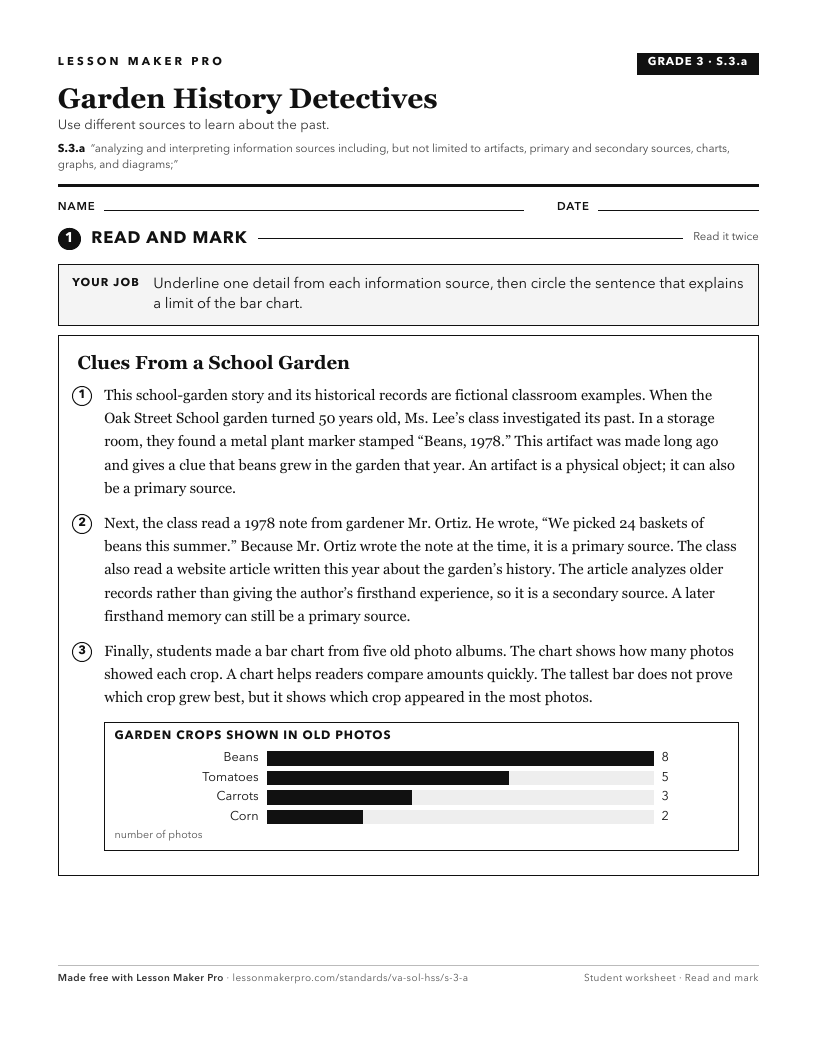
A ready-to-print activity worksheet aligned to S.3.a, with an answer key for the teacher on its own page. No account needed.
PDF, US Letter, prints cleanly in black and white.
Download the worksheetKeep exploring
Related Standards
- S.K.a
viewing and exploring information sources including, but not limited to artifacts, primary and secondary sources, charts, graphs, and diagrams
- S.VS.a
analyzing and interpreting information sources including, but not limited to artifacts, primary and secondary sources, charts, graphs, and diagrams
- S.1.a
viewing and exploring information sources including, but not limited to artifacts, primary and secondary sources, charts, graphs, and diagrams
- S.2.a
viewing and exploring information sources including, but not limited to artifacts, primary and secondary sources, charts, graphs, and diagrams
Turn this exact standard into a lesson
Grade, subject, topic, and the complete standard are prefilled. Create one free, no account needed.
Also for this standard:Make a WorksheetMake a QuizMake a Sub Lesson