Virginia SOL S.VS.a
The Standard
- S.VS
- The student will apply history and social science skills to the content by
analyzing and interpreting information sources including, but not limited to artifacts, primary and secondary sources, charts, graphs, and diagrams
Virginia Standards of Learning for History and Social Science
Teacher's field guide
What This Standard Means
What Students Need to Do
- Students examine different sources, notice key details, and explain what the information shows. They use evidence to make inferences, identify purpose, and compare sources that present different details.
What Mastery Looks Like
- A student can identify the source type and find relevant details in words, images, labels, or objects. They support a reasonable claim with evidence and explain why sources may differ.
Common Misconceptions
- Students may treat guesses as observations or repeat a caption without citing evidence. They may assume an old source is always accurate. They may overlook titles, keys, labels, scale, authorship, and purpose.
How to Assess It
- Show a historic photograph and a related bar graph. Ask students to write one claim and support it with one detail from each source.
Lesson moves
Ways to Teach It
Give pairs a replica coin, photograph, and map, then have them record three observations and one evidence-based inference for each.
Ask students to write which source best explains an event, then defend their choice with two specific details.
Play Source Detective, where teams draw source cards and earn points for naming the source type, purpose, and strongest evidence.
Compare a school lunch graph with the cafeteria menu, then discuss what each source reveals and what information is missing.
Free download
Printable S.VS.a Worksheet
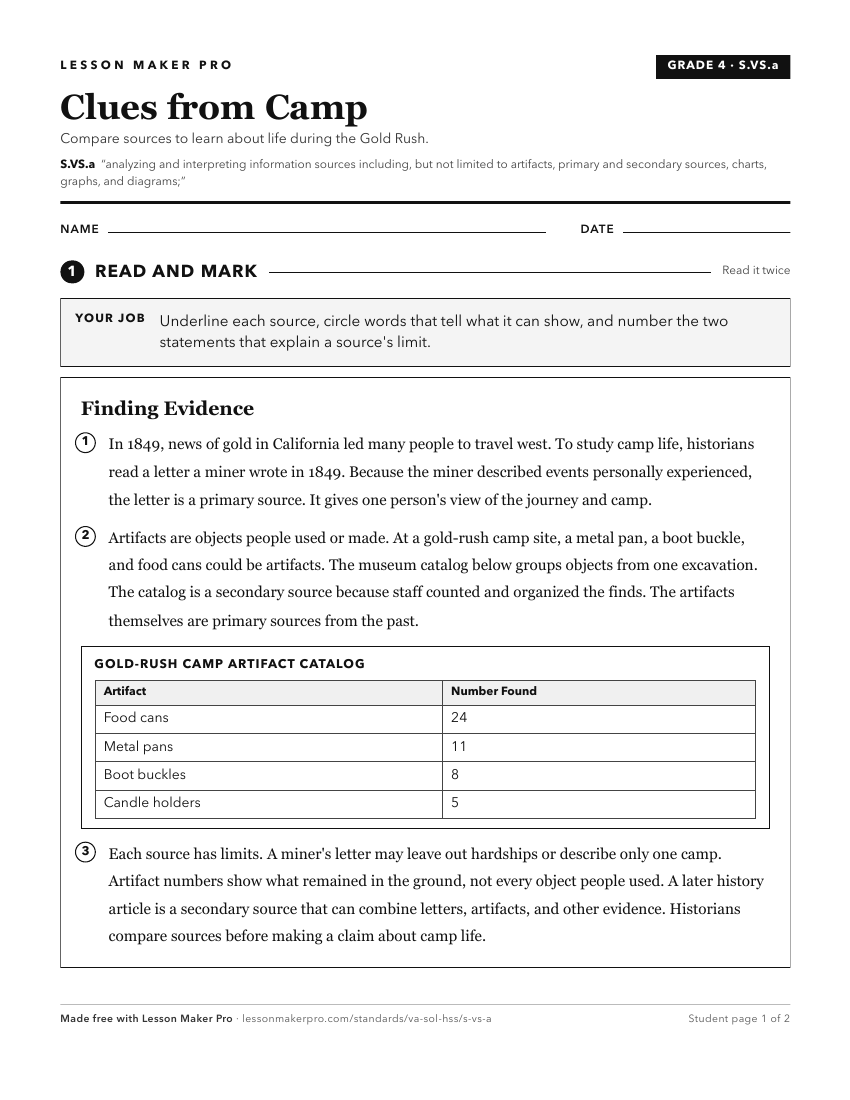
A ready-to-print activity worksheet aligned to S.VS.a, with an answer key for the teacher on its own page. No account needed.
PDF, US Letter, prints cleanly in black and white.
Download the worksheetKeep exploring
Related Standards
- S.K.a
viewing and exploring information sources including, but not limited to artifacts, primary and secondary sources, charts, graphs, and diagrams
- S.3.a
analyzing and interpreting information sources including, but not limited to artifacts, primary and secondary sources, charts, graphs, and diagrams
- S.1.a
viewing and exploring information sources including, but not limited to artifacts, primary and secondary sources, charts, graphs, and diagrams
- S.2.a
viewing and exploring information sources including, but not limited to artifacts, primary and secondary sources, charts, graphs, and diagrams
Turn this exact standard into a lesson
Grade, subject, topic, and the complete standard are prefilled. Create one free, no account needed.
Also for this standard:Make a WorksheetMake a QuizMake a Sub Lesson