Virginia SOL S.USII
SOL Standard (Skills Cluster)
The student will apply history and social science skills to the content by synthesizing evidence from information sources including, but not limited to artifacts, primary and secondary sources, charts, graphs, and diagrams to understand events in United States history; applying geographic skills to determine and predict patterns and trends of people, places, and events; developing questions, enhancing curiosity, and engaging in critical thinking and analysis; integrating evidence to construct and analyze timelines, classify events, and distinguish fact from opinion; comparing and contrasting people, places, events, and historical and political perspectives; determining and explaining cause-and-effect relationships; using an economic decision-making model to analyze the costs and benefits and explain the incentives and consequences of a specific choice made in U.S. history; engaging and communicating as a civil and informed individual with persons with different perspectives; and developing products that reflect an understanding of content.
Virginia Standards of Learning for History and Social Science
Cluster contents
Skills in This Standard
S.USII is a Standards of Learning history and social science standard. These are the skills expectations under it.
- S.USII.a
synthesizing evidence from information sources including, but not limited to artifacts, primary and secondary sources, charts, graphs, and diagrams to understan...
- S.USII.b
applying geographic skills to determine and predict patterns and trends of people, places, and events
- S.USII.c
developing questions, enhancing curiosity, and engaging in critical thinking and analysis
- S.USII.d
integrating evidence to construct and analyze timelines, classify events, and distinguish fact from opinion
- S.USII.e
comparing and contrasting people, places, events, and historical and political perspectives
- S.USII.f
determining and explaining cause-and-effect relationships
- S.USII.g
using an economic decision-making model to analyze the costs and benefits and explain the incentives and consequences of a specific choice made in U.S. history
- S.USII.h
engaging and communicating as a civil and informed individual with persons with different perspectives
- S.USII.i
developing products that reflect an understanding of content
Teacher's field guide
What This Cluster Means
What Students Need to Do
- Students gather evidence from artifacts, texts, maps, charts, graphs, and diagrams. They identify patterns, compare perspectives, sequence events, separate fact from opinion, and explain causes and effects. They weigh costs, benefits, incentives, and consequences, then communicate supported conclusions respectfully.
What Mastery Looks Like
- Given several sources, students make a clear claim and support it with accurate evidence. They can build a timeline, interpret geographic patterns, compare viewpoints, and explain why a historical choice was made. Their final product shows sound reasoning and acknowledges different perspectives.
Common Misconceptions
- Students may assume primary sources are always accurate, opinions are always false, or one source proves a claim. They may confuse events that happened in sequence with cause and effect. They may also ignore map legends, graph scales, source context, or author bias.
How to Assess It
- Give students a migration map, a short letter, and a population graph. Ask, "What caused one migration pattern, what two details support your claim, and what is one limitation of a source?"
Lesson moves
Ways to Teach It
Give groups ration cards, wartime posters, and production graphs to sort by source type, claim, and possible bias.
Ask students to compare two accounts of one protest and write which details agree, conflict, or reflect different perspectives.
Run a timeline card race where teams place events in order, then connect each event to one cause and one effect.
Use local census maps to predict a community need, then list the costs, benefits, incentives, and likely consequences of one response.
Free download
Printable S.USII Worksheet
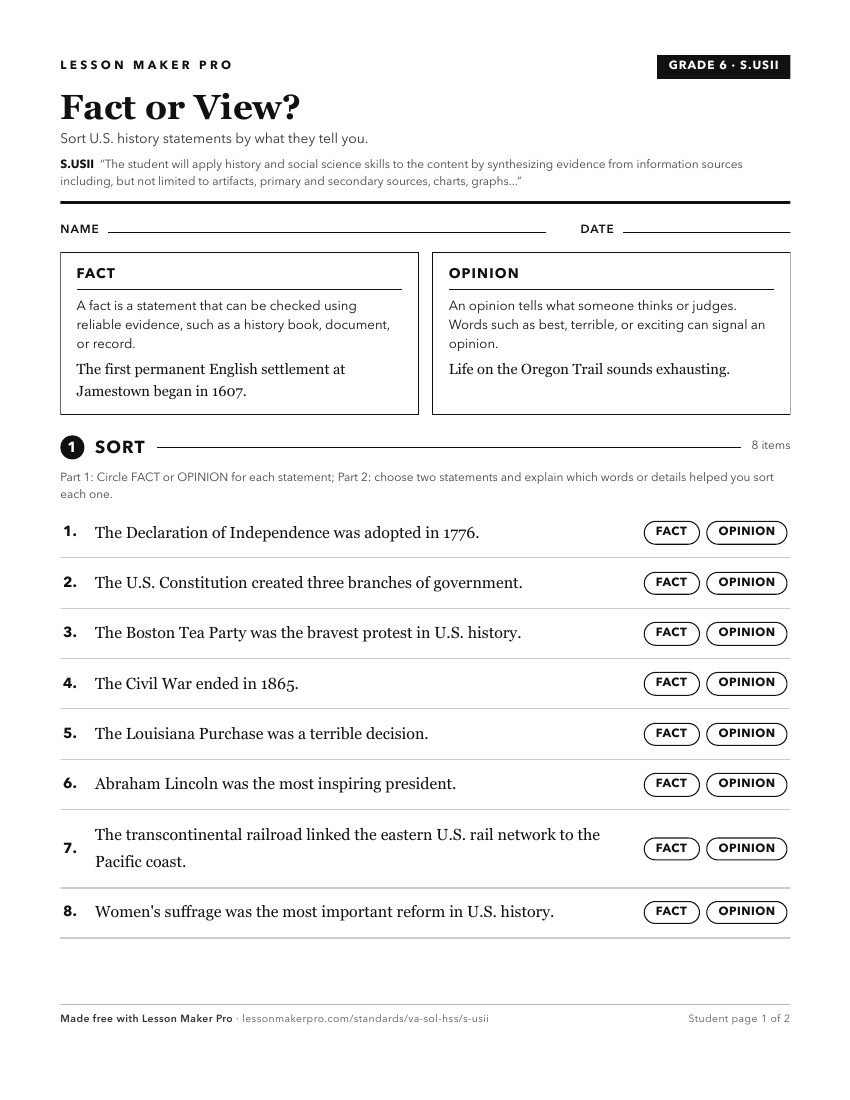
A ready-to-print activity worksheet aligned to S.USII, with an answer key for the teacher on its own page. No account needed.
PDF, US Letter, prints cleanly in black and white.
Download the worksheetKeep exploring
Related Standards
- S.1
The student will apply history and social science skills to the content by
- S.VS
The student will apply history and social science skills to the content by
- S.2
The student will apply history and social science skills to the content by
- S.CE
The student will apply history and social science skills to the content by
Turn this cluster into a lesson
Grade, subject, topic, and the complete cluster are prefilled. Create one free, no account needed.
Also for this cluster:Make a WorksheetMake a QuizMake a Sub Lesson