Virginia SOL S.CE
SOL Standard (Skills Cluster)
The student will apply history and social science skills to the content by selecting and synthesizing evidence from information sources including, but not limited to artifacts, primary and secondary sources, charts, graphs, and diagrams to understand civics and economics; applying geographic skills to determine and predict patterns and trends of people, places, or events; developing questions, enhancing curiosity, and engaging in critical thinking and analysis; integrating evidence to construct and analyze timelines, classify events, and to distinguish fact and opinion; comparing and contrasting historical, cultural, economic, and political perspectives; determining and explaining cause and effect relationships; analyzing the costs and benefits and incentives and consequences of a specific choice using various economic decision-making models; engaging and communicating as a civil and informed individual with persons with different perspectives; and developing products that reflect an understanding of research, content, and civics and economic concepts.
Virginia Standards of Learning for History and Social Science
Cluster contents
Skills in This Standard
S.CE is a Standards of Learning history and social science standard. These are the skills expectations under it.
- S.CE.a
selecting and synthesizing evidence from information sources including, but not limited to artifacts, primary and secondary sources, charts, graphs, and diagram...
- S.CE.b
applying geographic skills to determine and predict patterns and trends of people, places, or events
- S.CE.c
developing questions, enhancing curiosity, and engaging in critical thinking and analysis
- S.CE.d
integrating evidence to construct and analyze timelines, classify events, and to distinguish fact and opinion
- S.CE.e
comparing and contrasting historical, cultural, economic, and political perspectives
- S.CE.f
determining and explaining cause and effect relationships
- S.CE.g
analyzing the costs and benefits and incentives and consequences of a specific choice using various economic decision-making models
- S.CE.h
engaging and communicating as a civil and informed individual with persons with different perspectives
- S.CE.i
developing products that reflect an understanding of research, content, and civics and economic concepts.
Teacher's field guide
What This Cluster Means
What Students Need to Do
- Students gather relevant evidence from maps, artifacts, data displays, and written sources. They identify geographic patterns, compare viewpoints, explain causes, and make supported civic or economic claims. They present conclusions in timelines, diagrams, discussions, or short research products.
What Mastery Looks Like
- Given mixed sources, a student selects reliable evidence, separates fact from opinion, and explains how each detail supports a conclusion. The student predicts a pattern, weighs tradeoffs, and responds respectfully to a competing viewpoint.
Common Misconceptions
- Students often treat every source as equally reliable or copy evidence without explaining its meaning. They may confuse correlation with cause, fact with opinion, or a short-term benefit with the best overall choice.
How to Assess It
- Give students a short article, a population graph, and two town policy choices. Ask them to choose one, cite two details, and explain one likely consequence.
Lesson moves
Ways to Teach It
Set up source stations with a map, artifact image, graph, and news excerpt; students record one claim each source can support.
Ask students to write and discuss: Should the city spend limited funds on buses or parks, and why?
Play Evidence Match: teams pair claim cards with source cards, then earn a point by explaining each connection.
Compare two local grocery ads, calculate tradeoffs for a fixed budget, and explain how prices or incentives shape buying choices.
Free download
Printable S.CE Worksheet
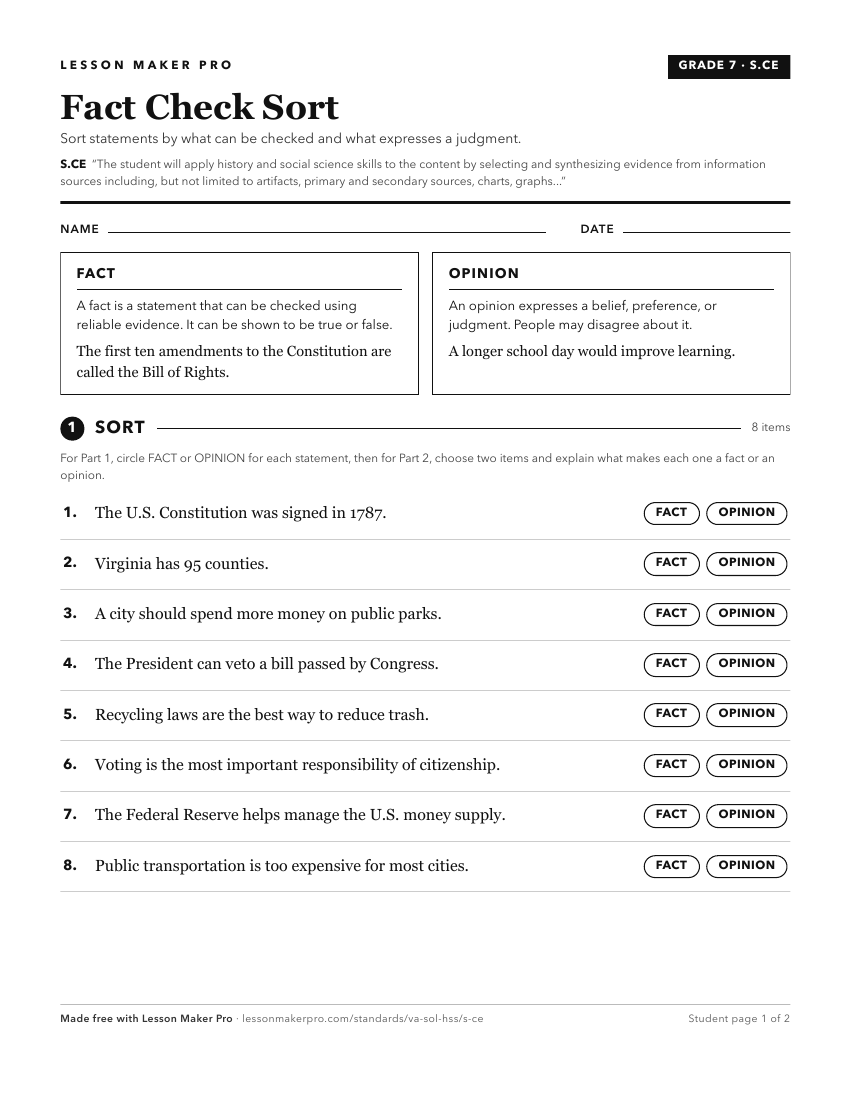
A ready-to-print activity worksheet aligned to S.CE, with an answer key for the teacher on its own page. No account needed.
PDF, US Letter, prints cleanly in black and white.
Download the worksheetKeep exploring
Related Standards
- S.USII
The student will apply history and social science skills to the content by
- S.VS
The student will apply history and social science skills to the content by
- S.USI
The student will apply history and social science skills to the content by
- S.K
The student will apply history and social science skills to the content by
Turn this cluster into a lesson
Grade, subject, topic, and the complete cluster are prefilled. Create one free, no account needed.
Also for this cluster:Make a WorksheetMake a QuizMake a Sub Lesson