Virginia SOL S.CE.a
The Standard
- S.CE
- The student will apply history and social science skills to the content by
selecting and synthesizing evidence from information sources including, but not limited to artifacts, primary and secondary sources, charts, graphs, and diagrams to understand civics and economics
Virginia Standards of Learning for History and Social Science
Teacher's field guide
What This Standard Means
What Students Need to Do
- Students choose relevant evidence from artifacts, written sources, charts, graphs, and diagrams. They combine details from several sources to explain a civics or economics question.
What Mastery Looks Like
- Students identify which sources and details answer the question. They connect evidence from at least two source types and explain how it supports a clear conclusion.
Common Misconceptions
- Students may copy facts without explaining how they connect. They may choose striking but irrelevant details, treat primary sources as unbiased, or misread graph labels and scales.
How to Assess It
- Give students a political cartoon, a short news excerpt, and a voter turnout graph. Ask them to select two details and explain what they show about voting participation.
Lesson moves
Ways to Teach It
Give pairs a campaign flyer, voter turnout graph, and sample ballot, then have them sort evidence that answers a question about participation.
Ask students to write: Which two sources best explain why citizens vote, and how does each source support your answer?
Play Evidence Match by having teams pair claim cards with supporting details from short texts, charts, photographs, and diagrams.
Compare a grocery advertisement, receipt, and price graph, then explain how the combined evidence could guide a consumer's choice.
Free download
Printable S.CE.a Worksheet
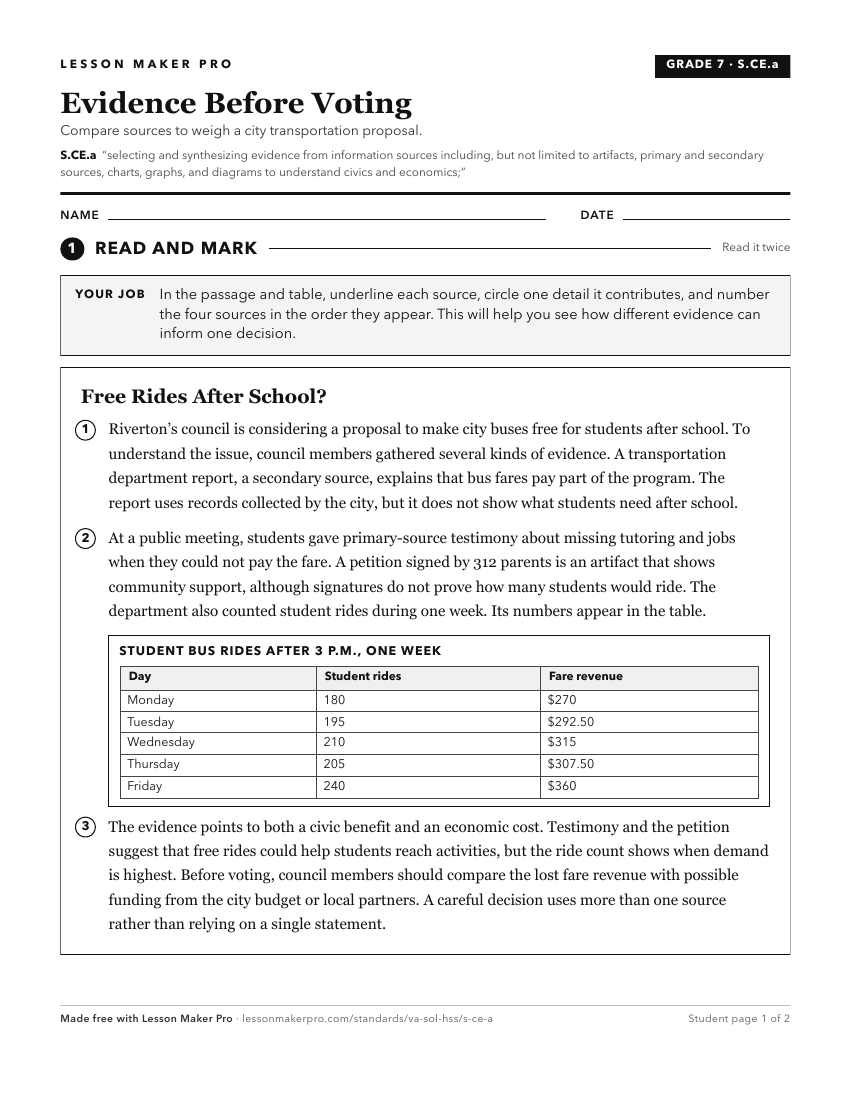
A ready-to-print activity worksheet aligned to S.CE.a, with an answer key for the teacher on its own page. No account needed.
PDF, US Letter, prints cleanly in black and white.
Download the worksheetKeep exploring
Related Standards
- S.WG.a
selecting and synthesizing evidence from information sources including, but not limited to artifacts, primary and secondary sources, charts, graphs, diagrams, a...
- S.3.a
analyzing and interpreting information sources including, but not limited to artifacts, primary and secondary sources, charts, graphs, and diagrams
- S.USII.a
synthesizing evidence from information sources including, but not limited to artifacts, primary and secondary sources, charts, graphs, and diagrams to understan...
- S.USI.a
synthesizing evidence from information sources including, but not limited to artifacts, primary and secondary sources, charts, graphs, and diagrams to understan...
Turn this exact standard into a lesson
Grade, subject, topic, and the complete standard are prefilled. Create one free, no account needed.
Also for this standard:Make a WorksheetMake a QuizMake a Sub Lesson