Virginia SOL S.WG.a
The Standard
- S.WG
- The student will demonstrate skills for historical thinking, geographical analysis, economic decision making, and responsible citizenship by
selecting and synthesizing evidence from information sources including, but not limited to artifacts, primary and secondary sources, charts, graphs, diagrams, and geospatial technologies, including maps, the geographic information system (GIS), and global positioning system (GPS) imagery, to understand the regions of the world
Virginia Standards of Learning for History and Social Science
Teacher's field guide
What This Standard Means
What Students Need to Do
- Students choose relevant evidence from maps, images, artifacts, graphs, and written sources to answer a geographic question. They combine details from several sources to explain a world region.
What Mastery Looks Like
- Students make a clear claim about a region and support it with accurate evidence from at least two source types. They explain how the evidence connects, rather than listing facts separately.
Common Misconceptions
- Students may treat every source as equally useful or assume maps and images are always current and unbiased. They may summarize each source separately without using the details to build one explanation.
How to Assess It
- Give students a climate graph, population map, and photograph from the Andes. Ask: “How does the physical environment shape where people live? Use two sources.”
Lesson moves
Ways to Teach It
Give groups printed maps, graphs, photographs, and artifact cards to sort into evidence for climate, population, economy, or culture.
Ask students to write one claim about a region, then explain which two sources provide the strongest support and why.
Play Evidence Match by having teams pair regional claims with source cards, earning points only when they explain each connection.
Use satellite images and a street map to compare how a nearby city and a world city use land.
Free download
Printable S.WG.a Worksheet
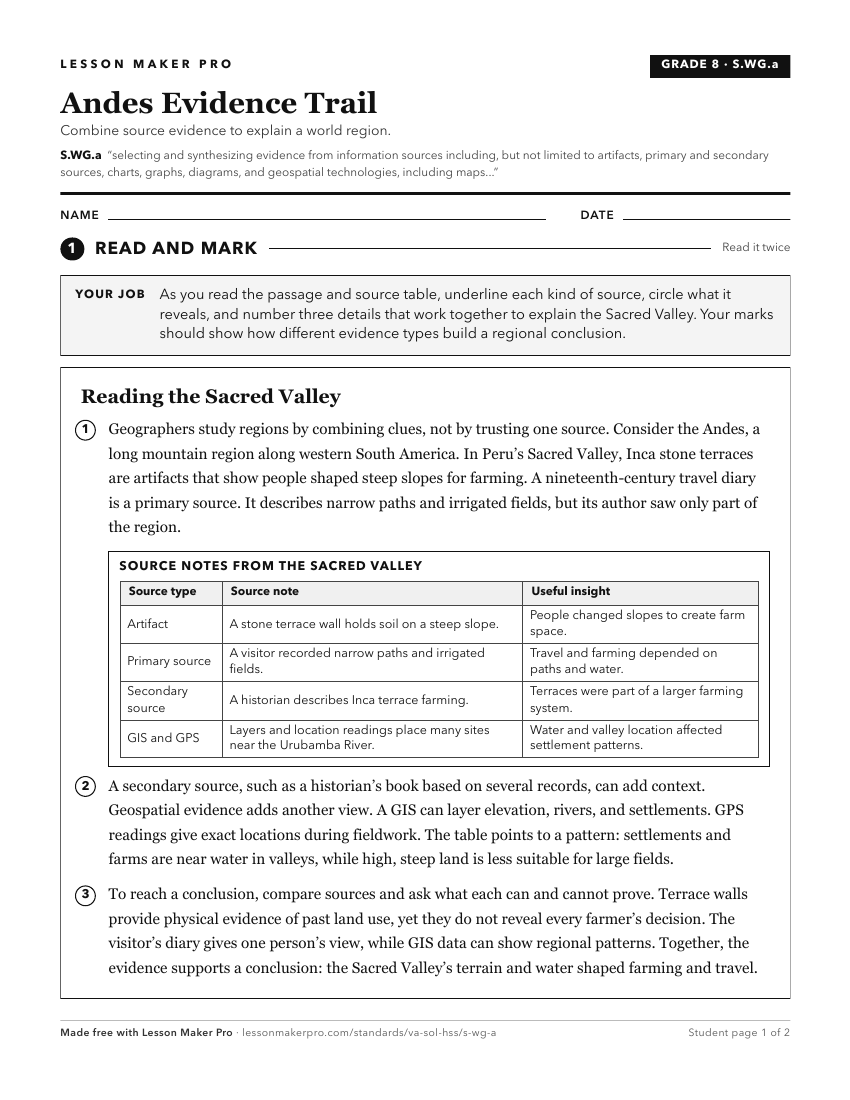
A ready-to-print activity worksheet aligned to S.WG.a, with an answer key for the teacher on its own page. No account needed.
PDF, US Letter, prints cleanly in black and white.
Download the worksheetKeep exploring
Related Standards
- S.CE.a
selecting and synthesizing evidence from information sources including, but not limited to artifacts, primary and secondary sources, charts, graphs, and diagram...
- S.3.a
analyzing and interpreting information sources including, but not limited to artifacts, primary and secondary sources, charts, graphs, and diagrams
- S.USII.a
synthesizing evidence from information sources including, but not limited to artifacts, primary and secondary sources, charts, graphs, and diagrams to understan...
- S.USI.a
synthesizing evidence from information sources including, but not limited to artifacts, primary and secondary sources, charts, graphs, and diagrams to understan...
Turn this exact standard into a lesson
Grade, subject, topic, and the complete standard are prefilled. Create one free, no account needed.
Also for this standard:Make a WorksheetMake a QuizMake a Sub Lesson