Virginia SOL S.USI
SOL Standard (Skills Cluster)
The student will apply history and social science skills to the content by synthesizing evidence from information sources including, but not limited to artifacts, primary and secondary sources, charts, graphs, and diagrams to understand events in United States history; applying geographic skills to determine patterns and trends of people, places, or events; developing questions, enhancing curiosity, and engaging in critical thinking and analysis; integrating evidence to construct and analyze timelines, classify events, and distinguish fact from opinion; comparing and contrasting historical, cultural, economic, and political perspectives; determining and explaining cause-and-effect relationships; using economic decision-making models to make a decision and explain the incentives and consequences of a specific choice; engaging and communicating as a civil and informed individual with persons with different perspectives; and developing products that reflect an understanding of content.
Virginia Standards of Learning for History and Social Science
Cluster contents
Skills in This Standard
S.USI is a Standards of Learning history and social science standard. These are the skills expectations under it.
- S.USI.a
synthesizing evidence from information sources including, but not limited to artifacts, primary and secondary sources, charts, graphs, and diagrams to understan...
- S.USI.b
applying geographic skills to determine patterns and trends of people, places, or events
- S.USI.c
developing questions, enhancing curiosity, and engaging in critical thinking and analysis
- S.USI.d
integrating evidence to construct and analyze timelines, classify events, and distinguish fact from opinion
- S.USI.e
comparing and contrasting historical, cultural, economic, and political perspectives
- S.USI.f
determining and explaining cause-and-effect relationships
- S.USI.g
using economic decision-making models to make a decision and explain the incentives and consequences of a specific choice
- S.USI.h
engaging and communicating as a civil and informed individual with persons with different perspectives
- S.USI.i
developing products that reflect an understanding of content
Teacher's field guide
What This Cluster Means
What Students Need to Do
- Students combine evidence from artifacts, written sources, maps, charts, graphs, and diagrams to explain United States history. They identify patterns, build timelines, separate fact from opinion, compare perspectives, trace causes and effects, and explain choices and consequences.
What Mastery Looks Like
- Students make a clear claim and support it with accurate evidence from several sources. They can explain geographic patterns, order and classify events, compare viewpoints, and discuss disagreements respectfully.
Common Misconceptions
- Students may treat every source as equally reliable or confuse a source's opinion with a verified fact. They may list events without explaining connections, assume one cause produced an event, or describe a choice without naming its incentives and consequences.
How to Assess It
- Give students a short source, a map, and a chart about one event. Ask them to state a claim, cite two pieces of evidence, and explain one cause, effect, or perspective.
Lesson moves
Ways to Teach It
Set up stations with a replica artifact, diary excerpt, map, and graph, then have groups build one evidence-based explanation.
Ask students to write which of two historical accounts is more convincing, citing one fact and identifying one opinion.
Play Evidence Sort with cards labeled fact, opinion, cause, effect, incentive, consequence, primary source, and secondary source.
Have groups compare two school lunch choices using cost, benefits, incentives, consequences, and the perspectives of students, families, and staff.
Free download
Printable S.USI Worksheet
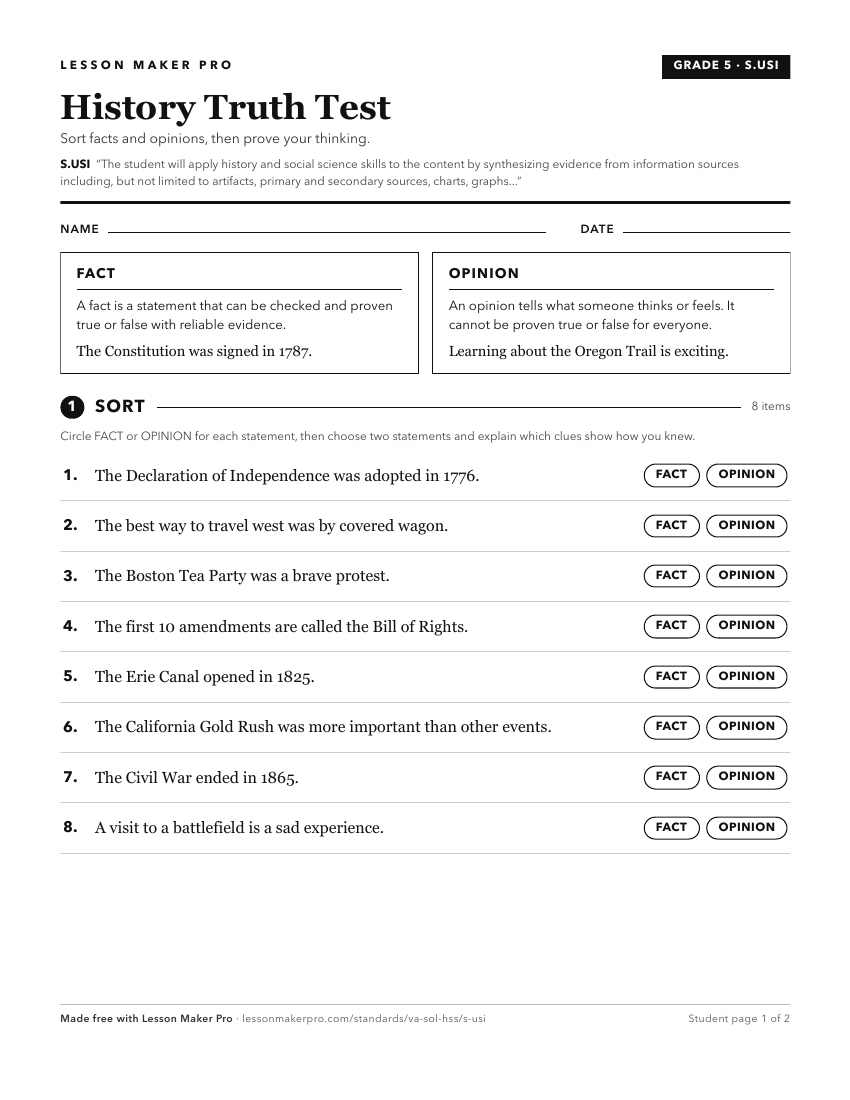
A ready-to-print activity worksheet aligned to S.USI, with an answer key for the teacher on its own page. No account needed.
PDF, US Letter, prints cleanly in black and white.
Download the worksheetKeep exploring
Related Standards
- S.1
The student will apply history and social science skills to the content by
- S.USII
The student will apply history and social science skills to the content by
- S.VS
The student will apply history and social science skills to the content by
- S.2
The student will apply history and social science skills to the content by
Turn this cluster into a lesson
Grade, subject, topic, and the complete cluster are prefilled. Create one free, no account needed.
Also for this cluster:Make a WorksheetMake a QuizMake a Sub Lesson