TEKS Math 6.14
Knowledge and Skills Statement (Standard Cluster)
The student applies mathematical process standards to develop an economic way of thinking and problem solving useful in one's life as a knowledgeable consumer and investor
Texas Essential Knowledge and Skills for Mathematics
Cluster contents
Student Expectations in This Statement
6.14 is a knowledge and skills statement. These are the student expectations under it.
- 6.14.A
compare the features and costs of a checking account and a debit card offered by different local financial institutions
- 6.14.B
distinguish between debit cards and credit cards
- 6.14.C
balance a check register that includes deposits, withdrawals, and transfers
- 6.14.D
explain why it is important to establish a positive credit history
- 6.14.E
describe the information in a credit report and how long it is retained
- 6.14.F
describe the value of credit reports to borrowers and to lenders
- 6.14.G
explain various methods to pay for college, including through savings, grants, scholarships, student loans, and work-study
- 6.14.H
compare the annual salary of several occupations requiring various levels of post-secondary education or vocational training and calculate the effects of the di...
Teacher's field guide
What This Cluster Means
What Students Need to Do
- Students compare checking account offers, track deposits and payments, and tell when debit or credit is being used. They interpret credit reports and explain how credit history affects future borrowing. They compare ways to pay for college and calculate lifetime earnings for careers with different training requirements.
What Mastery Looks Like
- Students can compare bank offers, identify fees, distinguish debit from credit, and maintain an accurate running balance. They can explain how payment history affects borrowing and identify information found in a credit report. They can compare college payment choices and calculate how salary differences affect earnings over time.
Common Misconceptions
- Students may think debit and credit cards both borrow money, or that a debit purchase does not affect the checking balance immediately. They may assume credit reports include only missed payments or that negative information stays forever. Some confuse grants and scholarships with loans, and compare salaries without considering training time or years worked.
How to Assess It
- Give a four-part exit ticket: identify debit versus credit, update a register with three transactions, name two credit report items, and compare two lifetime incomes.
Lesson moves
Ways to Teach It
Give pairs printed bank fee sheets and transaction cards, then have them choose an account and update a paper check register.
Ask students to write which college payment option they would use first and explain the long-term cost of each choice.
Play a debit-or-credit sorting game using purchase cards, payment timing, interest, account balance, and credit history clues.
Compare three local career salaries, subtract estimated education costs, and graph cumulative earnings at ages 25, 35, and 55.
Free download
Printable 6.14 Worksheet
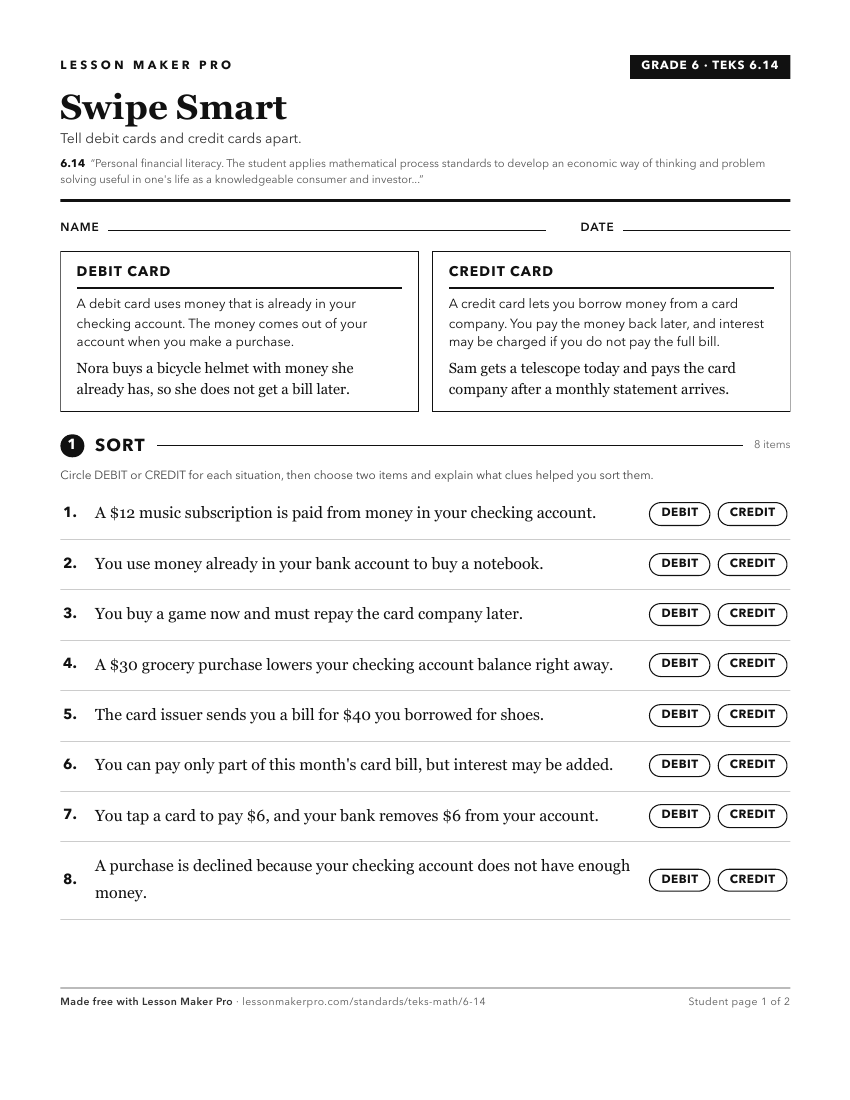
A ready-to-print activity worksheet aligned to 6.14, with an answer key for the teacher on its own page. No account needed.
PDF, US Letter, prints cleanly in black and white.
Download the worksheetKeep exploring
Related Standards
- 7.13
The 7th Grade version of this standard.
- 3.9
The student applies mathematical process standards to manage one's financial resources effectively for lifetime financial security
- 4.10
The student applies mathematical process standards to manage one's financial resources effectively for lifetime financial security
- 8.12
The 8th Grade version of this standard.
Turn this cluster into a lesson
Grade, subject, topic, and the complete cluster are prefilled. Create one free, no account needed.
Also for this cluster:Make a WorksheetMake a QuizMake a Sub Lesson