TEKS Math 7.13
Knowledge and Skills Statement (Standard Cluster)
The student applies mathematical process standards to develop an economic way of thinking and problem solving useful in one's life as a knowledgeable consumer and investor
Texas Essential Knowledge and Skills for Mathematics
Cluster contents
Student Expectations in This Statement
7.13 is a knowledge and skills statement. These are the student expectations under it.
- 7.13.A
calculate the sales tax for a given purchase and calculate income tax for earned wages
- 7.13.B
identify the components of a personal budget, including income; planned savings for college, retirement, and emergencies; taxes; and fixed and variable expenses...
- 7.13.C
create and organize a financial assets and liabilities record and construct a net worth statement
- 7.13.D
use a family budget estimator to determine the minimum household budget and average hourly wage needed for a family to meet its basic needs in the student's cit...
- 7.13.E
calculate and compare simple interest and compound interest earnings
- 7.13.F
analyze and compare monetary incentives, including sales, rebates, and coupons
Teacher's field guide
What This Cluster Means
What Students Need to Do
- Students use rates, percentages, and tables to calculate taxes, discounts, rebates, interest, and budget shares. They organize income, savings, expenses, assets, and debts to find net worth and judge whether a household budget works. They compare financial choices and support decisions with calculations.
What Mastery Looks Like
- Students accurately calculate taxes, discounts, rebates, budget percentages, interest earnings, and net worth from given information. They can organize a budget and explain whether income covers fixed expenses, variable expenses, taxes, and savings. They can compare financial options using calculations rather than price claims alone.
Common Misconceptions
- Students may add a tax rate as a dollar amount instead of multiplying by the price or wages. They often treat coupons and rebates as identical, confuse assets with income, or reverse assets and liabilities when finding net worth. They may also expect simple and compound interest to produce the same earnings.
How to Assess It
- Give this exit ticket: A $60 item has 8% sales tax and a $10 rebate. Find the final cost, then name whether the rebate applies before or after purchase.
Lesson moves
Ways to Teach It
Give pairs mock paychecks, bills, and savings cards, then have them build a monthly budget and calculate each category's percentage.
Ask students to write which expense they would reduce when a budget exceeds income, then defend the choice with numbers.
Run a coupon challenge where teams calculate final prices for items with sales, coupons, rebates, and sales tax.
Use a local family budget calculator to find needed hourly wages, then compare results for two nearby cities.
Free download
Printable 7.13 Worksheet
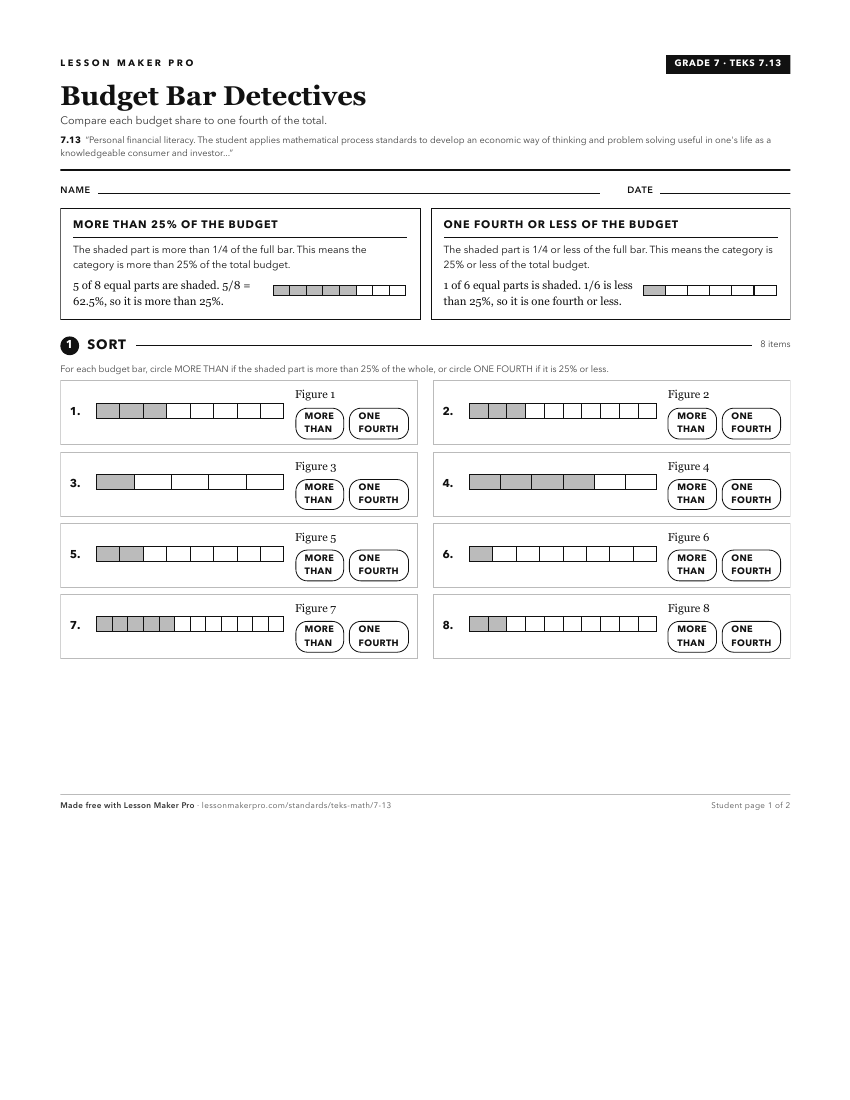
A ready-to-print activity worksheet aligned to 7.13, with an answer key for the teacher on its own page. No account needed.
PDF, US Letter, prints cleanly in black and white.
Download the worksheetKeep exploring
Related Standards
- 3.9
The student applies mathematical process standards to manage one's financial resources effectively for lifetime financial security
- 4.10
The student applies mathematical process standards to manage one's financial resources effectively for lifetime financial security
- 8.12
The 8th Grade version of this standard.
- 6.14
The 6th Grade version of this standard.
Turn this cluster into a lesson
Grade, subject, topic, and the complete cluster are prefilled. Create one free, no account needed.
Also for this cluster:Make a WorksheetMake a QuizMake a Sub Lesson