TEKS Math 4.10
Knowledge and Skills Statement (Standard Cluster)
The student applies mathematical process standards to manage one's financial resources effectively for lifetime financial security
Texas Essential Knowledge and Skills for Mathematics
Cluster contents
Student Expectations in This Statement
4.10 is a knowledge and skills statement. These are the student expectations under it.
- 4.10.A
distinguish between fixed and variable expenses
- 4.10.B
calculate profit in a given situation
- 4.10.C
compare the advantages and disadvantages of various savings options
- 4.10.D
describe how to allocate a weekly allowance among spending; saving, including for college; and sharing
- 4.10.E
describe the basic purpose of financial institutions, including keeping money safe, borrowing money, and lending
Teacher's field guide
What This Cluster Means
What Students Need to Do
- Students sort costs by whether the amount stays predictable or changes, and they find what remains after business costs are paid. They compare places to save money and divide an allowance among current spending, future goals, college, and giving. They also explain how financial institutions protect money and provide borrowing and lending services.
What Mastery Looks Like
- Students correctly classify expenses from a budget and find profit by subtracting all costs from sales income. They compare savings choices using safety, access, and possible earnings, then make an allowance plan whose parts equal the total. They can explain how banks protect deposits and make loans to borrowers.
Common Misconceptions
- Students often call every regular purchase fixed, even when the amount changes, or assume variable means optional. They may subtract sales from costs, treat total sales as profit, or make allowance shares that exceed the available amount. Some think a bank only stores cash and miss that it accepts deposits and makes loans.
How to Assess It
- Use this exit ticket: A student sells bracelets for $24 after spending $9, then divides the profit among spending, college savings, and sharing. Students find the profit, propose an allocation, classify rent and groceries, compare a locked box with a savings account, and name one bank purpose.
Lesson moves
Ways to Teach It
Give pairs $40 in play money and four labeled envelopes: spending, short-term saving, college saving, and sharing; students allocate and explain each amount.
Ask students to write which is better for saving $100, a locked box or bank account, and give one advantage and disadvantage of each.
Run a card sort with rent, electricity, groceries, and subscriptions, then solve profit cards showing sales income and business costs.
Examine pages from a local bank website and label examples of keeping deposits safe, paying interest, making loans, and charging borrowers.
Free download
Printable 4.10 Worksheet
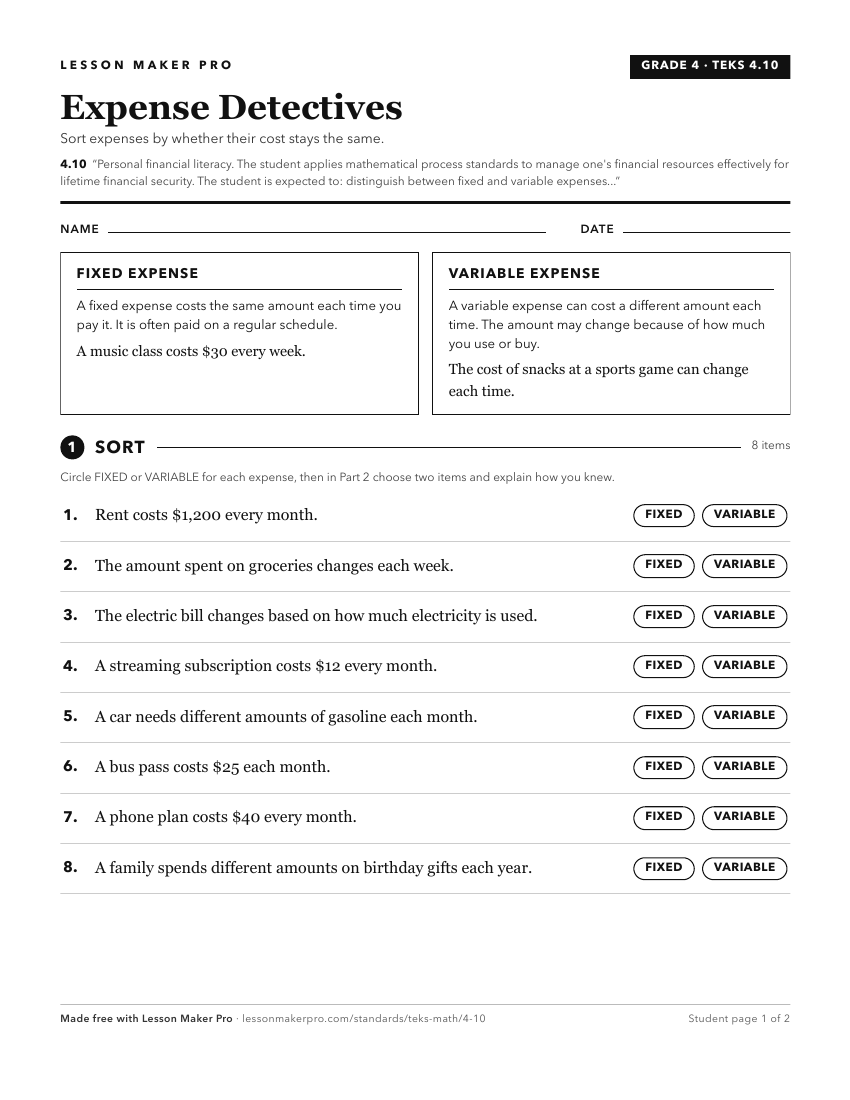
A ready-to-print activity worksheet aligned to 4.10, with an answer key for the teacher on its own page. No account needed.
PDF, US Letter, prints cleanly in black and white.
Download the worksheetKeep exploring
Related Standards
Turn this cluster into a lesson
Grade, subject, topic, and the complete cluster are prefilled. Create one free, no account needed.
Also for this cluster:Make a WorksheetMake a QuizMake a Sub Lesson