TEKS Math 3.9
Knowledge and Skills Statement (Standard Cluster)
The student applies mathematical process standards to manage one's financial resources effectively for lifetime financial security
Texas Essential Knowledge and Skills for Mathematics
Cluster contents
Student Expectations in This Statement
3.9 is a knowledge and skills statement. These are the student expectations under it.
- 3.9.A
explain the connection between human capital/labor and income
- 3.9.B
describe the relationship between the availability or scarcity of resources and how that impacts cost
- 3.9.C
identify the costs and benefits of planned and unplanned spending decisions
- 3.9.D
explain that credit is used when wants or needs exceed the ability to pay and that it is the borrower's responsibility to pay it back to the lender, usually wit...
- 3.9.E
list reasons to save and explain the benefit of a savings plan, including for college
- 3.9.F
identify decisions involving income, spending, saving, credit, and charitable giving
Teacher's field guide
What This Cluster Means
What Students Need to Do
- Students explain how work, education, and skills can affect income, and how scarce goods may cost more. They compare planned and unplanned purchases and sort choices involving income, spending, saving, borrowing, and giving. They explain credit repayment and make savings plans for goals such as college.
What Mastery Looks Like
- Given a money scenario, students identify income, spending, saving, credit, and charitable giving. They explain how skills can increase income, why scarcity can raise prices, and how planned spending avoids problems. They can create a savings plan and explain that borrowed money must be repaid with interest.
Common Misconceptions
- Students may think income only comes from a salary and is unrelated to skills or education. They may assume credit is free money, interest is optional, or saving means keeping whatever remains after spending. Some believe scarce items always cost more or that unplanned purchases have no cost beyond the price.
How to Assess It
- Give students this exit ticket: “Lena earns $15 walking dogs, saves $5 for college, donates $2, and wants a scarce $12 toy today.” Ask them to label each money decision, predict the toy’s price, choose cash, saving, or credit, and justify the choice.
Lesson moves
Ways to Teach It
Give pairs $20 in play money and cards for wages, needs, wants, savings, credit, and donations, then have them make a budget.
Discuss: Would you borrow $30 for a game that costs $40, and how would interest change your decision?
Play a scarcity auction with limited classroom coupons, then compare winning prices and explain why some coupons cost more.
Compare two grocery ads, identify scarce or seasonal items, and plan how to spend, save, and donate from a sample weekly income.
Free download
Printable 3.9 Worksheet
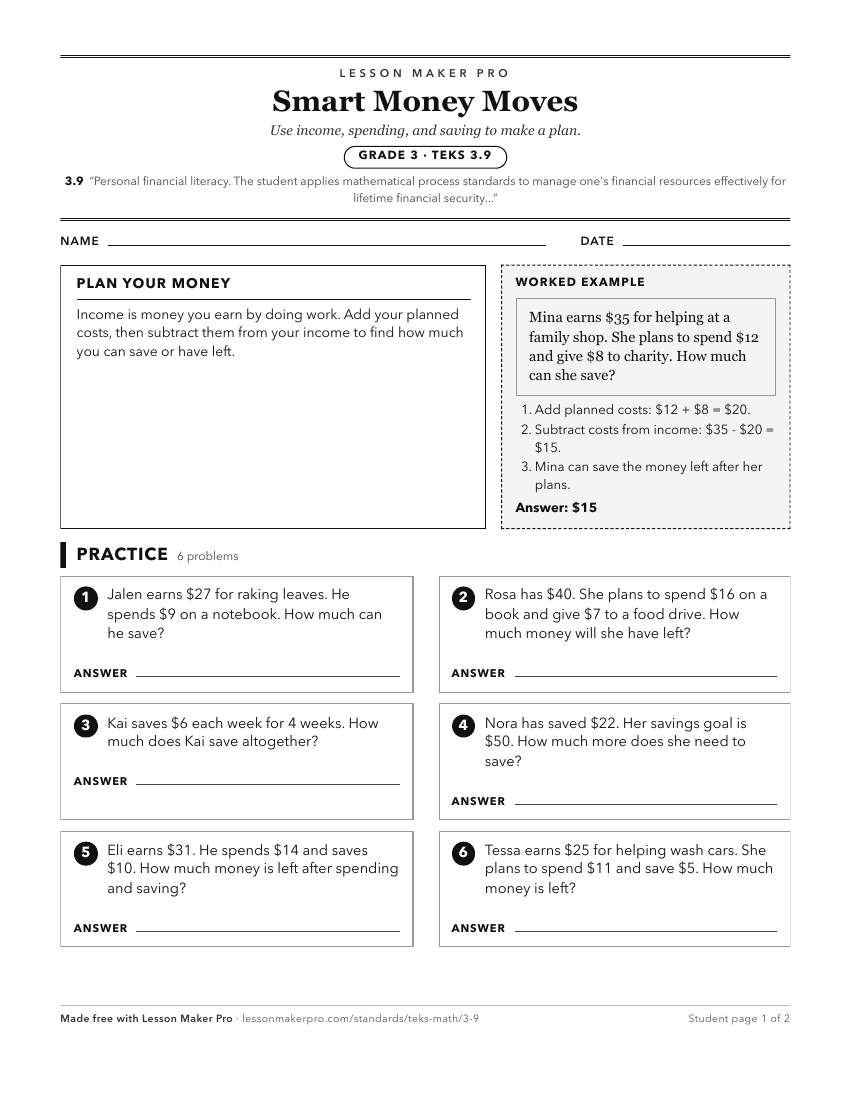
A ready-to-print activity worksheet aligned to 3.9, with an answer key for the teacher on its own page. No account needed.
PDF, US Letter, prints cleanly in black and white.
Download the worksheetKeep exploring
Related Standards
Turn this cluster into a lesson
Grade, subject, topic, and the complete cluster are prefilled. Create one free, no account needed.
Also for this cluster:Make a WorksheetMake a QuizMake a Sub Lesson