TEKS Math 3.9.F
The Standard
identify decisions involving income, spending, saving, credit, and charitable giving
Texas Essential Knowledge and Skills for Mathematics
Teacher's field guide
What This Standard Means
What Students Need to Do
- Students examine everyday money choices and name what is happening with the money. They tell whether money is earned, used now, kept for later, borrowed, or donated.
What Mastery Looks Like
- Students correctly classify choices in short money scenarios. They explain that credit must be repaid and distinguish keeping money for later from giving it away.
Common Misconceptions
- Students may think income means any money they already have. They may treat credit as free money or confuse saving with charitable giving because neither buys an item right away.
How to Assess It
- Give this exit ticket: Mia earns $8 for yard work, buys a book, saves $2, borrows for shoes, and donates $1. Label each choice and circle the one requiring repayment.
Lesson moves
Ways to Teach It
Give pairs five labeled jars and money-choice cards, then have them place each card in a jar and explain their choice.
Have students write how they would use $20 among buying something, keeping money for later, and helping a charity.
Play Money Choice Bingo by reading scenarios while students cover the matching income, purchase, savings, borrowing, or donation square.
Create a class budget for a pretend bake sale, including money earned, supply costs, savings, borrowing, and a donation.
Free download
Printable 3.9.F Worksheet
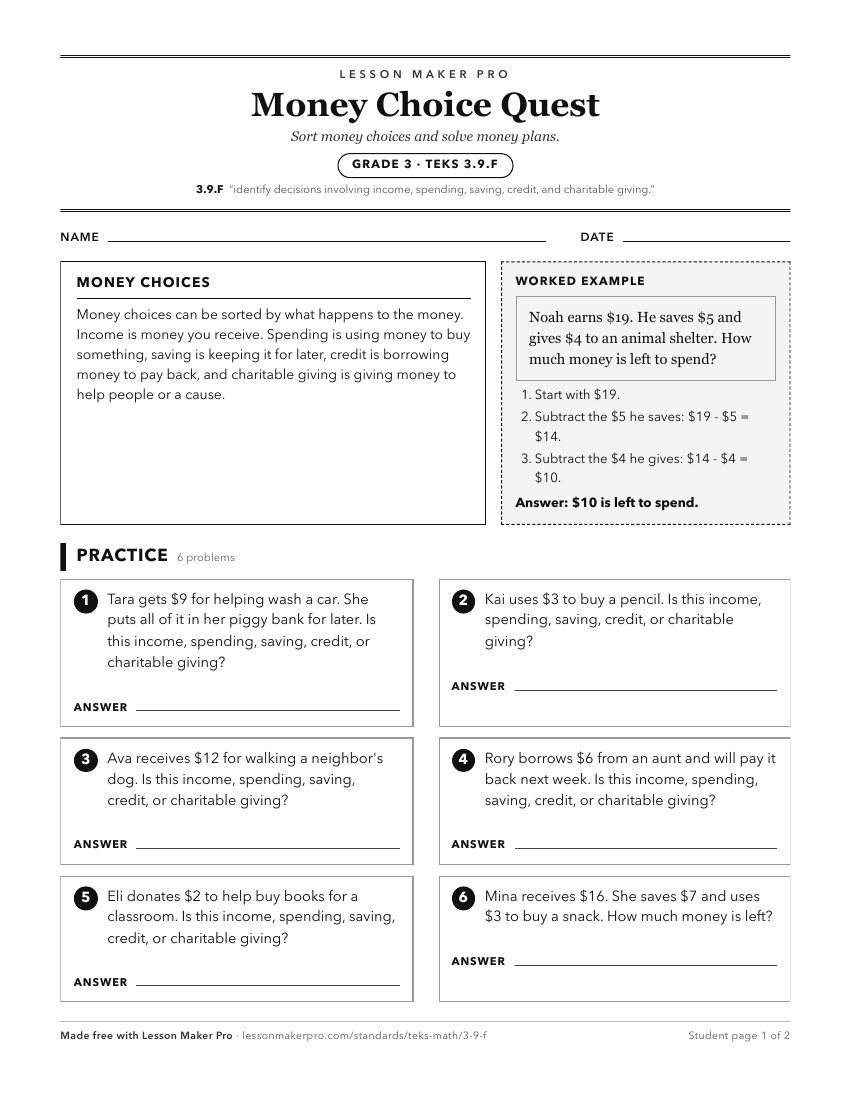
A ready-to-print activity worksheet aligned to 3.9.F, with an answer key for the teacher on its own page. No account needed.
PDF, US Letter, prints cleanly in black and white.
Download the worksheetKeep exploring
Related Standards
- K.9.D
distinguish between wants and needs and identify income as a source to meet one's wants and needs
- 3.9.C
identify the costs and benefits of planned and unplanned spending decisions
- 8.12.F
analyze situations to determine if they represent financially responsible decisions and identify the benefits of financial responsibility and the costs of finan...
- 1.9.B
identify income as a means of obtaining goods and services, oftentimes making choices between wants and needs
Turn this exact standard into a lesson
Grade, subject, topic, and the complete standard are prefilled. Create one free, no account needed.
Also for this standard:Make a WorksheetMake a QuizMake a Sub Lesson