TEKS Math K.9.D
The Standard
distinguish between wants and needs and identify income as a source to meet one's wants and needs
Texas Essential Knowledge and Skills for Mathematics
Teacher's field guide
What This Standard Means
What Students Need to Do
- Students decide whether familiar goods and services are necessary for daily life or simply desired. They connect money people receive, often from work, with paying for those items.
What Mastery Looks Like
- Students correctly sort familiar items such as water, shoes, candy, and toys. They explain that income is money people receive, often from work, and use to pay for items.
Common Misconceptions
- Students may label every food item as a need, including candy or soda. They may think anything they strongly want is a need. Some think money simply comes from a bank or store rather than from income.
How to Assess It
- Show pictures of bread, medicine, and a toy beside a worker receiving $20. Ask students to circle the needs, mark the want, and identify the $20 as income.
Lesson moves
Ways to Teach It
Sort picture cards for food, water, housing, toys, and treats into two labeled hoops, then explain one choice.
Ask, “Is a bicycle always a need?” and have students draw or tell when it might be a want or need.
Play a matching game where students pair workers with income cards, then choose a need and a want they could buy.
Give a fictional family a small play-money budget and let students choose which pictured items to pay for first.
Free download
Printable K.9.D Worksheet
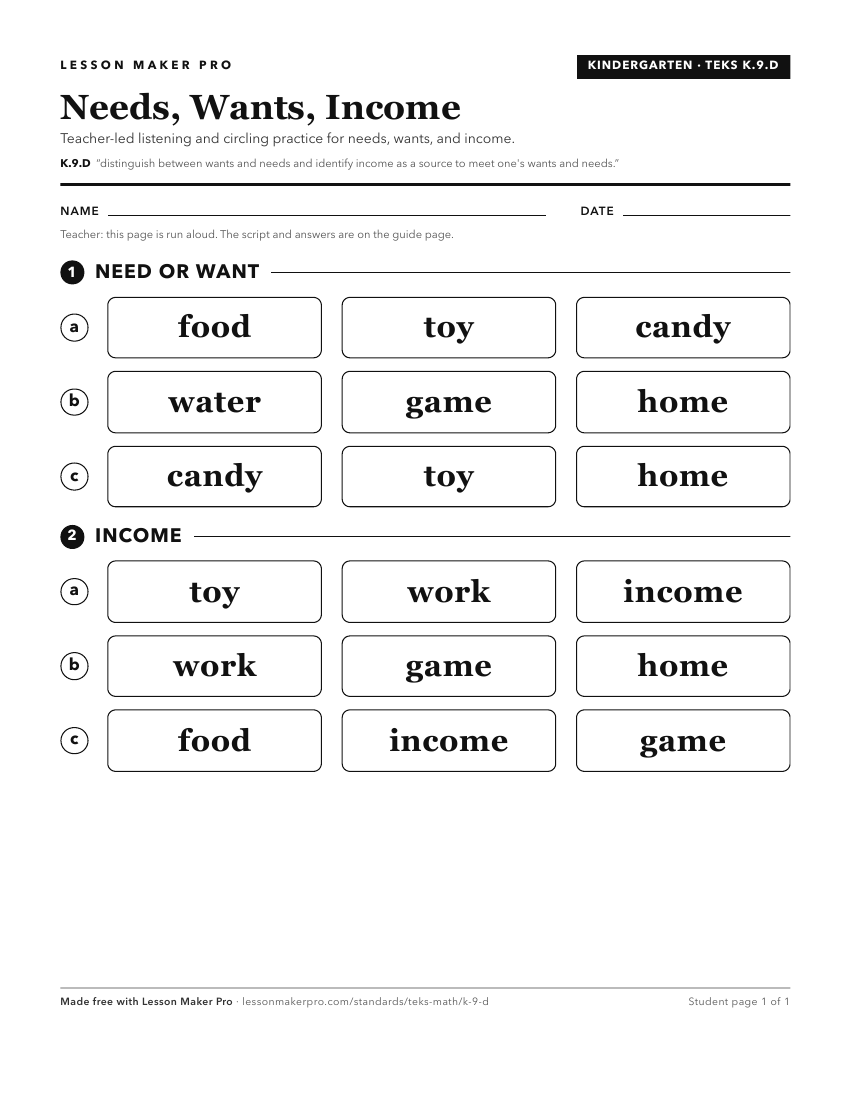
A ready-to-print activity worksheet aligned to K.9.D, with an answer key for the teacher on its own page. No account needed.
PDF, US Letter, prints cleanly in black and white.
Download the worksheetKeep exploring
Related Standards
- 3.9.F
identify decisions involving income, spending, saving, credit, and charitable giving
- K.9.A
identify ways to earn income
- K.9.B
differentiate between money received as income and money received as gifts
- 1.9.B
identify income as a means of obtaining goods and services, oftentimes making choices between wants and needs
Turn this exact standard into a lesson
Grade, subject, topic, and the complete standard are prefilled. Create one free, no account needed.
Also for this standard:Make a WorksheetMake a QuizMake a Sub Lesson