TEKS Math 8.12.F
The Standard
analyze situations to determine if they represent financially responsible decisions and identify the benefits of financial responsibility and the costs of financial irresponsibility
Texas Essential Knowledge and Skills for Mathematics
Teacher's field guide
What This Standard Means
What Students Need to Do
- Students compare financial choices by looking at income, costs, debt, savings, and future consequences. They decide which choice is responsible and support that decision with numbers and evidence.
What Mastery Looks Like
- Students can classify a financial choice as responsible, irresponsible, or dependent on the circumstances. They use costs, interest, savings goals, and future effects to justify their answer.
Common Misconceptions
- Students may assume the lowest upfront price is always the best choice. They may treat available credit as income or overlook interest, late fees, and lost savings. Some also think all debt is irresponsible.
How to Assess It
- Give this exit ticket: “Jordan has $300 in emergency savings and wants a $240 phone. Compare paying cash, using a $288 credit plan, or waiting. Recommend one choice and name one benefit and one cost.”
Lesson moves
Ways to Teach It
Give pairs budget cards and expense cards; students build a balanced monthly budget, then revise it after drawing an unexpected-cost card.
Ask students to defend whether saving for a laptop or buying it with interest is more responsible, using two numerical facts.
Run a scenario sort where teams place choice cards under responsible, risky, or depends, then earn points for accurate evidence.
Have students compare two real checking account fee schedules and choose the better option for a teen with limited monthly income.
Free download
Printable 8.12.F Worksheet
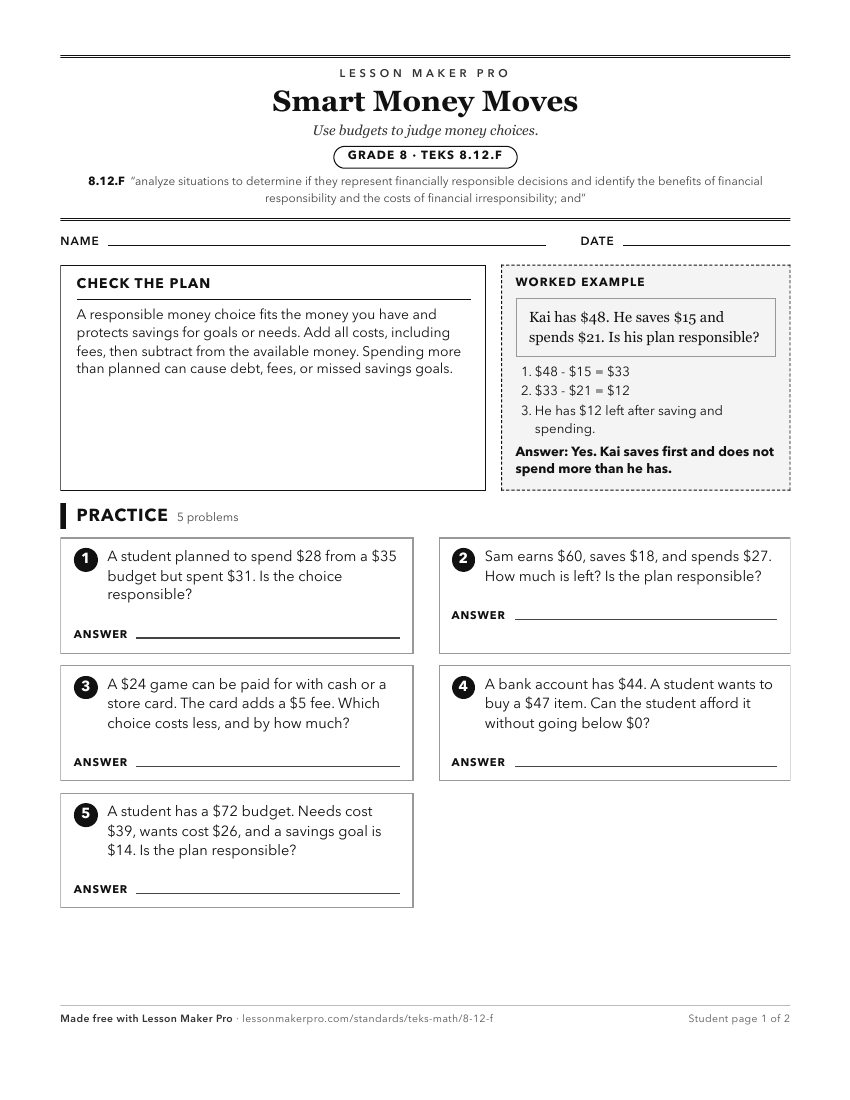
A ready-to-print activity worksheet aligned to 8.12.F, with an answer key for the teacher on its own page. No account needed.
PDF, US Letter, prints cleanly in black and white.
Download the worksheetKeep exploring
Related Standards
- 3.9.F
identify decisions involving income, spending, saving, credit, and charitable giving
- 3.9.C
identify the costs and benefits of planned and unplanned spending decisions
- 5.10
The student applies mathematical process standards to manage one's financial resources effectively for lifetime financial security
- 2.11.E
identify examples of lending and use concepts of benefits and costs to evaluate lending decisions
Turn this exact standard into a lesson
Grade, subject, topic, and the complete standard are prefilled. Create one free, no account needed.
Also for this standard:Make a WorksheetMake a QuizMake a Sub Lesson