TEKS Math 5.10
Knowledge and Skills Statement (Standard Cluster)
The student applies mathematical process standards to manage one's financial resources effectively for lifetime financial security
Texas Essential Knowledge and Skills for Mathematics
Cluster contents
Student Expectations in This Statement
5.10 is a knowledge and skills statement. These are the student expectations under it.
- 5.10.A
define income tax, payroll tax, sales tax, and property tax
- 5.10.B
explain the difference between gross income and net income
- 5.10.C
identify the advantages and disadvantages of different methods of payment, including check, credit card, debit card, and electronic payments
- 5.10.D
develop a system for keeping and using financial records
- 5.10.E
describe actions that might be taken to balance a budget when expenses exceed income
- 5.10.F
balance a simple budget
Teacher's field guide
What This Cluster Means
What Students Need to Do
- Students name common taxes and explain when each one is charged. They find the difference between gross and net income, compare payment methods, organize financial records, and adjust a simple budget.
What Mastery Looks Like
- A student can read a sample pay stub, identify deductions, and find net income. Given income and expenses, the student keeps a clear record, balances the totals, and suggests a realistic change. The student can choose a payment method and explain one benefit and one drawback.
Common Misconceptions
- Students often confuse gross income with take-home pay or treat every deduction as income tax. They may think debit and credit both use money already in a bank account, and that electronic payments leave no record. When expenses exceed income, they may change the arithmetic instead of revising the plan.
How to Assess It
- Use this exit ticket: Maya earns $600 gross, has $75 in payroll deductions, and plans $550 in expenses. Students find her net income, determine whether the budget balances, suggest one adjustment, and choose a payment method for a $40 bill.
Lesson moves
Ways to Teach It
Give pairs play money, a pay stub, bills, and four labeled tax cards to build and revise a monthly budget.
Ask students to write: Which payment method would you use for an online purchase, and what is one benefit and one risk?
Play Budget Fix: teams draw surprise expense cards, then cut spending or add income until every budget balances.
Have students examine a grocery receipt and sample property tax bill, then identify the tax and record each payment in a ledger.
Free download
Printable 5.10 Worksheet
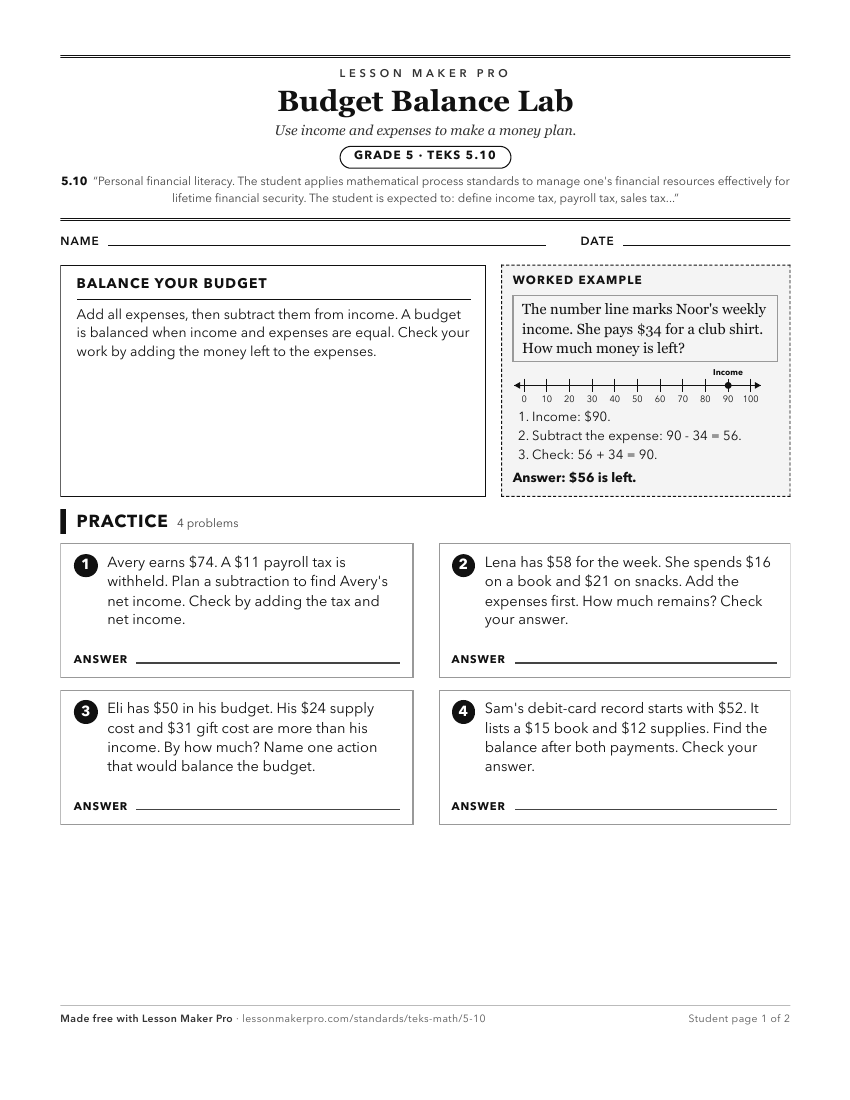
A ready-to-print activity worksheet aligned to 5.10, with an answer key for the teacher on its own page. No account needed.
PDF, US Letter, prints cleanly in black and white.
Download the worksheetKeep exploring
Related Standards
Turn this cluster into a lesson
Grade, subject, topic, and the complete cluster are prefilled. Create one free, no account needed.
Also for this cluster:Make a WorksheetMake a QuizMake a Sub Lesson