TEKS Math 5.10.F
The Standard
balance a simple budget
Texas Essential Knowledge and Skills for Mathematics
Teacher's field guide
What This Standard Means
What Students Need to Do
- Students list money coming in and money going out. They add each amount, compare the totals, and change spending when expenses are greater than income.
What Mastery Looks Like
- Students correctly total income and expenses, then find the amount remaining or the shortage. They adjust optional spending so expenses do not exceed income and explain their choice.
Common Misconceptions
- Students may add expenses incorrectly or treat income as money to spend more than once. They may also think a budget must use every dollar, or ignore whether a cost is required or optional.
How to Assess It
- Give students $60 of income and expenses of $18, $12, $25, and $10. Ask them to identify the problem and revise one expense.
Lesson moves
Ways to Teach It
Give pairs play money, an income card, and expense cards, then have them choose costs without spending beyond their income.
Ask students to write which expense they would reduce first when a plan is $15 over income, and explain why.
Play Budget Match, where students pair income cards with expense sets that leave zero or a positive amount.
Plan spending for a class party using a $100 limit and a menu with prices for food, drinks, plates, and decorations.
Free download
Printable 5.10.F Worksheet
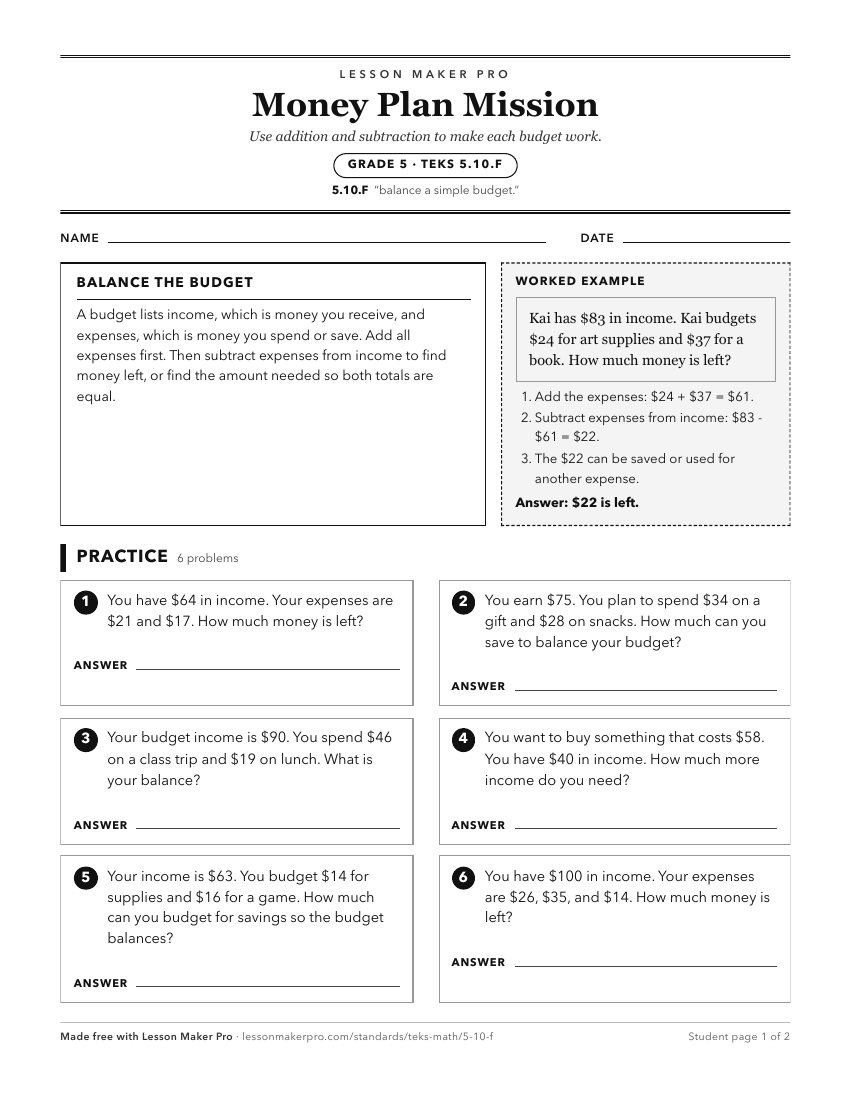
A ready-to-print activity worksheet aligned to 5.10.F, with an answer key for the teacher on its own page. No account needed.
PDF, US Letter, prints cleanly in black and white.
Download the worksheetKeep exploring
Related Standards
- 4.10.D
describe how to allocate a weekly allowance among spending; saving, including for college; and sharing
- 7.13.B
identify the components of a personal budget, including income; planned savings for college, retirement, and emergencies; taxes; and fixed and variable expenses...
- 6.14.C
balance a check register that includes deposits, withdrawals, and transfers
- 5.10.E
describe actions that might be taken to balance a budget when expenses exceed income
Turn this exact standard into a lesson
Grade, subject, topic, and the complete standard are prefilled. Create one free, no account needed.
Also for this standard:Make a WorksheetMake a QuizMake a Sub Lesson