TEKS Math 7.13.B
The Standard
identify the components of a personal budget, including income; planned savings for college, retirement, and emergencies; taxes; and fixed and variable expenses, and calculate what percentage each category comprises of the total budget
Texas Essential Knowledge and Skills for Mathematics
Teacher's field guide
What This Standard Means
What Students Need to Do
- Students organize a monthly income into taxes, three savings goals, fixed costs, and variable costs. They divide each amount by total income and multiply by 100 to find its budget share.
What Mastery Looks Like
- Given a monthly budget, a student identifies income as the whole and correctly classifies every allocation. The student calculates each percentage and checks that all allocations total 100%, apart from reasonable rounding.
Common Misconceptions
- Students often divide by the money left after expenses instead of total income. They may call any repeated purchase fixed, even when its amount changes, or treat savings as leftover spending. They may also forget that 10% means 0.10 when multiplying.
How to Assess It
- Exit ticket: Maya has $5,000 monthly income, with $750 taxes, $250 college savings, $500 retirement, $250 emergency savings, $1,500 rent, $500 car payment, $600 groceries, $300 gas, and $350 entertainment. Classify the expenses, calculate each category's percentage of income, and check that the allocations total 100%.
Lesson moves
Ways to Teach It
Give pairs $4,000 in play money and envelopes labeled taxes, college, retirement, emergencies, fixed, and variable; they allocate funds and calculate percentages.
Ask students to defend whether a streaming subscription is fixed or variable, then explain how cutting it changes the budget percentages.
Run a budget card sort where students match dollar amounts to category labels and percentage cards, earning a point for each complete match.
Have students use a sample pay stub and apartment listing to build a monthly budget with taxes, savings, rent, and flexible spending.
Free download
Printable 7.13.B Worksheet
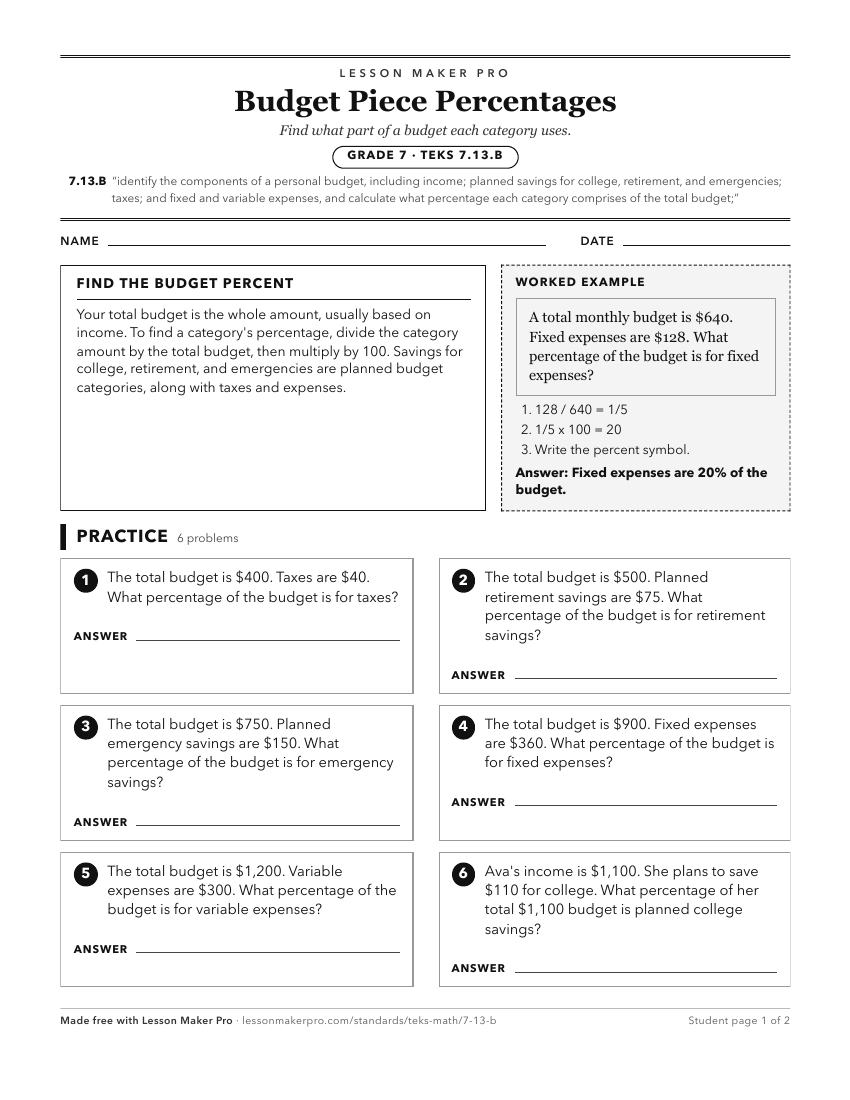
A ready-to-print activity worksheet aligned to 7.13.B, with an answer key for the teacher on its own page. No account needed.
PDF, US Letter, prints cleanly in black and white.
Download the worksheetKeep exploring
Related Standards
- 5.10.F
balance a simple budget
- 4.10.D
describe how to allocate a weekly allowance among spending; saving, including for college; and sharing
- 3.9.E
list reasons to save and explain the benefit of a savings plan, including for college
- 8.12.G
estimate the cost of a two-year and four-year college education, including family contribution, and devise a periodic savings plan for accumulating the money ne...
Turn this exact standard into a lesson
Grade, subject, topic, and the complete standard are prefilled. Create one free, no account needed.
Also for this standard:Make a WorksheetMake a QuizMake a Sub Lesson