TEKS Math 8.12.G
The Standard
estimate the cost of a two-year and four-year college education, including family contribution, and devise a periodic savings plan for accumulating the money needed to contribute to the total cost of attendance for at least the first year of college
Texas Essential Knowledge and Skills for Mathematics
Teacher's field guide
What This Standard Means
What Students Need to Do
- Students estimate total attendance costs for two-year and four-year colleges. They include a family contribution, find the remaining first-year amount, and create a weekly or monthly savings plan.
What Mastery Looks Like
- Students total the main costs for two-year and four-year college options. They subtract the family contribution, choose a savings period, and calculate a reasonable weekly or monthly amount.
Common Misconceptions
- Students may count only tuition and leave out fees, housing, meals, books, and transportation. They may confuse yearly and semester costs or forget to subtract the family contribution before planning savings.
How to Assess It
- Exit ticket: A two-year college costs $12,500 yearly and a four-year college costs $24,000 yearly. Find each total, then subtract a $6,000 family contribution from one first-year cost and calculate the monthly savings needed over 30 months.
Lesson moves
Ways to Teach It
Give groups cards for tuition, fees, housing, meals, books, and transportation, then have them build and total two college budgets.
Ask students to write which college option fits a sample family budget and support their choice with cost and savings calculations.
Teams draw cost, contribution, and timeline cards, then race to calculate the savings gap and monthly deposit.
Students compare posted costs from a nearby community college and public university, then create a first-year family savings plan.
Free download
Printable 8.12.G Worksheet
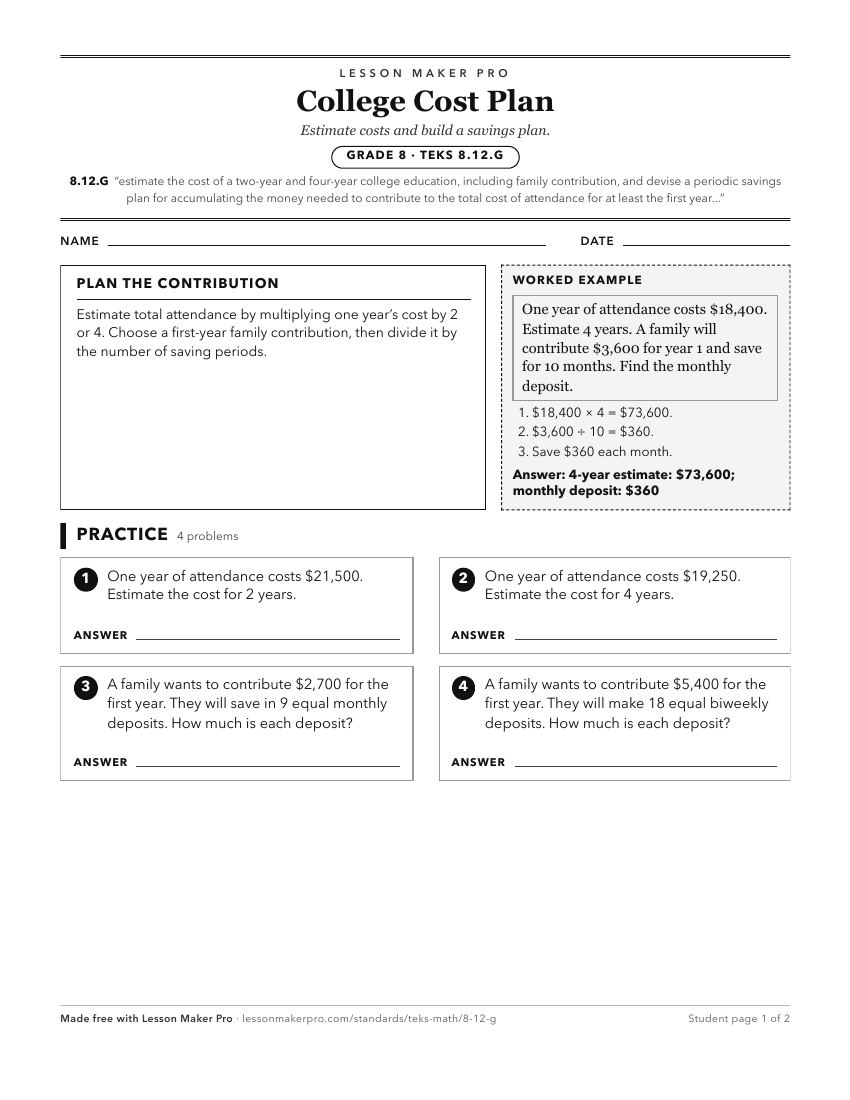
A ready-to-print activity worksheet aligned to 8.12.G, with an answer key for the teacher on its own page. No account needed.
PDF, US Letter, prints cleanly in black and white.
Download the worksheetKeep exploring
Related Standards
- 4.10.D
describe how to allocate a weekly allowance among spending; saving, including for college; and sharing
- 3.9.E
list reasons to save and explain the benefit of a savings plan, including for college
- 7.13.B
identify the components of a personal budget, including income; planned savings for college, retirement, and emergencies; taxes; and fixed and variable expenses...
- 7.13.D
use a family budget estimator to determine the minimum household budget and average hourly wage needed for a family to meet its basic needs in the student's cit...
Turn this exact standard into a lesson
Grade, subject, topic, and the complete standard are prefilled. Create one free, no account needed.
Also for this standard:Make a WorksheetMake a QuizMake a Sub Lesson