TEKS Math 7.13.D
The Standard
use a family budget estimator to determine the minimum household budget and average hourly wage needed for a family to meet its basic needs in the student's city or another large city nearby
Texas Essential Knowledge and Skills for Mathematics
Teacher's field guide
What This Standard Means
What Students Need to Do
- Students use a family budget estimator for a selected city, household size, and number of working adults. They find the household's basic costs and calculate the hourly wage needed to cover them.
What Mastery Looks Like
- Students correctly record the estimated monthly or annual cost for a chosen family and city. They calculate the needed hourly wage using stated work hours and explain assumptions about family size and working adults.
Common Misconceptions
- Students may mix monthly and annual amounts or divide by 40 hours instead of annual work hours. They may also confuse one worker's wage with the total wages earned by all working adults.
How to Assess It
- Exit ticket: A household needs $4,680 each month, and one adult works 40 hours weekly for 52 weeks. Find the annual budget and required hourly wage.
Lesson moves
Ways to Teach It
Give pairs a printed budget estimator and calculators to find housing, food, childcare, transportation, and total costs for a selected family.
Ask students to write which budget category most affects the required wage and support their answer with two numbers.
Run a matching game where students pair monthly budgets, annual budgets, work hours, and required hourly wages.
Have students compare the required wage with three local job postings and identify which jobs could support the estimated household budget.
Free download
Printable 7.13.D Worksheet
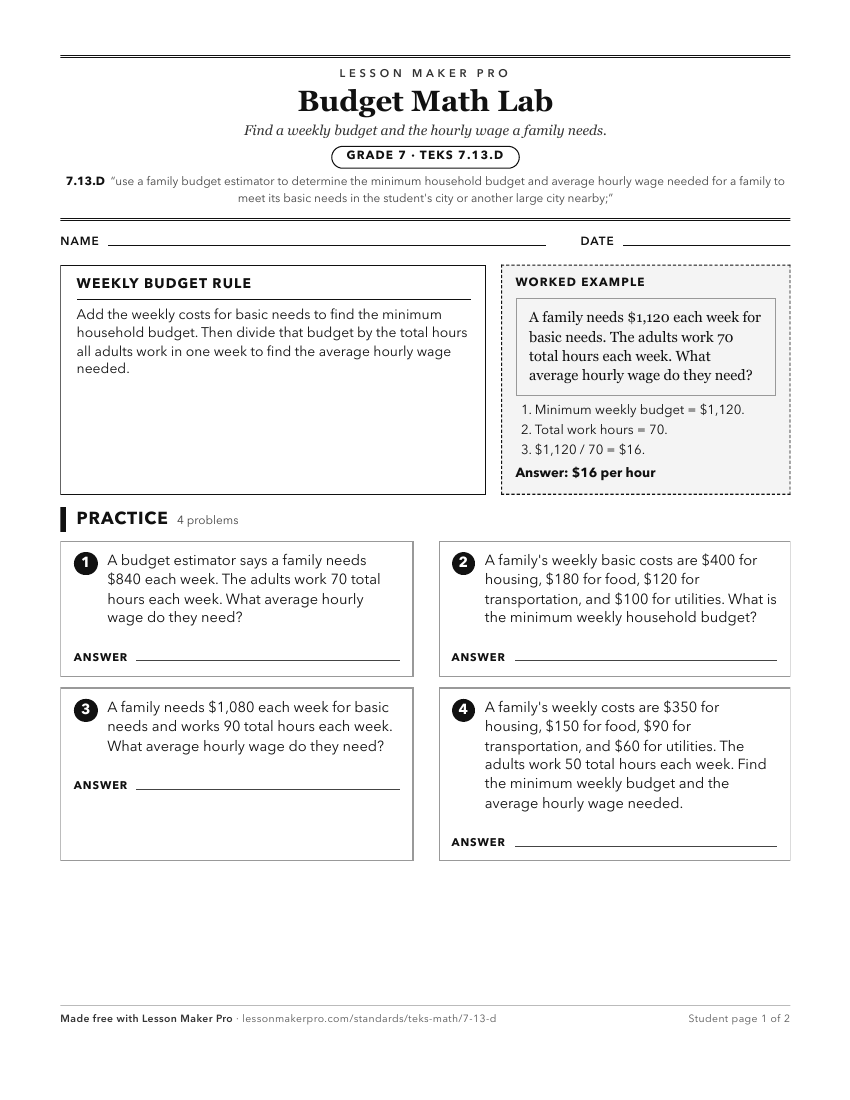
A ready-to-print activity worksheet aligned to 7.13.D, with an answer key for the teacher on its own page. No account needed.
PDF, US Letter, prints cleanly in black and white.
Download the worksheetKeep exploring
Related Standards
- 4.10.D
describe how to allocate a weekly allowance among spending; saving, including for college; and sharing
- 7.13.B
identify the components of a personal budget, including income; planned savings for college, retirement, and emergencies; taxes; and fixed and variable expenses...
- 8.12.G
estimate the cost of a two-year and four-year college education, including family contribution, and devise a periodic savings plan for accumulating the money ne...
- 6.14.H
compare the annual salary of several occupations requiring various levels of post-secondary education or vocational training and calculate the effects of the di...
Turn this exact standard into a lesson
Grade, subject, topic, and the complete standard are prefilled. Create one free, no account needed.
Also for this standard:Make a WorksheetMake a QuizMake a Sub Lesson