TEKS Math 6.14.H
The Standard
compare the annual salary of several occupations requiring various levels of post-secondary education or vocational training and calculate the effects of the different annual salaries on lifetime income
Texas Essential Knowledge and Skills for Mathematics
Teacher's field guide
What This Standard Means
What Students Need to Do
- Students compare pay for careers that require different types and lengths of education or job training. They calculate projected income over a set career length and explain the differences.
What Mastery Looks Like
- Students accurately calculate lifetime income by multiplying annual salary by a stated number of working years. They compare results and explain how salary differences grow over time.
Common Misconceptions
- Students may confuse annual salary with total lifetime income. They may compare jobs without using the same number of working years. Some assume more education always guarantees a higher salary.
How to Assess It
- Exit ticket: One worker earns $42,000 yearly and another earns $57,000. Find each income over 40 years and the difference.
Lesson moves
Ways to Teach It
Give groups occupation cards with salaries and training requirements, then have them sort the cards and calculate 40-year incomes.
Ask students to write which of three careers offers the strongest financial outcome and support their choice with calculations.
Play Career Match, where students pair salary cards with lifetime income cards and earn points for correct matches.
Use printed local job listings to compare salaries, training requirements, and projected income over the same career length.
Free download
Printable 6.14.H Worksheet
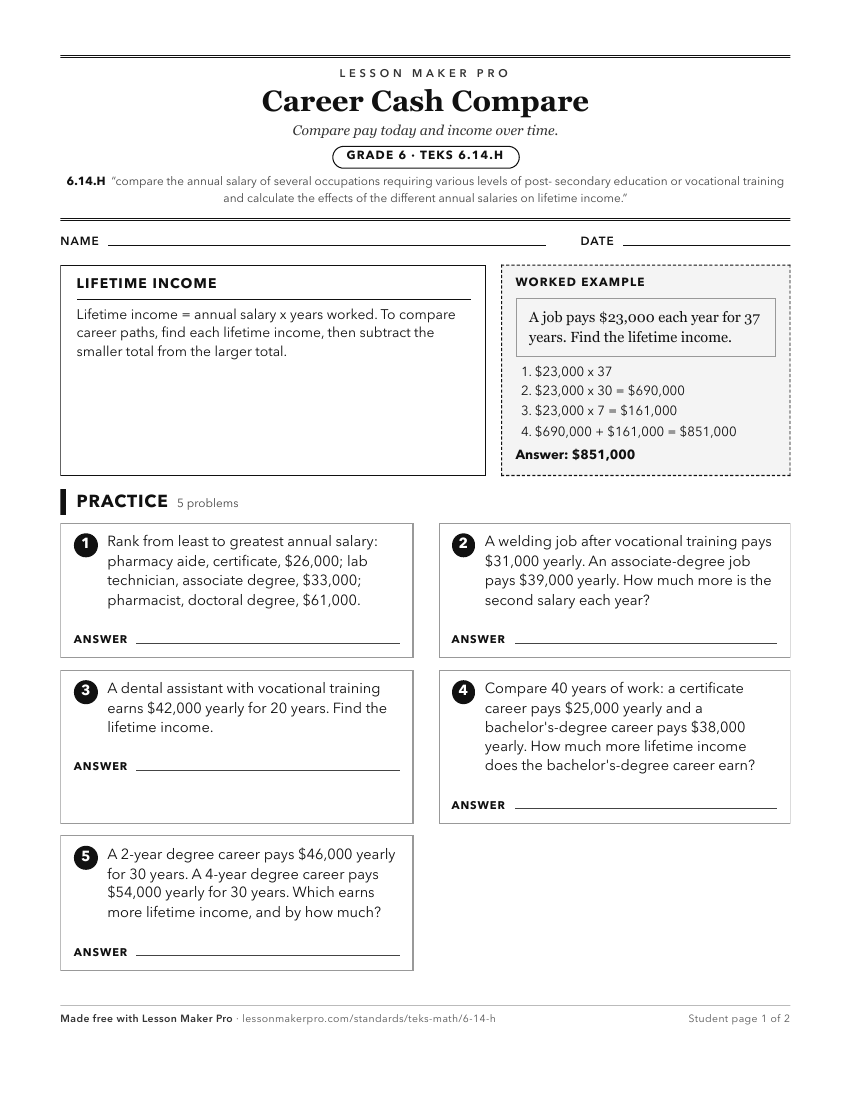
A ready-to-print activity worksheet aligned to 6.14.H, with an answer key for the teacher on its own page. No account needed.
PDF, US Letter, prints cleanly in black and white.
Download the worksheetKeep exploring
Related Standards
- 7.13.E
calculate and compare simple interest and compound interest earnings
- 7.13.D
use a family budget estimator to determine the minimum household budget and average hourly wage needed for a family to meet its basic needs in the student's cit...
- 8.12.G
estimate the cost of a two-year and four-year college education, including family contribution, and devise a periodic savings plan for accumulating the money ne...
- 8.12.D
calculate and compare simple interest and compound interest earnings
Turn this exact standard into a lesson
Grade, subject, topic, and the complete standard are prefilled. Create one free, no account needed.
Also for this standard:Make a WorksheetMake a QuizMake a Sub Lesson