TEKS Math 3.9.D
The Standard
explain that credit is used when wants or needs exceed the ability to pay and that it is the borrower's responsibility to pay it back to the lender, usually with interest
Texas Essential Knowledge and Skills for Mathematics
Teacher's field guide
What This Standard Means
What Students Need to Do
- Students explain why someone might borrow money when they cannot pay for something right away. They identify the borrower, lender, amount owed, and interest, then explain who must repay the money.
What Mastery Looks Like
- Given a short scenario, students can identify why credit was used and name the borrower and lender. They explain that the borrower repays the borrowed amount, often with an added interest charge.
Common Misconceptions
- Students may think credit is free money or the same as income. They may confuse credit with debit, or think interest is charged only when a payment is late.
How to Assess It
- Give this exit ticket: “Maya borrows $60 from a bank and repays $66. Name the borrower, the lender, and what the extra $6 represents.”
Lesson moves
Ways to Teach It
Use play money and role cards to act out a $20 loan, repayment, and a $2 interest charge.
Discuss when borrowing might help someone, then have students write three sentences explaining the borrower’s responsibility.
Sort scenario cards into credit or not credit, then earn points by identifying the borrower, lender, and interest.
Compare a store’s cash price and payment plan, then circle the total repaid and discuss why the totals differ.
Free download
Printable 3.9.D Worksheet
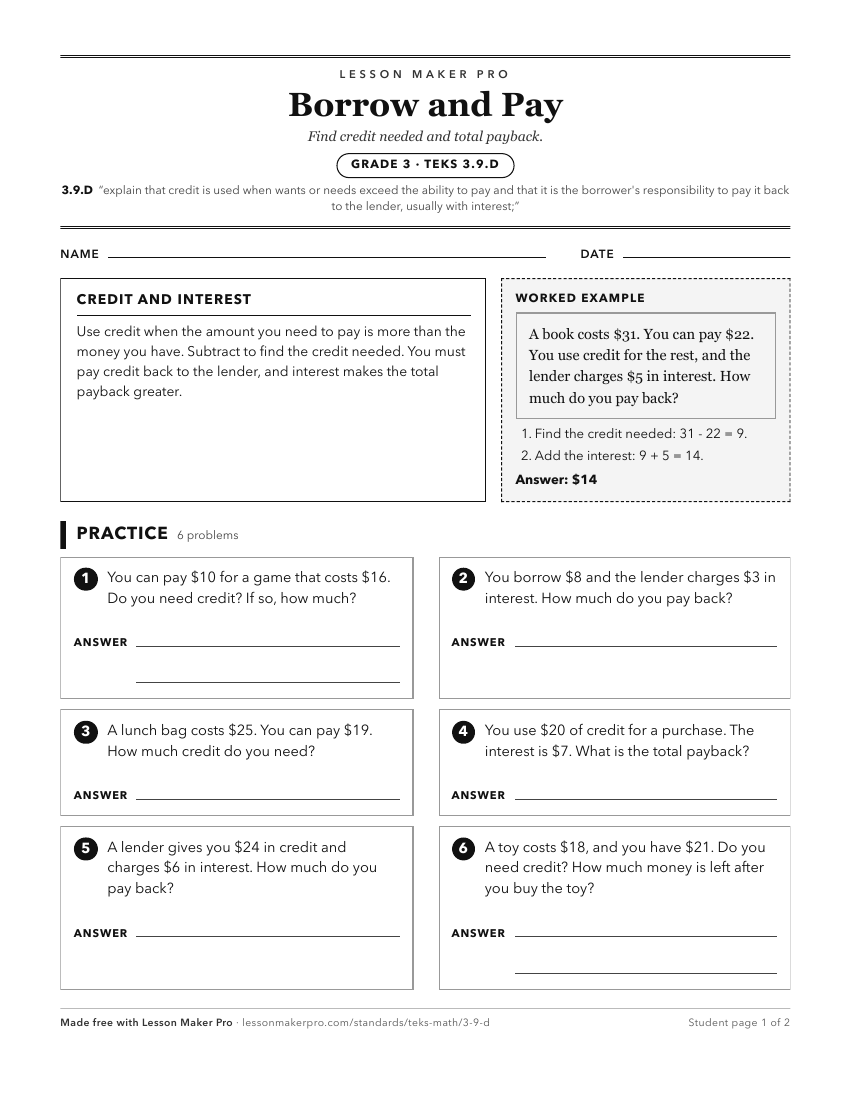
A ready-to-print activity worksheet aligned to 3.9.D, with an answer key for the teacher on its own page. No account needed.
PDF, US Letter, prints cleanly in black and white.
Download the worksheetKeep exploring
Related Standards
- 6.14.D
explain why it is important to establish a positive credit history
- 6.14.F
describe the value of credit reports to borrowers and to lenders
- 2.11.E
identify examples of lending and use concepts of benefits and costs to evaluate lending decisions
- 2.11.D
identify examples of borrowing and distinguish between responsible and irresponsible borrowing
Turn this exact standard into a lesson
Grade, subject, topic, and the complete standard are prefilled. Create one free, no account needed.
Also for this standard:Make a WorksheetMake a QuizMake a Sub Lesson