TEKS Math 6.14.D
The Standard
explain why it is important to establish a positive credit history
Texas Essential Knowledge and Skills for Mathematics
Teacher's field guide
What This Standard Means
What Students Need to Do
- Students explain how a record of borrowing and repayment can affect future access to loans, housing, and services. They identify choices that build a reliable record, such as paying bills on time and correcting report errors.
What Mastery Looks Like
- Given two sample borrowers, students can identify who appears less risky to a lender and support the choice with evidence. They can name likely consequences, including approval, denial, or different interest rates.
Common Misconceptions
- Students may think a high income automatically creates a strong credit record. They may believe carrying a balance helps more than paying on time. Some confuse a credit report with a credit score.
How to Assess It
- Use this exit ticket: “Maya pays every bill on time, while Leo often pays late. Who will lenders view as less risky, and why?”
Lesson moves
Ways to Teach It
Give groups payment timeline cards to arrange, then label each action as helping or hurting the borrower’s record.
Write a response to: “Why might a landlord or lender care whether someone paid past bills on time?”
Play Credit Choices, where teams earn or lose points by selecting responses to borrowing and payment scenarios.
Compare two sample car loan offers for borrowers with different records, then calculate which borrower pays more each month.
Free download
Printable 6.14.D Worksheet
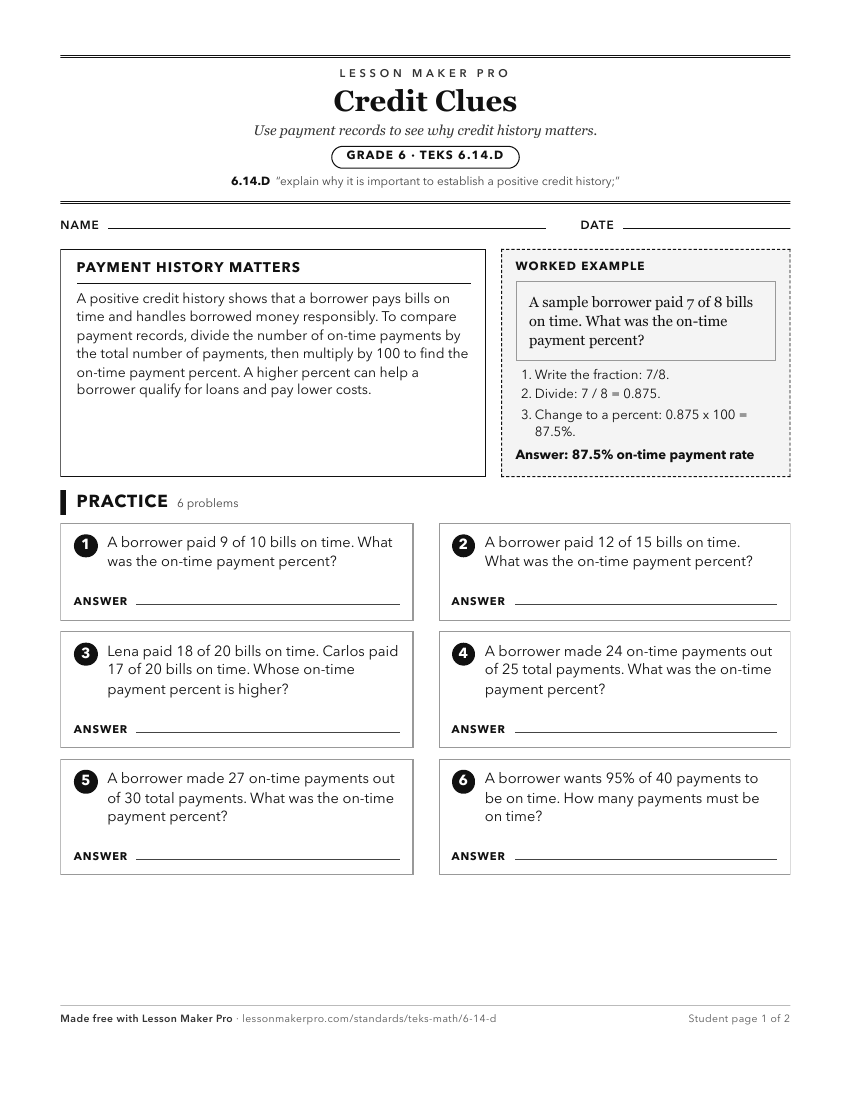
A ready-to-print activity worksheet aligned to 6.14.D, with an answer key for the teacher on its own page. No account needed.
PDF, US Letter, prints cleanly in black and white.
Download the worksheetKeep exploring
Related Standards
- 6.14.E
describe the information in a credit report and how long it is retained
- 3.9.E
list reasons to save and explain the benefit of a savings plan, including for college
- 6.14.F
describe the value of credit reports to borrowers and to lenders
- 3.9.D
explain that credit is used when wants or needs exceed the ability to pay and that it is the borrower's responsibility to pay it back to the lender, usually wit...
Turn this exact standard into a lesson
Grade, subject, topic, and the complete standard are prefilled. Create one free, no account needed.
Also for this standard:Make a WorksheetMake a QuizMake a Sub Lesson