TEKS Math 8.12
Knowledge and Skills Statement (Standard Cluster)
The student applies mathematical process standards to develop an economic way of thinking and problem solving useful in one's life as a knowledgeable consumer and investor
Texas Essential Knowledge and Skills for Mathematics
Cluster contents
Student Expectations in This Statement
8.12 is a knowledge and skills statement. These are the student expectations under it.
- 8.12.A
solve real-world problems comparing how interest rate and loan length affect the cost of credit
- 8.12.B
calculate the total cost of repaying a loan, including credit cards and easy access loans, under various rates of interest and over different periods using an o...
- 8.12.C
explain how small amounts of money invested regularly, including money saved for college and retirement, grow over time
- 8.12.D
calculate and compare simple interest and compound interest earnings
- 8.12.E
identify and explain the advantages and disadvantages of different payment methods
- 8.12.F
analyze situations to determine if they represent financially responsible decisions and identify the benefits of financial responsibility and the costs of finan...
- 8.12.G
estimate the cost of a two-year and four-year college education, including family contribution, and devise a periodic savings plan for accumulating the money ne...
Teacher's field guide
What This Cluster Means
What Students Need to Do
- Students use rates, time, fees, and payment schedules to compare borrowing and saving choices. They calculate loan repayment and investment growth, including simple and compound interest. They weigh payment methods and spending decisions, then estimate college costs and build a regular savings plan.
What Mastery Looks Like
- Given two loan offers, students can find total repayment and explain how rate and term change the cost. They can calculate simple and compound earnings, compare payment methods, and defend a sound spending choice. They can estimate one year of college costs and create a realistic deposit schedule.
Common Misconceptions
- Students often assume the lowest monthly payment is the cheapest loan, without considering a longer term. They may treat compound interest like simple interest or think small regular deposits cannot grow much. They may count a credit limit as income and leave fees, housing, or books out of college estimates.
How to Assess It
- Give students two $1,000 loan offers: 8% for 12 months and 11% for 6 months. Have them find total repayment, choose one, and justify the choice.
Lesson moves
Ways to Teach It
Give pairs loan cards with different principal amounts, rates, and terms, then have them calculate total repayment and rank the offers.
Ask students to write which payment method they would use for a phone purchase and explain one benefit and one risk.
Play a savings race where teams calculate simple and compound balances at yearly checkpoints and earn points for accurate comparisons.
Use a local college cost sheet to build a monthly savings plan for one year of tuition, fees, books, and housing.
Free download
Printable 8.12 Worksheet
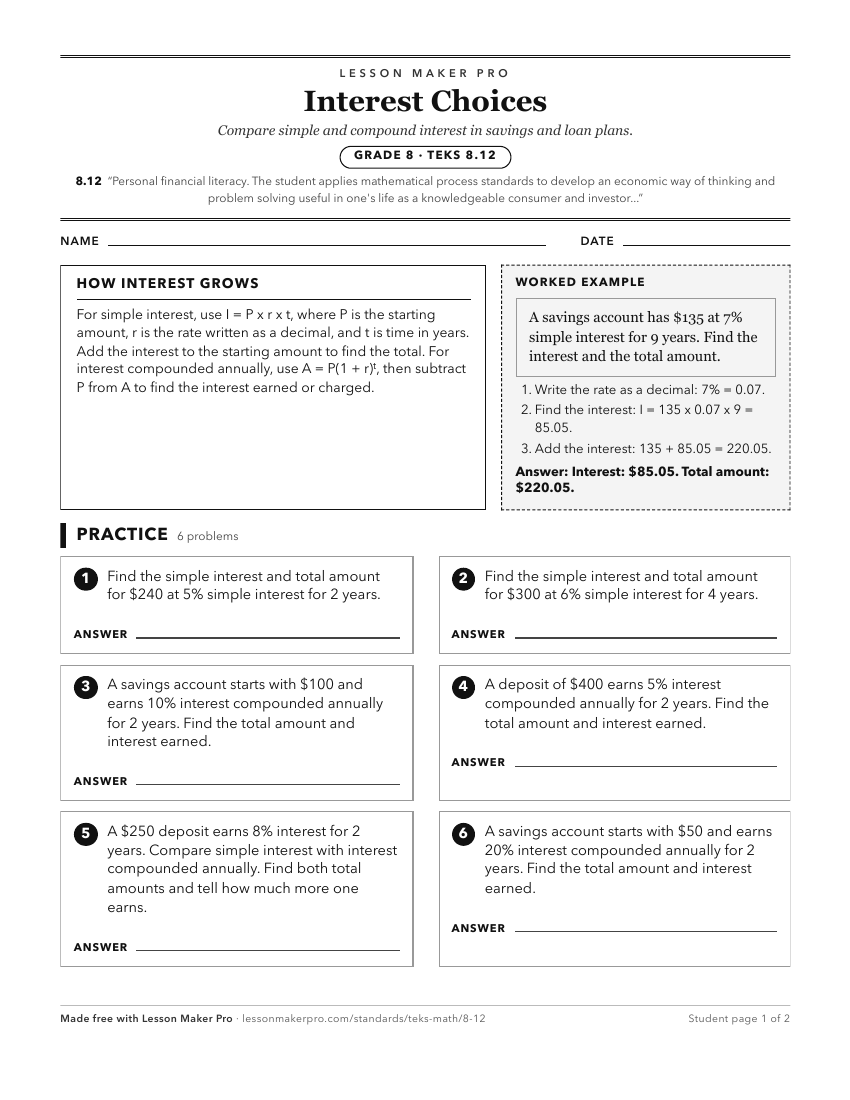
A ready-to-print activity worksheet aligned to 8.12, with an answer key for the teacher on its own page. No account needed.
PDF, US Letter, prints cleanly in black and white.
Download the worksheetKeep exploring
Related Standards
- 7.13
The 7th Grade version of this standard.
- 3.9
The student applies mathematical process standards to manage one's financial resources effectively for lifetime financial security
- 4.10
The student applies mathematical process standards to manage one's financial resources effectively for lifetime financial security
- 6.14
The 6th Grade version of this standard.
Turn this cluster into a lesson
Grade, subject, topic, and the complete cluster are prefilled. Create one free, no account needed.
Also for this cluster:Make a WorksheetMake a QuizMake a Sub Lesson