TEKS Math 8.12.C
The Standard
explain how small amounts of money invested regularly, including money saved for college and retirement, grow over time
Texas Essential Knowledge and Skills for Mathematics
Teacher's field guide
What This Standard Means
What Students Need to Do
- Students explain how repeated deposits and investment earnings work together to increase a balance. They use tables, graphs, or calculations to compare starting early with starting later.
What Mastery Looks Like
- Students can read a table or graph and identify contributions, investment earnings, and total balance. They can explain why starting earlier often produces more growth, even with the same regular deposit.
Common Misconceptions
- Students may think the balance grows only by the amount deposited. They may treat compound growth as simple interest or assume starting later produces the same result. Some confuse an investment projection with a guaranteed return.
How to Assess It
- Give students a table showing yearly balances for investing $50 monthly and ask: “Why does the balance increase by more than $600 each year?”
Lesson moves
Ways to Teach It
Build a spreadsheet that adds a $25 monthly deposit and monthly growth, then graph the balance over ten years.
Ask students to write which matters more, starting age or monthly amount, using evidence from two provided investment tables.
Run a card sort matching contribution schedules, time periods, rates, and final balances, then have pairs justify each match.
Compare college and retirement savings scenarios with an online investment calculator, changing the deposit amount, return rate, and starting age.
Free download
Printable 8.12.C Worksheet
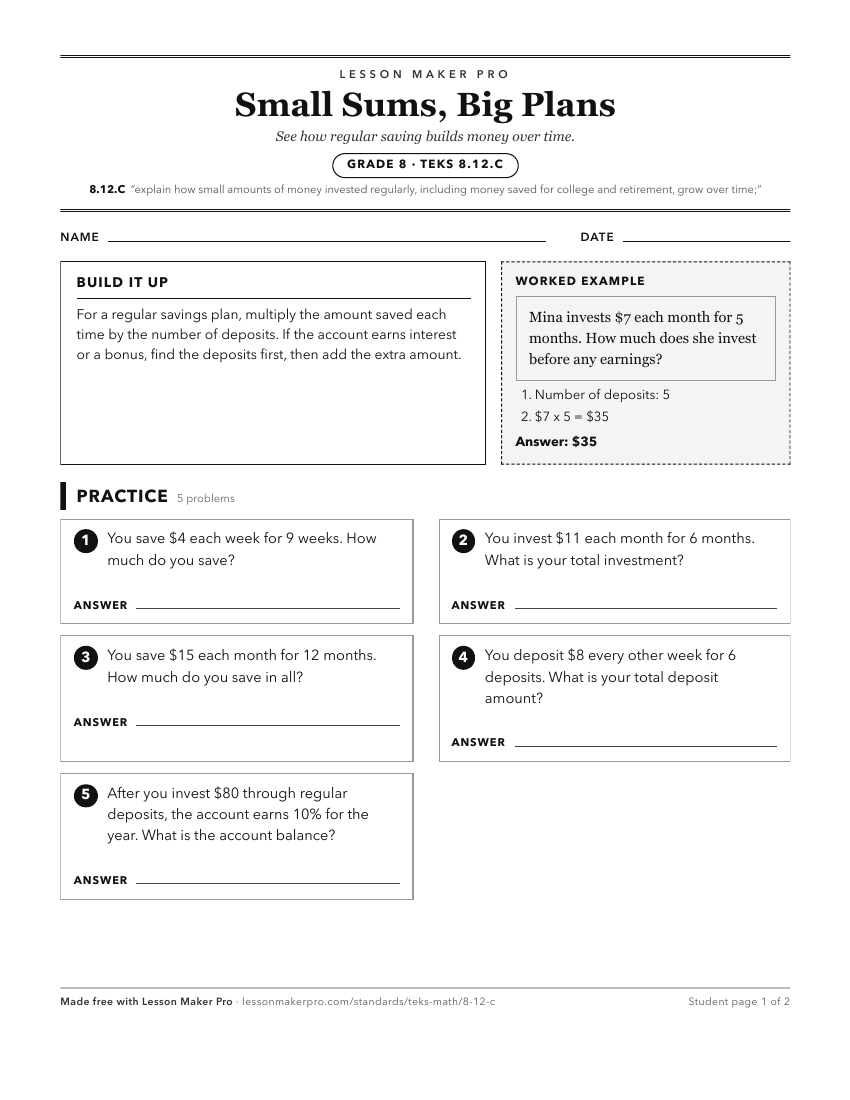
A ready-to-print activity worksheet aligned to 8.12.C, with an answer key for the teacher on its own page. No account needed.
PDF, US Letter, prints cleanly in black and white.
Download the worksheetKeep exploring
Related Standards
- 4.10.D
describe how to allocate a weekly allowance among spending; saving, including for college; and sharing
- 3.9.E
list reasons to save and explain the benefit of a savings plan, including for college
- 8.12.G
estimate the cost of a two-year and four-year college education, including family contribution, and devise a periodic savings plan for accumulating the money ne...
- 2.11.A
calculate how money saved can accumulate into a larger amount over time
Turn this exact standard into a lesson
Grade, subject, topic, and the complete standard are prefilled. Create one free, no account needed.
Also for this standard:Make a WorksheetMake a QuizMake a Sub Lesson