TEKS Math 2.11.A
The Standard
calculate how money saved can accumulate into a larger amount over time
Texas Essential Knowledge and Skills for Mathematics
Teacher's field guide
What This Standard Means
What Students Need to Do
- Students add regular deposits across several days or weeks to find a savings total. They represent the growing amount with coins, repeated addition, number lines, or tables.
What Mastery Looks Like
- Given a weekly deposit and a number of weeks, students find the total saved. They can show their work with coins, repeated addition, a number line, or a table.
Common Misconceptions
- Students may confuse the number of weeks with the number of dollars saved. They may count only one deposit or forget to include the starting amount. Some mix dollars and cents when adding.
How to Assess It
- Exit ticket: Mia saves $3 each week for 4 weeks. Show an equation or table, then write how much she saves altogether.
Lesson moves
Ways to Teach It
Give pairs play coins and four labeled cups, then have them place $2 in each cup and count the total savings.
Ask students to compare saving $1 weekly and $2 weekly for six weeks, then write which plan saves more and why.
Students roll one die for the weekly deposit and another for the number of weeks, then race to calculate the savings total.
Have students plan how many weeks they need to save $2 each week for a $12 book.
Free download
Printable 2.11.A Worksheet
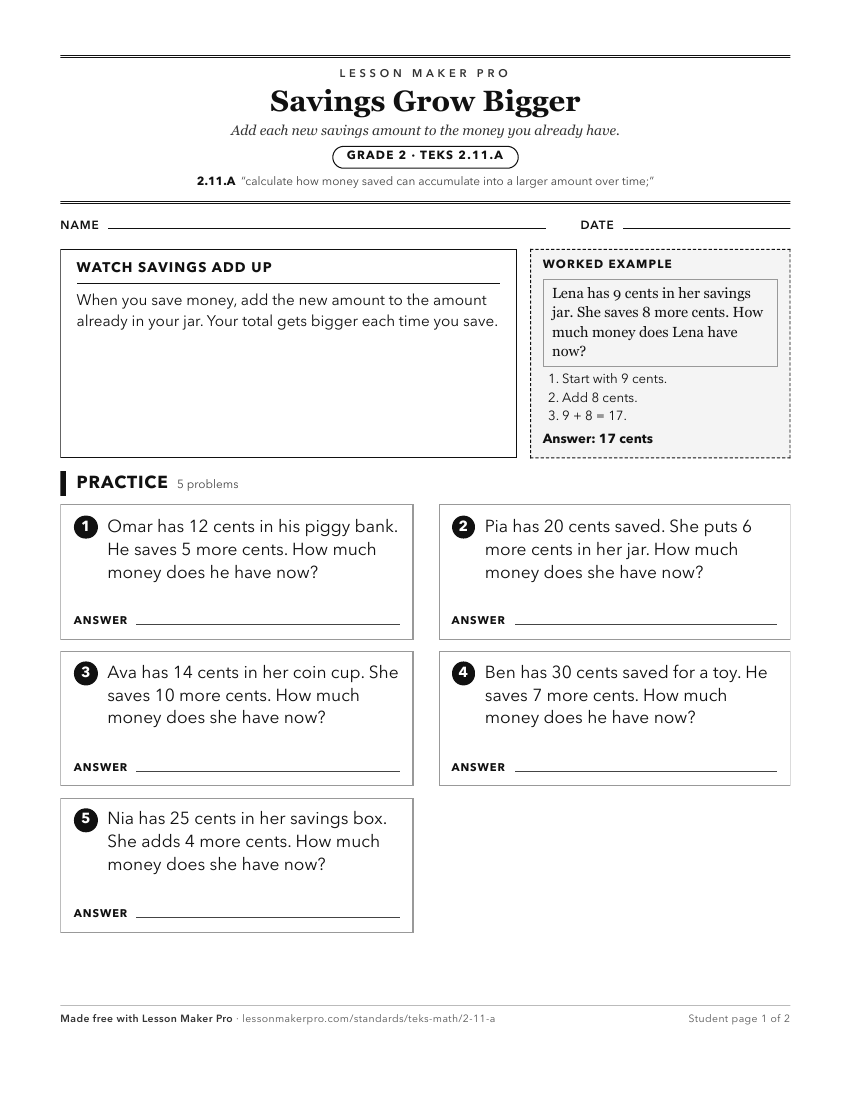
A ready-to-print activity worksheet aligned to 2.11.A, with an answer key for the teacher on its own page. No account needed.
PDF, US Letter, prints cleanly in black and white.
Download the worksheetKeep exploring
Related Standards
- 7.13.E
calculate and compare simple interest and compound interest earnings
- 8.12.C
explain how small amounts of money invested regularly, including money saved for college and retirement, grow over time
- 2.11.B
explain that saving is an alternative to spending
- 8.12.D
calculate and compare simple interest and compound interest earnings
Turn this exact standard into a lesson
Grade, subject, topic, and the complete standard are prefilled. Create one free, no account needed.
Also for this standard:Make a WorksheetMake a QuizMake a Sub Lesson