TEKS Math 8.12.A
The Standard
solve real-world problems comparing how interest rate and loan length affect the cost of credit
Texas Essential Knowledge and Skills for Mathematics
Teacher's field guide
What This Standard Means
What Students Need to Do
- Students multiply the monthly payment by the number of payments, then subtract the principal to find the cost of credit. They compare equal loan amounts to explain the effects of different rates and repayment periods.
What Mastery Looks Like
- Given three offers for the same purchase, students correctly find total repayment and interest for each. They explain how rate and loan length affect cost when other details stay fixed.
Common Misconceptions
- Students often choose the lowest monthly payment without checking the total paid. They may treat interest as a one time fee, assume a longer term costs less, or compare loans with different principal amounts.
How to Assess It
- Exit ticket: For a $6,000 loan, A is 6% for 36 months at $182.53 monthly, B is 8% for 36 months at $188.02, and C is 6% for 60 months at $115.99. Find total paid and interest for each, then use A versus B and A versus C to explain each effect.
Lesson moves
Ways to Teach It
Give groups loan offer cards and calculators, then have them sort the offers by total interest and label which loan feature changed.
Ask students to respond to this claim using loan data: A longer loan is cheaper because the monthly payment is lower.
Run a Loan Match relay where teams pair principal, rate, term, and payment cards with the correct total repayment and interest.
Use a printed used car ad and three lender quotes, then have students choose financing within a fixed monthly budget and defend it.
Free download
Printable 8.12.A Worksheet
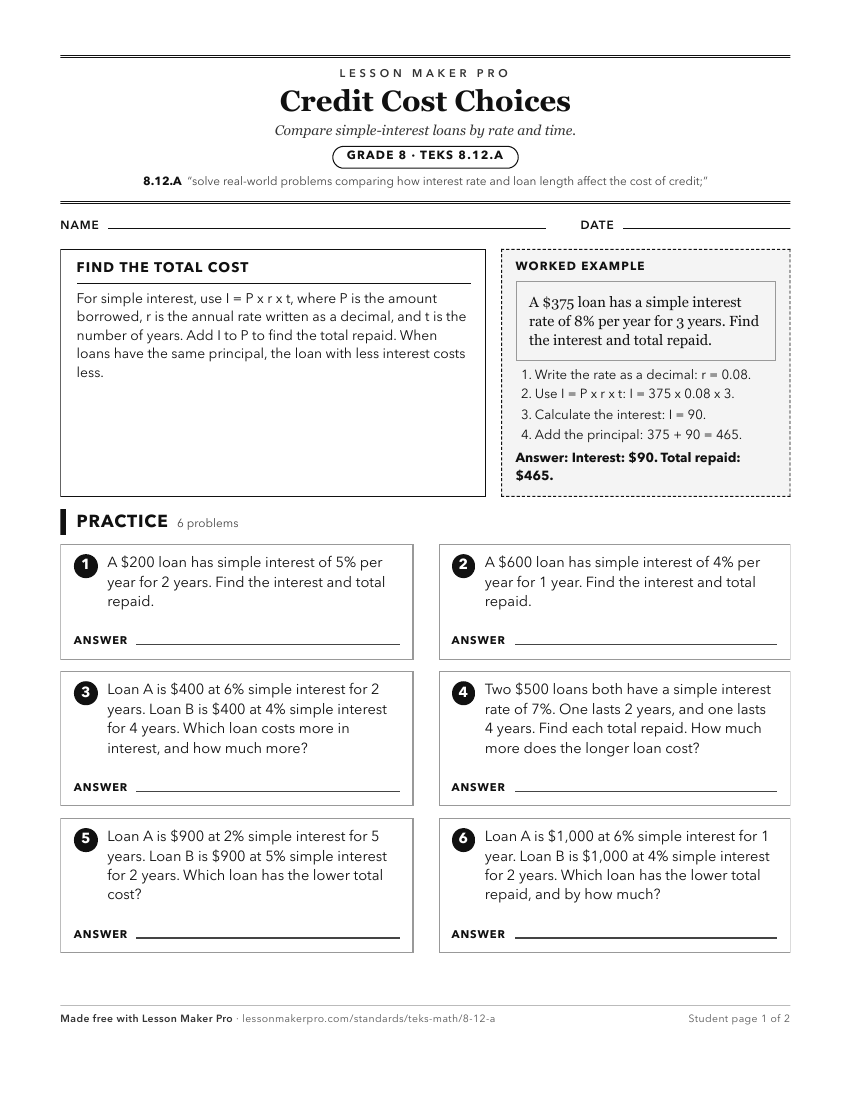
A ready-to-print activity worksheet aligned to 8.12.A, with an answer key for the teacher on its own page. No account needed.
PDF, US Letter, prints cleanly in black and white.
Download the worksheetKeep exploring
Related Standards
- 8.12.B
calculate the total cost of repaying a loan, including credit cards and easy access loans, under various rates of interest and over different periods using an o...
- 3.9.D
explain that credit is used when wants or needs exceed the ability to pay and that it is the borrower's responsibility to pay it back to the lender, usually wit...
- 2.11.E
identify examples of lending and use concepts of benefits and costs to evaluate lending decisions
- 8.12.D
calculate and compare simple interest and compound interest earnings
Turn this exact standard into a lesson
Grade, subject, topic, and the complete standard are prefilled. Create one free, no account needed.
Also for this standard:Make a WorksheetMake a QuizMake a Sub Lesson