TEKS Math 8.12.E
The Standard
identify and explain the advantages and disadvantages of different payment methods
Texas Essential Knowledge and Skills for Mathematics
Teacher's field guide
What This Standard Means
What Students Need to Do
- Students compare common ways to pay, such as cash, debit cards, credit cards, checks, and mobile wallets. They explain how each choice affects cost, safety, convenience, records, and possible debt.
What Mastery Looks Like
- Students can select a sensible payment method for a given purchase and support their choice with a clear tradeoff. They consider fees, interest, security, convenience, spending limits, and purchase records.
Common Misconceptions
- Students may think debit and credit cards take money from the same source. They may also assume digital payments are always safer or that cash never has drawbacks.
How to Assess It
- Give an exit ticket: “You are buying a $60 item online. Choose cash, debit, credit, or mobile payment, then explain one benefit and one risk.”
Lesson moves
Ways to Teach It
Set up checkout stations with mock cash, debit, credit, and mobile payments, then have students record speed, fees, security, and receipts.
Ask students to write which payment method they would use for lunch, concert tickets, and an emergency repair, with reasons.
Play Payment Match by pairing purchase scenario cards with method cards, then award points for naming one benefit and one drawback.
Compare actual store payment policies, ATM fees, and credit card interest rates to decide the best method for three purchases.
Free download
Printable 8.12.E Worksheet
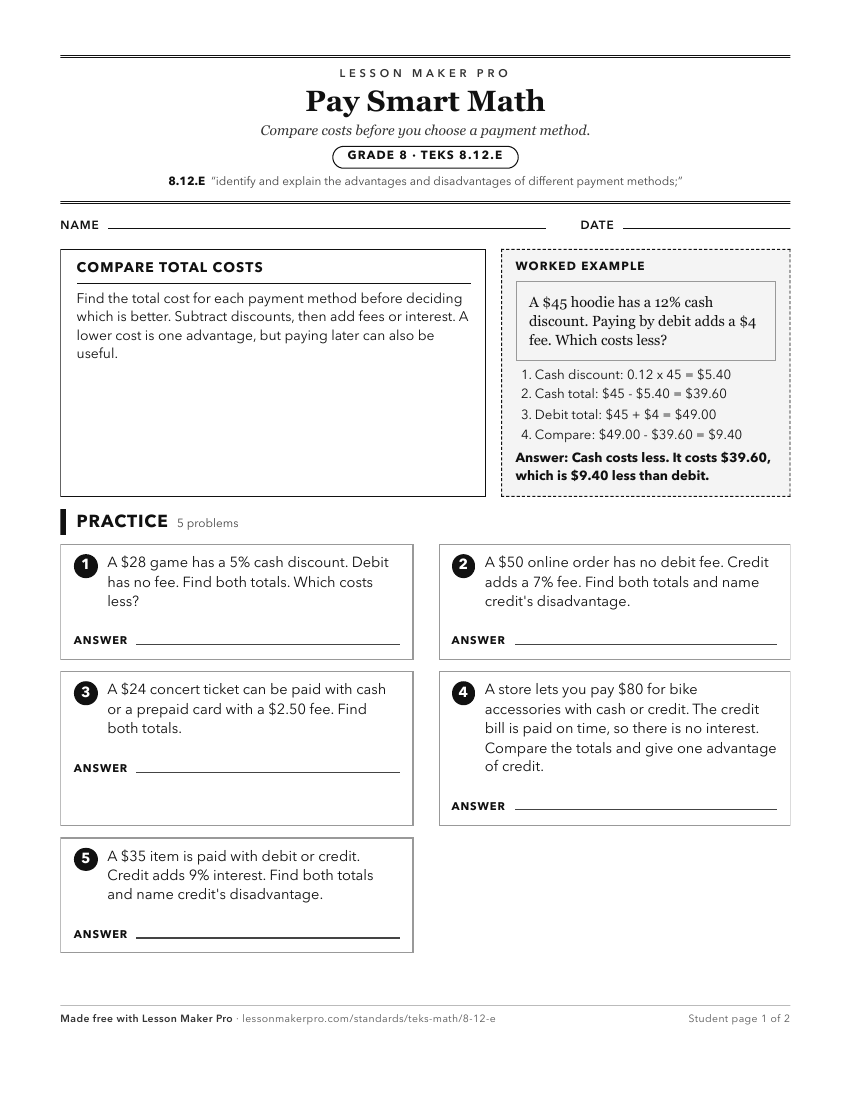
A ready-to-print activity worksheet aligned to 8.12.E, with an answer key for the teacher on its own page. No account needed.
PDF, US Letter, prints cleanly in black and white.
Download the worksheetKeep exploring
Related Standards
- 4.10.C
compare the advantages and disadvantages of various savings options
- 6.14.A
compare the features and costs of a checking account and a debit card offered by different local financial institutions
- 5.10.C
identify the advantages and disadvantages of different methods of payment, including check, credit card, debit card, and electronic payments
- 2.11.E
identify examples of lending and use concepts of benefits and costs to evaluate lending decisions
Turn this exact standard into a lesson
Grade, subject, topic, and the complete standard are prefilled. Create one free, no account needed.
Also for this standard:Make a WorksheetMake a QuizMake a Sub Lesson