TEKS Math 7.13.F
The Standard
analyze and compare monetary incentives, including sales, rebates, and coupons
Texas Essential Knowledge and Skills for Mathematics
Teacher's field guide
What This Standard Means
What Students Need to Do
- Students calculate how sales, coupons, and rebates change the cost of an item. They compare the savings, timing, and restrictions to decide which offer is best.
What Mastery Looks Like
- Students correctly calculate the final cost under each offer. They explain whether savings happen at checkout or later and choose the best offer based on cost and conditions.
Common Misconceptions
- Students may subtract a percentage as if it were a dollar amount. They may also treat rebates as instant discounts or ignore coupon restrictions.
How to Assess It
- Give students a $60 item with three offers: 20% off, a $10 coupon, or a $15 mail-in rebate. Ask which costs least and when each saving occurs.
Lesson moves
Ways to Teach It
Set up a classroom store with price tags, sale signs, coupons, and rebate cards, then have pairs calculate final costs.
Ask students to write which offer they would choose for a $75 purchase: 15% off, $10 coupon, or $12 rebate.
Play Offer Match by having students pair product cards with the sale, coupon, or rebate card that gives the lowest final cost.
Compare current grocery or electronics advertisements, then calculate actual savings and note expiration dates, purchase requirements, and rebate steps.
Free download
Printable 7.13.F Worksheet
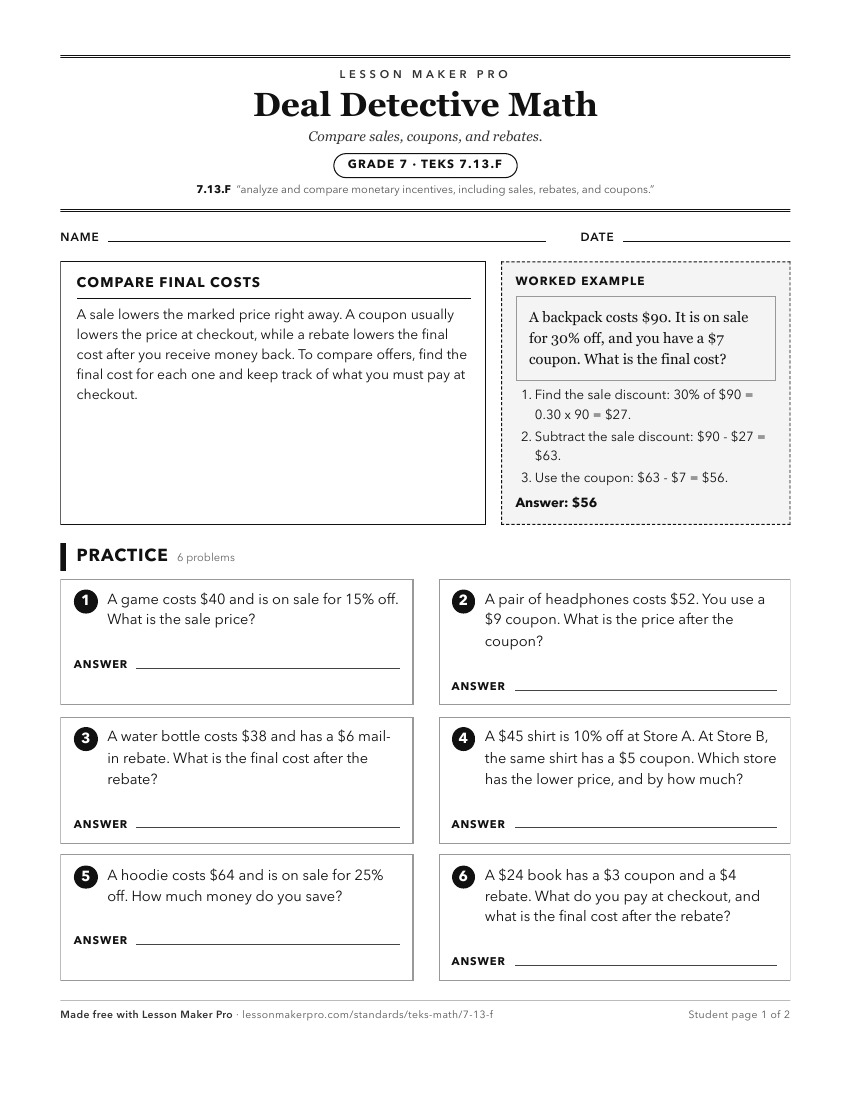
A ready-to-print activity worksheet aligned to 7.13.F, with an answer key for the teacher on its own page. No account needed.
PDF, US Letter, prints cleanly in black and white.
Download the worksheetKeep exploring
Related Standards
- 7.13.E
calculate and compare simple interest and compound interest earnings
- 3.9.F
identify decisions involving income, spending, saving, credit, and charitable giving
- 8.12.F
analyze situations to determine if they represent financially responsible decisions and identify the benefits of financial responsibility and the costs of finan...
- 8.12.D
calculate and compare simple interest and compound interest earnings
Turn this exact standard into a lesson
Grade, subject, topic, and the complete standard are prefilled. Create one free, no account needed.
Also for this standard:Make a WorksheetMake a QuizMake a Sub Lesson