TEKS Math 7.13.C
The Standard
create and organize a financial assets and liabilities record and construct a net worth statement
Texas Essential Knowledge and Skills for Mathematics
Teacher's field guide
What This Standard Means
What Students Need to Do
- Students list financial items they own and debts they owe in an organized record. They total both groups and subtract debts from owned value to find net worth.
What Mastery Looks Like
- Students correctly sort financial items into what is owned and what is owed. They total each group, subtract liabilities from assets, and label a negative result correctly.
Common Misconceptions
- Students may count monthly payments as liabilities instead of the full unpaid balance. They may use an item's purchase price rather than its current value, or assume net worth cannot be negative.
How to Assess It
- Give an exit ticket with $250 in savings, a $900 laptop, $400 in credit card debt, and a $1,000 loan. Ask students to organize the amounts and calculate net worth.
Lesson moves
Ways to Teach It
Give pairs cards showing savings, property, loans, and credit balances, then have them sort, total, and calculate net worth.
Ask students to explain in writing how buying a $600 phone with $600 of borrowed money affects net worth.
Run a matching game where students pair financial items with asset, liability, or neither, then justify disputed choices.
Use a fictional young adult's bank balance, used car value, and auto loan to create a personal net worth statement.
Free download
Printable 7.13.C Worksheet
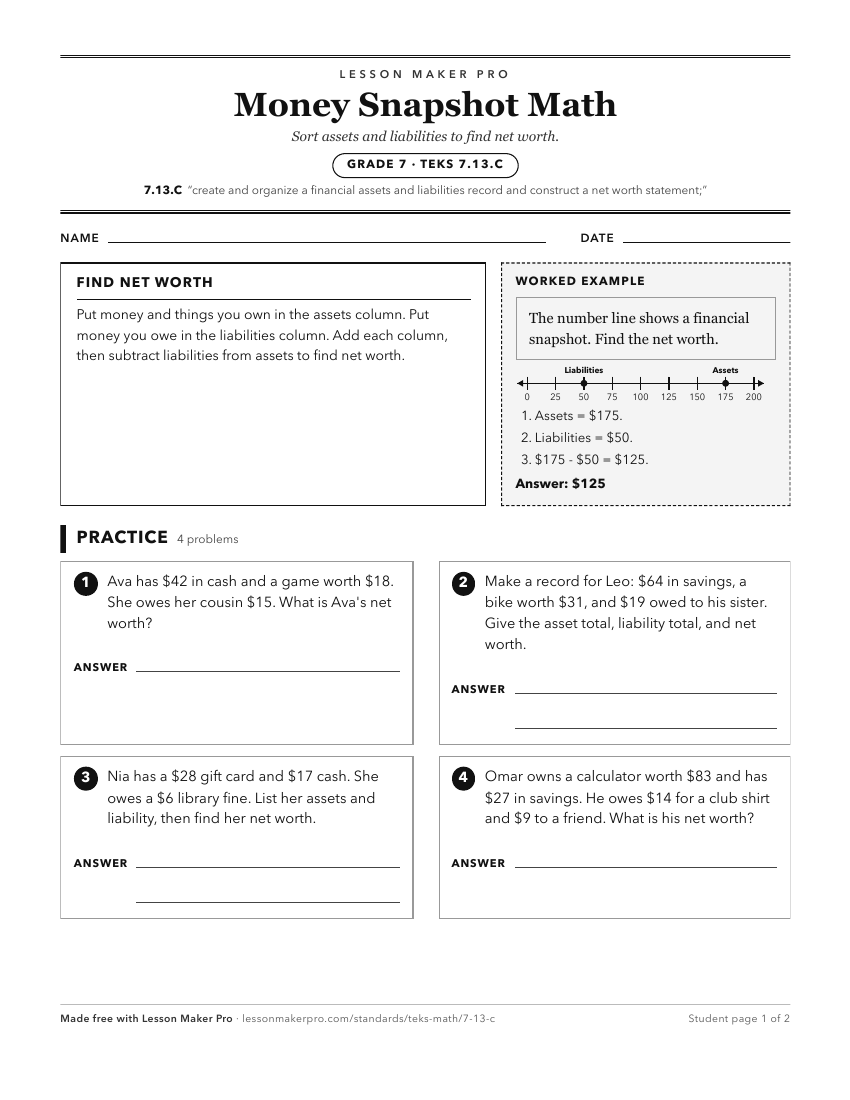
A ready-to-print activity worksheet aligned to 7.13.C, with an answer key for the teacher on its own page. No account needed.
PDF, US Letter, prints cleanly in black and white.
Download the worksheetKeep exploring
Related Standards
- 5.10
The student applies mathematical process standards to manage one's financial resources effectively for lifetime financial security
- 4.10
The student applies mathematical process standards to manage one's financial resources effectively for lifetime financial security
- K.9
The student applies mathematical process standards to manage one's financial resources effectively for lifetime financial security
- 5.10.D
develop a system for keeping and using financial records
Turn this exact standard into a lesson
Grade, subject, topic, and the complete standard are prefilled. Create one free, no account needed.
Also for this standard:Make a WorksheetMake a QuizMake a Sub Lesson