TEKS Math 6.14.G
The Standard
explain various methods to pay for college, including through savings, grants, scholarships, student loans, and work-study
Texas Essential Knowledge and Skills for Mathematics
Teacher's field guide
What This Standard Means
What Students Need to Do
- Students distinguish among money that is saved, awarded, earned, or borrowed for college. They explain eligibility, repayment, and how families may combine several payment sources.
What Mastery Looks Like
- Given a college cost and a sample aid package, students can classify each funding source and describe how it works. They can identify which money is earned, borrowed, saved, or awarded and explain likely repayment costs.
Common Misconceptions
- Students may think all financial aid is free money or that every scholarship is based on grades. They may also think work-study pays tuition automatically or that student loans do not include interest.
How to Assess It
- Exit ticket: A student receives $3,000 in savings, a $4,000 grant, a $2,000 scholarship, $1,500 in work-study, and a $1,500 loan. For each source, state whether it is saved, awarded, earned, or borrowed, and whether it must be repaid.
Lesson moves
Ways to Teach It
Sort college funding cards into savings, grants, scholarships, loans, and work-study, then label each as earned, saved, awarded, or repaid.
Write a recommendation for a student with a $6,000 gap, explaining which two payment methods should come first and why.
Play Funding Match: teams pair student profiles with payment options and earn points for accurate explanations of cost, eligibility, and repayment.
Use a local college cost sheet to build a one-year payment plan from sample savings, aid offers, wages, and loans.
Free download
Printable 6.14.G Worksheet
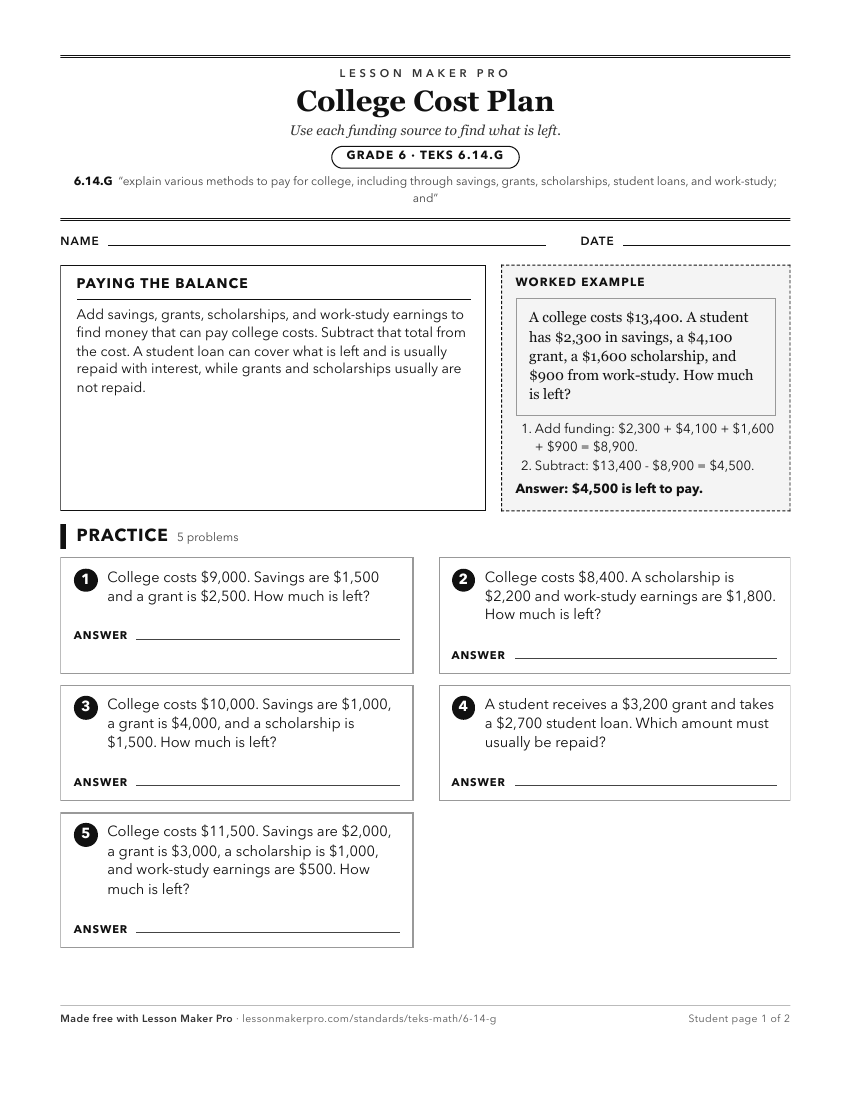
A ready-to-print activity worksheet aligned to 6.14.G, with an answer key for the teacher on its own page. No account needed.
PDF, US Letter, prints cleanly in black and white.
Download the worksheetKeep exploring
Related Standards
- 4.10.D
describe how to allocate a weekly allowance among spending; saving, including for college; and sharing
- 3.9.E
list reasons to save and explain the benefit of a savings plan, including for college
- 8.12.G
estimate the cost of a two-year and four-year college education, including family contribution, and devise a periodic savings plan for accumulating the money ne...
- 5.10.C
identify the advantages and disadvantages of different methods of payment, including check, credit card, debit card, and electronic payments
Turn this exact standard into a lesson
Grade, subject, topic, and the complete standard are prefilled. Create one free, no account needed.
Also for this standard:Make a WorksheetMake a QuizMake a Sub Lesson