Oklahoma Social Studies USH.C.3
Standard Cluster
Analyze the expanding role of the United States of America in international affairs as the United States of America was transformed into a world power in the late 19th and early 20th centuries. Evaluate the impact of Imperialism on international relations and its effect on developing nations. Explain the rise of the United States of America as a world power amidst debates over the United States of America’s role in world affairs and overseas expansion. Compare the economic, religious, social, and political rationales for American imperialism, comparing the concept of Social Darwinism to arguments made by Anti-Imperialists and colonial responses. Explain the economic and military justifications for the annexation of Hawaii, including the impact of Admiral Alfred T. Mahan’s vision for American naval power. Identify the events that led many people in the United States of America to support going to war with Spain, assessing how yellow journalism and jingoism influenced public opinion. Examine how the Spanish-American War resulted in the rise of the United States as a world power, leading to new territorial acquisitions and followed by national insurrections in Cuba and the Philippines. Assess the foreign policy of President Roosevelt’s “Big Stick” Diplomacy and his Corollary to the Monroe Doctrine, influencing the acquisition and construction of the Panama Canal. Explain the focus of President Taft’s “Dollar Diplomacy” to ensure the financial stability of a region while protecting and extending national commercial interests. Examine how President Wilson's ethical and religious beliefs influenced his vision of “Missionary Diplomacy” as the United States of America’s moral responsibility to spread the benefits of democracy to emerging nations. Evaluate the long-term impact of the United States’ entry into World War I on national politics, the economy, and society. Examine the justification for the United States of America’s movement from neutrality to engagement in World War I by explaining the intent and impact of the Zimmermann Telegram and threats to international trade caused by unrestricted submarine warfare. Identify the Selective Service Act as a means to mobilize armed forces to support allied nations of the Triple Entente during the First World War. Describe the purpose of the Espionage Act and Sedition Act within the context of the First Red Scare and its impact on individual liberties, such as the imprisonment of anti-war critics and activists, the Palmer Raids, and the Sacco-Vanzetti trials. Explain how the American Expeditionary Forces, economic support, and the production of armaments helped turn the tide of war, leading to an Allied victory. Analyze the impact of the war on the home front including the use of propaganda, women’s increased role in industry, the marshaling of industrial production, and the Great Migration. Examine Wilson’s foreign policy as proposed in his Fourteen Points and reasons for the nation’s return to isolationism highlighted by the Senate’s rejection of the terms of the Treaty of Versailles and the proposed League of Nations.
Oklahoma Academic Standards for Social Studies (2026)
Cluster contents
Standards in This Cluster
USH.C.3 is a cluster heading. These are the individual standards under it.
- USH.C.3.1
Evaluate the impact of Imperialism on international relations and its effect on developing nations.
- USH.C.3.1.A
Explain the rise of the United States of America as a world power amidst debates over the United States of America’s role in world affairs and overseas expansio...
- USH.C.3.1.B
Compare the economic, religious, social, and political rationales for American imperialism, comparing the concept of Social Darwinism to arguments made by Anti-...
- USH.C.3.1.C
Explain the economic and military justifications for the annexation of Hawaii, including the impact of Admiral Alfred T. Mahan’s vision for American naval power...
- USH.C.3.1.D
Identify the events that led many people in the United States of America to support going to war with Spain, assessing how yellow journalism and jingoism influe...
- USH.C.3.1.E
Examine how the Spanish-American War resulted in the rise of the United States as a world power, leading to new territorial acquisitions and followed by nationa...
- USH.C.3.1.F
Assess the foreign policy of President Roosevelt’s “Big Stick” Diplomacy and his Corollary to the Monroe Doctrine, influencing the acquisition and construction ...
- USH.C.3.1.G
Explain the focus of President Taft’s “Dollar Diplomacy” to ensure the financial stability of a region while protecting and extending national commercial intere...
- USH.C.3.1.H
Examine how President Wilson's ethical and religious beliefs influenced his vision of “Missionary Diplomacy” as the United States of America’s moral responsibil...
- USH.C.3.2
Evaluate the long-term impact of the United States’ entry into World War I on national politics, the economy, and society.
- USH.C.3.2.A
Examine the justification for the United States of America’s movement from neutrality to engagement in World War I by explaining the intent and impact of the Zi...
- USH.C.3.2.B
Identify the Selective Service Act as a means to mobilize armed forces to support allied nations of the Triple Entente during the First World War.
- USH.C.3.2.C
Describe the purpose of the Espionage Act and Sedition Act within the context of the First Red Scare and its impact on individual liberties, such as the impriso...
- USH.C.3.2.D
Explain how the American Expeditionary Forces, economic support, and the production of armaments helped turn the tide of war, leading to an Allied victory.
- USH.C.3.2.E
Analyze the impact of the war on the home front including the use of propaganda, women’s increased role in industry, the marshaling of industrial production, an...
- USH.C.3.2.F
Examine Wilson’s foreign policy as proposed in his Fourteen Points and reasons for the nation’s return to isolationism highlighted by the Senate’s rejection of ...
Teacher's field guide
What This Cluster Means
What Students Need to Do
- Students compare reasons for overseas expansion with objections from anti-imperialists and people under U.S. rule. They explain U.S. actions in Hawaii, Cuba, the Philippines, and Latin America. They trace entry into World War I, changes at home, limits on dissent, and the treaty debate.
What Mastery Looks Like
- A student uses a map and a source to explain a policy, then names who gained power and who resisted. They connect submarine warfare and the Zimmermann Telegram to U.S. entry, and the draft and war production to changes at home. They explain how wartime speech laws restricted dissent and why senators opposed joining the League of Nations.
Common Misconceptions
- Students may blame the war with Spain only on newspaper headlines and assume Cuba and the Philippines gained the same freedom. They often confuse Roosevelt’s military pressure with Taft’s financial loans, or think Wilson kept the United States out of World War I. Some place the Palmer Raids during the war rather than after the armistice.
How to Assess It
- On an exit ticket, ask: "Name one reason the U.S. expanded overseas, one reason it entered World War I, and one cost of either decision. Use a named event or policy as evidence."
Lesson moves
Ways to Teach It
Give pairs a Pacific map, a short Mahan excerpt, and sticky notes; mark Hawaii and the Philippines, then label naval and economic motives.
Read short excerpts from Albert Beveridge and Emilio Aguinaldo; ask, "Who benefits from U.S. rule in the Philippines, according to each?"
Match Big Stick, Dollar Diplomacy, and Missionary Diplomacy cards to the Panama Canal, Nicaraguan loans, and Veracruz occupation.
Compare a 1917 war bond poster with a CDC flu-shot poster; circle appeals to fear or duty and name each poster's intended action.
Free download
Printable USH.C.3 Worksheet
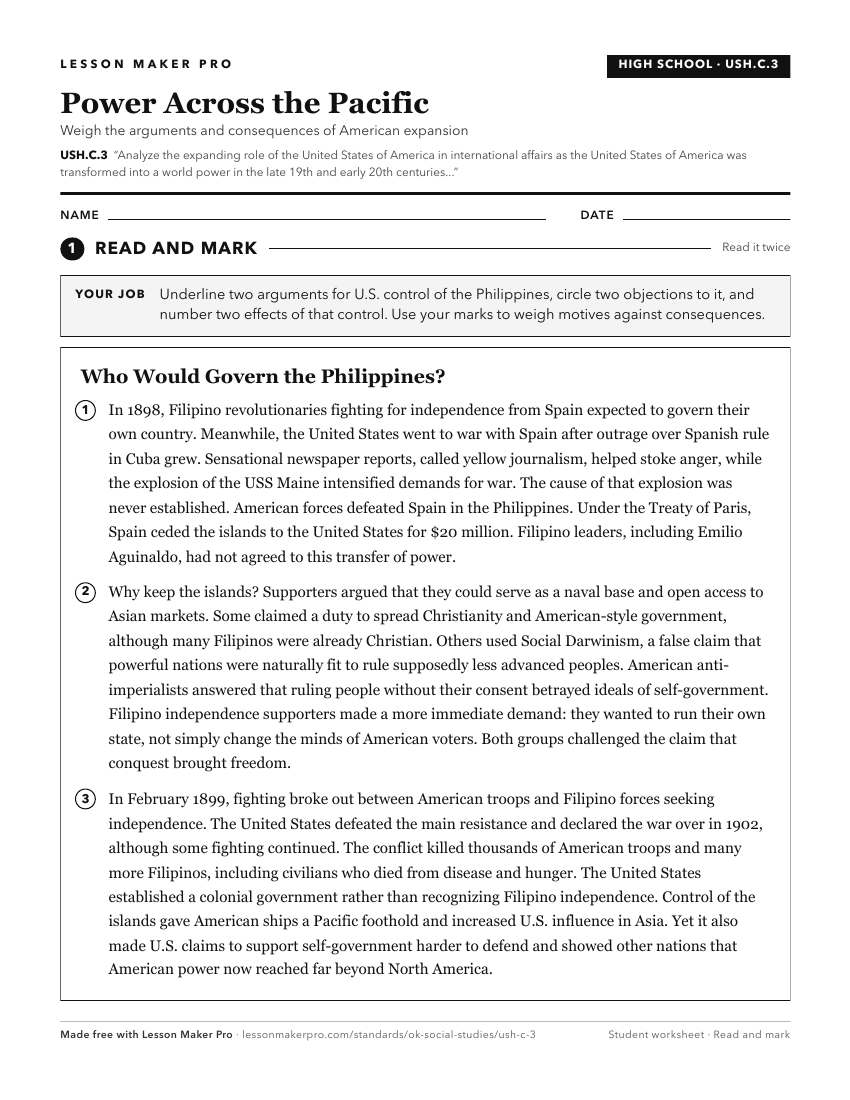
A ready-to-print activity worksheet aligned to USH.C.3, with an answer key for the teacher on its own page. No account needed.
PDF, US Letter, prints cleanly in black and white.
Download the worksheetKeep exploring
Related Standards
- USH.C.7.3
Analyze the ongoing social and political transformations within the United States of America , affecting domestic and foreign policy.
- 8.C.9.2
Analyze the territorial growth of the United States of America and the consequences of westward expansion.
- USH.C.5
Analyze the United States of America’s role in international affairs by examining the major causes, events, and effects of the nation’s involvement in World War...
Turn this cluster into a lesson
Grade, subject, topic, and the complete cluster are prefilled. Create one free, no account needed.
Also for this cluster:Make a WorksheetMake a QuizMake a Sub Lesson