Oklahoma Social Studies USH.C.3.1.E
The Standard
- USH.C.3
- Analyze the expanding role of the United States of America in international affairs as the United States of America was transformed into a world power in the late 19th and early 20th centuries.
- USH.C.3.1
- Evaluate the impact of Imperialism on international relations and its effect on developing nations.
Examine how the Spanish-American War resulted in the rise of the United States as a world power, leading to new territorial acquisitions and followed by national insurrections in Cuba and the Philippines.
Oklahoma Academic Standards for Social Studies (2026) · USH.C.3.1
Teacher's field guide
What This Standard Means
What Students Need to Do
- Trace how the 1898 war gave the United States Puerto Rico, Guam, and the Philippines and expanded its reach overseas. Explain Philippine resistance to U.S. rule and the U.S. response to Cuba’s 1906 uprising.
What Mastery Looks Like
- A student can locate the three acquisitions on a map and explain that Cuba was occupied, not annexed. They can distinguish the Philippine fight against U.S. rule from the Cuban uprising against Cuba’s government.
Common Misconceptions
- Students may think Spain ceded Cuba to the United States. They may also assume the fighting in Cuba and the Philippines had the same cause.
How to Assess It
- On an exit ticket, ask students to name two acquisitions, explain how they expanded U.S. power, and distinguish the Philippine rebellion from Cuba’s 1906 uprising.
Lesson moves
Ways to Teach It
Give pairs a blank Caribbean and Pacific map and place cards for Cuba, Puerto Rico, Guam, and the Philippines; have them mark each place’s outcome.
Ask: Did the war bring Cuba and the Philippines independence on the same terms? Write an answer with one fact about each place.
Run a four-card timeline race with the 1898 war, 1898 treaty, 1899 Philippine rebellion, and 1906 Cuban uprising; require one cause-and-effect note.
Use a current map to locate Puerto Rico and Guam, then compare their status with independent Cuba and the Philippines.
Free download
Printable USH.C.3.1.E Worksheet
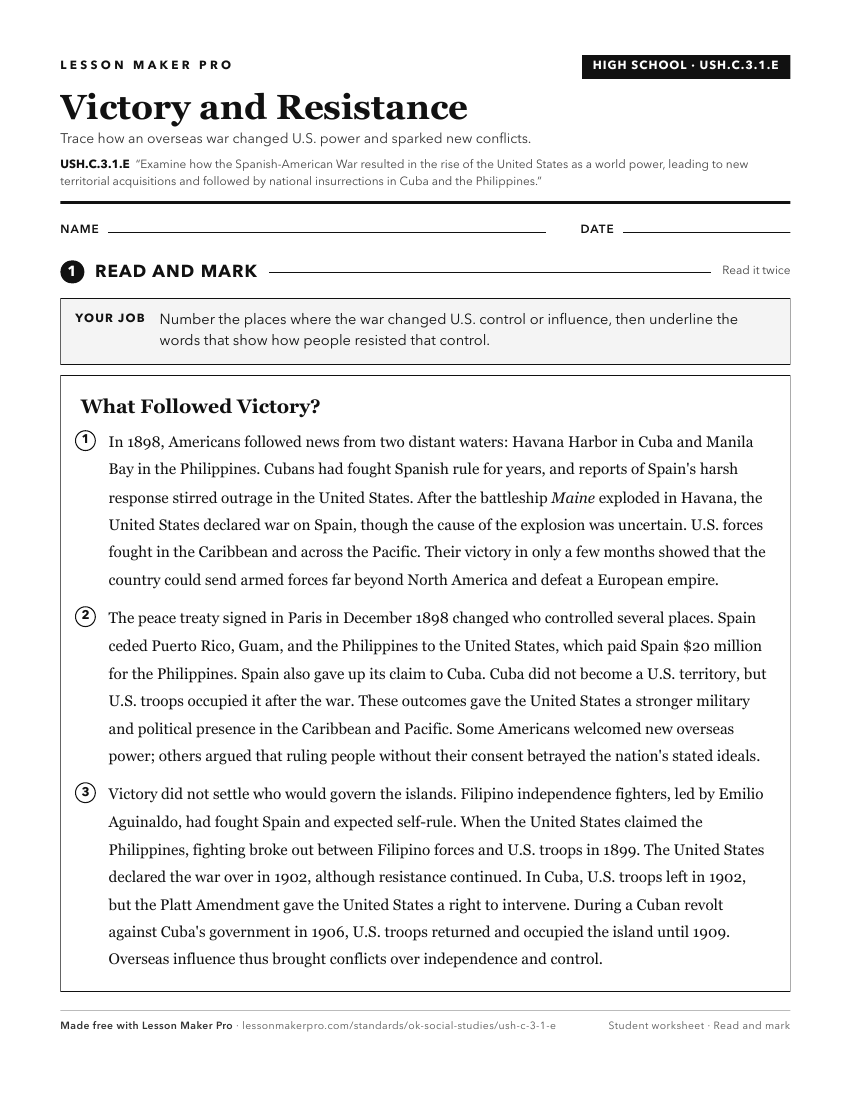
A ready-to-print activity worksheet aligned to USH.C.3.1.E, with an answer key for the teacher on its own page. No account needed.
PDF, US Letter, prints cleanly in black and white.
Download the worksheetKeep exploring
Related Standards
- USH.C.3.1.A
Explain the rise of the United States of America as a world power amidst debates over the United States of America’s role in world affairs and overseas expansio...
- 6.C.3.6.C
Examine Spanish colonialism of Latin America and its influence on language, religion, and customs, including the practices of privateering and mercantilism.
- USH.C.3.1.F
Assess the foreign policy of President Roosevelt’s “Big Stick” Diplomacy and his Corollary to the Monroe Doctrine, influencing the acquisition and construction ...
- USH.C.3.1.D
Identify the events that led many people in the United States of America to support going to war with Spain, assessing how yellow journalism and jingoism influe...
Turn this exact standard into a lesson
Grade, subject, topic, and the complete standard are prefilled. Create one free, no account needed.
Also for this standard:Make a WorksheetMake a QuizMake a Sub Lesson