Oklahoma Social Studies USH.C.3.1.G
The Standard
- USH.C.3
- Analyze the expanding role of the United States of America in international affairs as the United States of America was transformed into a world power in the late 19th and early 20th centuries.
- USH.C.3.1
- Evaluate the impact of Imperialism on international relations and its effect on developing nations.
Explain the focus of President Taft’s “Dollar Diplomacy” to ensure the financial stability of a region while protecting and extending national commercial interests.
Oklahoma Academic Standards for Social Studies (2026) · USH.C.3.1
Teacher's field guide
What This Standard Means
What Students Need to Do
- Students explain how Taft used U.S. bank loans and investments to steady other countries' finances. They connect those loans to U.S. business profits and political influence.
What Mastery Looks Like
- A student can explain how a U.S. bank loan to Nicaragua might help pay debts while giving the U.S. more influence. They can name a possible cost, such as reduced local control.
Common Misconceptions
- Students may think the U.S. gave money away rather than encouraging loans from banks. They may think the policy helped everyone equally or relied only on military force.
How to Assess It
- Exit ticket: A U.S. bank lends Nicaragua money to pay debts. In two sentences, explain how the loan could support stability and serve U.S. interests.
Lesson moves
Ways to Teach It
Give pairs cards labeled U.S. bank, Nicaragua, and loan. Have them draw arrows showing who receives money, who owes debt, and who gains influence.
Ask students to write: How could a loan help Nicaragua pay debts but give the U.S. more control?
Give groups four scenario cards: a bank loan, a tariff, an annexation, and a treaty. Have them identify which best fits Taft's policy.
Show a sample small-business loan sheet. Ask who gets cash, who earns interest, and how the lender might gain influence.
Free download
Printable USH.C.3.1.G Worksheet
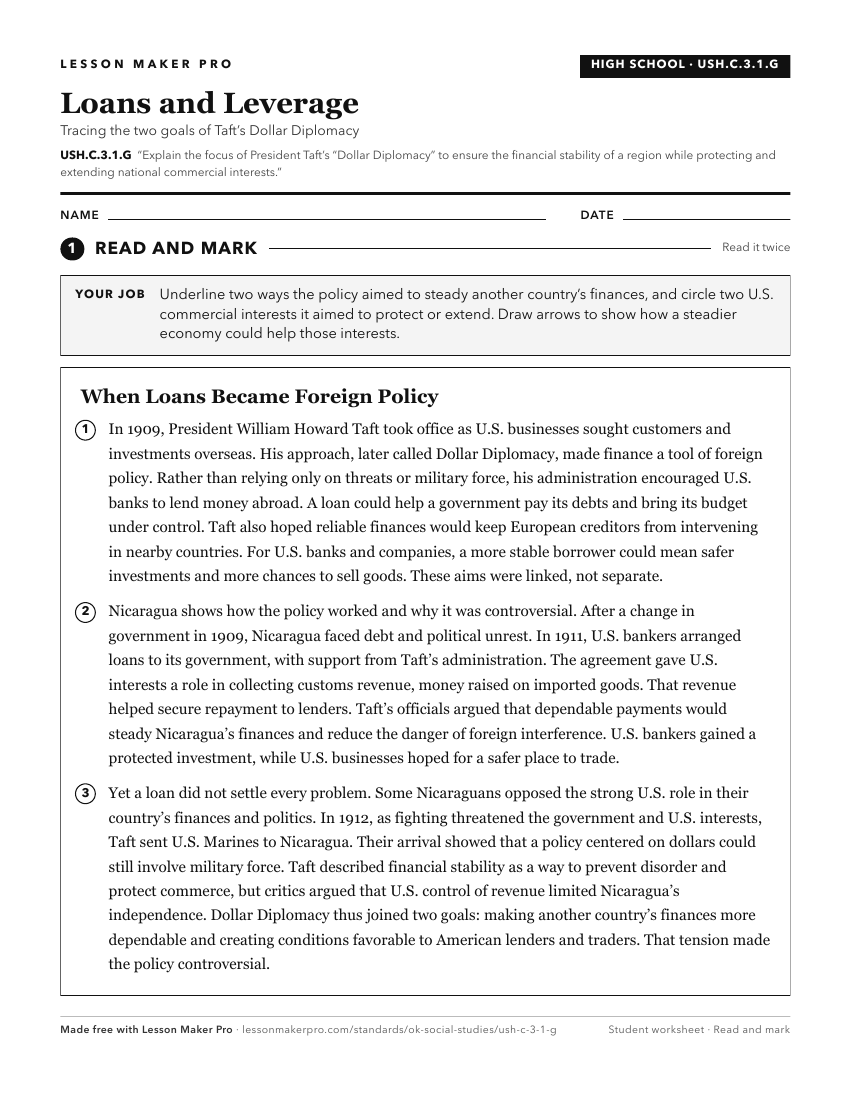
A ready-to-print activity worksheet aligned to USH.C.3.1.G, with an answer key for the teacher on its own page. No account needed.
PDF, US Letter, prints cleanly in black and white.
Download the worksheetKeep exploring
Related Standards
- USH.C.2.4.B
Examine President William Howard Taft’s trust-busting agenda, the Pure Food and Drug Act, and formation of the Interstate Commerce Commission.
- 8.C.7.2
Examine the Monroe Doctrine as a policy of isolationism which was designed to protect the United States of America’s interests in the Western Hemisphere.
- USH.C.3.1.F
Assess the foreign policy of President Roosevelt’s “Big Stick” Diplomacy and his Corollary to the Monroe Doctrine, influencing the acquisition and construction ...
- USH.C.2.4.D
Describe the work of President Woodrow Wilson’s administration, including the promises of “New Freedom” and passage of the Federal Reserve Act.
Turn this exact standard into a lesson
Grade, subject, topic, and the complete standard are prefilled. Create one free, no account needed.
Also for this standard:Make a WorksheetMake a QuizMake a Sub Lesson