Oklahoma Social Studies USH.C.3.1.H
The Standard
- USH.C.3
- Analyze the expanding role of the United States of America in international affairs as the United States of America was transformed into a world power in the late 19th and early 20th centuries.
- USH.C.3.1
- Evaluate the impact of Imperialism on international relations and its effect on developing nations.
Examine how President Wilson's ethical and religious beliefs influenced his vision of “Missionary Diplomacy” as the United States of America’s moral responsibility to spread the benefits of democracy to emerging nations.
Oklahoma Academic Standards for Social Studies (2026) · USH.C.3.1
Teacher's field guide
What This Standard Means
What Students Need to Do
- Students explain how Wilson’s religious faith and belief in moral leadership shaped his approach to foreign policy. They connect those beliefs to his support for democracy abroad and examine whether his actions matched his stated goals.
What Mastery Looks Like
- A student can use Wilson’s words to explain why he saw democracy as a moral cause. They can name a policy action, such as refusing to recognize Mexico’s Huerta government, and explain how it fit that view.
Common Misconceptions
- Students may think missionary diplomacy meant sending religious missionaries overseas. They may also assume Wilson always respected other nations’ choices because he spoke about democracy.
How to Assess It
- Exit ticket: Ask, “How did Wilson’s beliefs help explain his refusal to recognize Mexico’s Huerta government? Use one detail from his 1913 Mobile speech.”
Lesson moves
Ways to Teach It
Give pairs cards on Wilson’s Presbyterian upbringing, his 1913 Mobile speech, and the Veracruz intervention; have them arrange the cards as belief, goal, and action.
Ask students to write three sentences: What moral duty did Wilson claim, and did the Veracruz intervention support or challenge that claim?
Run a card sort with Wilson’s stated goals and actions in Mexico and Haiti; students match each action to a goal or flag a conflict.
Read two lines from Biden’s 2021 Summit for Democracy remarks and compare their stated goals with Wilson’s 1913 Mobile speech.
Free download
Printable USH.C.3.1.H Worksheet
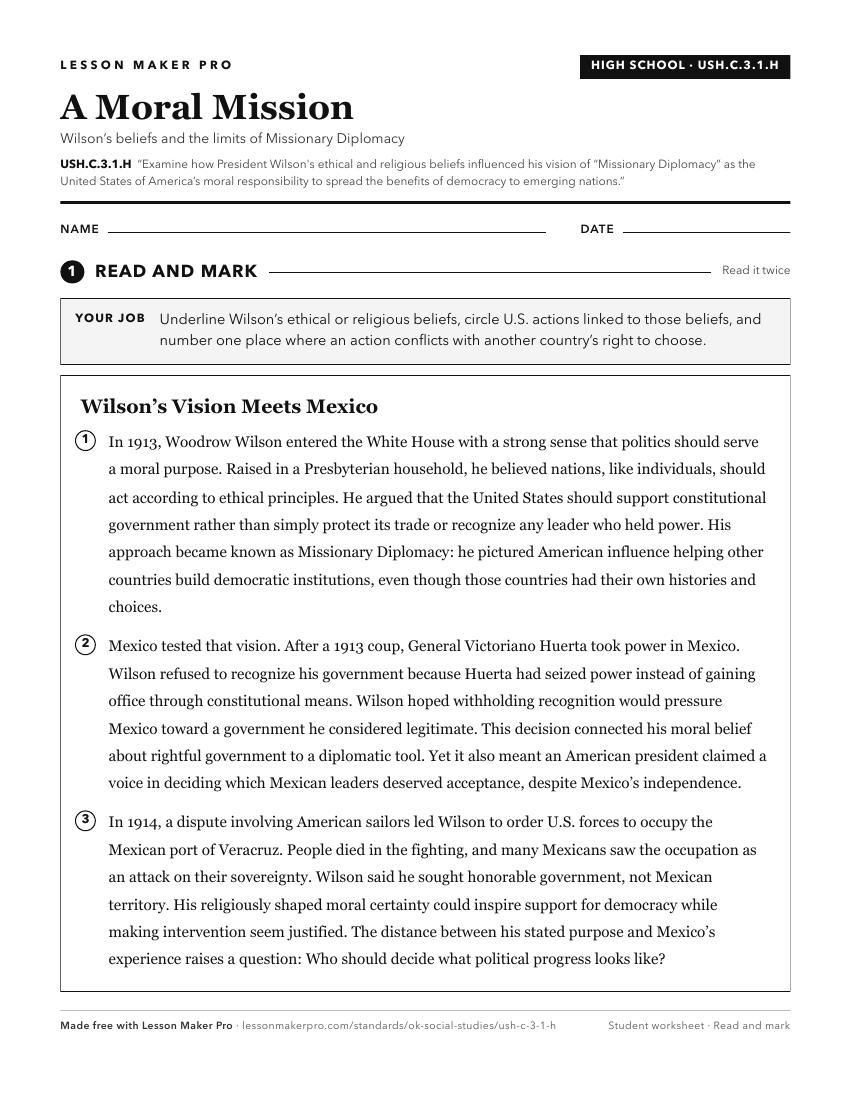
A ready-to-print activity worksheet aligned to USH.C.3.1.H, with an answer key for the teacher on its own page. No account needed.
PDF, US Letter, prints cleanly in black and white.
Download the worksheetKeep exploring
Related Standards
- USH.C.3.1.F
Assess the foreign policy of President Roosevelt’s “Big Stick” Diplomacy and his Corollary to the Monroe Doctrine, influencing the acquisition and construction ...
- 4.C.1.1.B
Examine the responsibility of the United States of America’s government as it relates to the promotion of the common good (e.g., security of the people, law and...
- USH.C.2.4.D
Describe the work of President Woodrow Wilson’s administration, including the promises of “New Freedom” and passage of the Federal Reserve Act.
- USH.C.3.2.F
Examine Wilson’s foreign policy as proposed in his Fourteen Points and reasons for the nation’s return to isolationism highlighted by the Senate’s rejection of ...
Turn this exact standard into a lesson
Grade, subject, topic, and the complete standard are prefilled. Create one free, no account needed.
Also for this standard:Make a WorksheetMake a QuizMake a Sub Lesson