Virginia SOL 2.W
SOL Standard (Knowledge and Skills Cluster)
The student will write in a variety of forms for diverse audiences and purposes, linked to grade two content and texts. Modes and Purposes for Writing Write narratives that recount a well-elaborated event or short sequence of events and include details about the events and characters and use of time-related words to signal the event sequence. Write informative/explanatory texts that introduce a topic and develop the ideas with facts and examples. Write opinion pieces on topics or texts that support a point of view with reasons. Write in response to text(s) read or heard to share thinking with a couple supporting details from the text. Organization and Composition Engage in writing as a process to plan writing based on purpose and genre. This includes: Writing a clear topic sentence focusing on the main idea. Identifying the audience and purpose of the writing. Developing, selecting, and organizing ideas and details relevant to the topic, purpose, and genre. Providing a concluding statement or section. Usage and Mechanics With guidance and support from adults, develop and strengthen writing as needed by revising for quality of ideas, organization, sentence fluency, and word choice. With guidance and support from adults, edit writing for conventions (e.g., spelling, capitalization, usage, punctuation). (See Language Usage for grade level expectations).
Virginia Standards of Learning for English
Cluster contents
Knowledge and Skills in This Standard
2.W is a Standards of Learning standard. These are the knowledge and skills expectations under it.
- 2.W.1
Modes and Purposes for Writing
- 2.W.1.A
Write narratives that recount a well-elaborated event or short sequence of events and include details about the events and characters and use of time-related wo...
- 2.W.1.B
Write informative/explanatory texts that introduce a topic and develop the ideas with facts and examples.
- 2.W.1.C
Write opinion pieces on topics or texts that support a point of view with reasons.
- 2.W.1.D
Write in response to text(s) read or heard to share thinking with a couple supporting details from the text.
- 2.W.2
Organization and Composition
- 2.W.2.A.i
Writing a clear topic sentence focusing on the main idea.
- 2.W.2.A.ii
Identifying the audience and purpose of the writing.
- 2.W.2.A.iii
Developing, selecting, and organizing ideas and details relevant to the topic, purpose, and genre.
- 2.W.2.A.iv
Providing a concluding statement or section.
- 2.W.3
Usage and Mechanics
- 2.W.3.A
With guidance and support from adults, develop and strengthen writing as needed by revising for quality of ideas, organization, sentence fluency, and word choic...
- 2.W.3.B
With guidance and support from adults, edit writing for conventions (e.g., spelling, capitalization, usage, punctuation). (See Language Usage for grade level ex...
Teacher's field guide
What This Cluster Means
What Students Need to Do
- Students write narratives, explanations, opinions, and responses to reading for a clear audience and purpose. They plan and organize a main idea, relevant details, and a conclusion, then revise and edit with adult support.
What Mastery Looks Like
- Students choose a form that fits the audience and purpose, then organize writing around a clear main idea. They include sequenced events, facts, examples, reasons, or text details as needed. With support, they revise unclear parts and edit capitals, punctuation, spelling, and grammar.
Common Misconceptions
- Students may retell every detail instead of choosing details that support the main idea. They may confuse facts with opinions, give unrelated reasons, or omit text evidence. Narratives may jump in time, and drafts may end without a conclusion.
How to Assess It
- After reading a short passage, ask students to write for a classmate: state one idea, support it with two text details, and add a conclusion.
Lesson moves
Ways to Teach It
Give pairs picture cards to arrange in order, then have each student write a narrative using first, next, then, and finally.
Read three short examples and ask students to name each writer's audience, purpose, main idea, and strongest supporting detail.
Play Detail Match by having teams place fact, reason, event, and text evidence cards under the writing form they best support.
Have students write a library book recommendation for younger readers, including an opinion, two reasons, and a concluding sentence.
Free download
Printable 2.W Worksheet
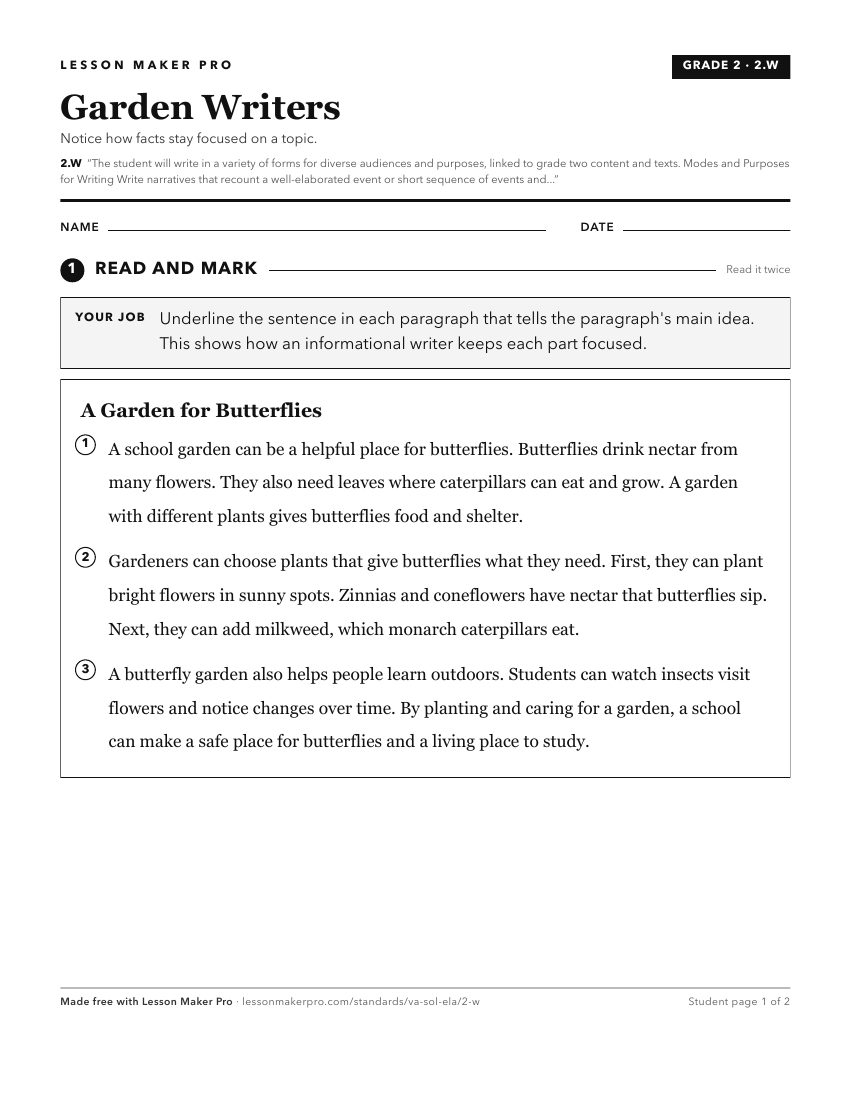
A ready-to-print activity worksheet aligned to 2.W, with an answer key for the teacher on its own page. No account needed.
PDF, US Letter, prints cleanly in black and white.
Download the worksheetKeep exploring
Related Standards
- 1.W
The student will write in a variety of forms for diverse audiences and purposes linked to grade one content and texts
- K.W
The student will write in a variety of forms, linked to kindergarten content and texts
- 3.W
The student will compose various works for diverse audiences and purposes, linked to grade three content and texts.
- 10.W
The student will write in a variety of forms for diverse audiences and purposes linked to grade ten content and texts with an emphasis on argumentative writing.
Turn this cluster into a lesson
Grade, subject, topic, and the complete cluster are prefilled. Create one free, no account needed.
Also for this cluster:Make a WorksheetMake a QuizMake a Sub Lesson