Virginia SOL 1.W
SOL Standard (Knowledge and Skills Cluster)
The student will write in a variety of forms for diverse audiences and purposes linked to grade one content and texts. Modes and Purposes for Writing Use a combination of drawing, dictating, and writing to recount two or more sequenced events or experiences and include details about the events and characters. Use a combination of drawing, dictating, and writing to compose informative/expository texts that name a topic and supply some facts about the topic. Use a combination of drawing, dictating, and writing to compose opinion pieces that state an opinion and supply a reason for the opinion. Use a combination of drawing, dictating, and writing about text(s) read or heard in which students share their thinking with a couple of supporting details from the text. Organization and Composition With guidance and support, use a variety of prewriting activities, such as brainstorming, drawing and graphic organizers, to generate ideas and draft writing or dictation. This includes: Identifying the audience and purpose of the writing (e.g., letters, stories, journals, etc.). Composing a series of simple sentences focused on the topic, including sentences with a subject and predicate, subject/verb agreement, and one or more descriptive adjectives. Usage and Mechanics With guidance and support from adults, edit writing for conventions e.g., spelling, capitalization, usage, punctuation). (See Language Usage for grade level expectations).
Virginia Standards of Learning for English
Cluster contents
Knowledge and Skills in This Standard
1.W is a Standards of Learning standard. These are the knowledge and skills expectations under it.
- 1.W.1
Modes and Purposes for Writing
- 1.W.1.A
Use a combination of drawing, dictating, and writing to recount two or more sequenced events or experiences and include details about the events and characters.
- 1.W.1.B
Use a combination of drawing, dictating, and writing to compose informative/expository texts that name a topic and supply some facts about the topic.
- 1.W.1.C
Use a combination of drawing, dictating, and writing to compose opinion pieces that state an opinion and supply a reason for the opinion.
- 1.W.1.D
Use a combination of drawing, dictating, and writing about text(s) read or heard in which students share their thinking with a couple of supporting details from...
- 1.W.2
Organization and Composition
- 1.W.2.A.i
Identifying the audience and purpose of the writing (e.g., letters, stories, journals, etc.).
- 1.W.2.A.ii
Composing a series of simple sentences focused on the topic, including sentences with a subject and predicate, subject/verb agreement, and one or more descripti...
- 1.W.3
Usage and Mechanics
- 1.W.3.A
With guidance and support from adults, edit writing for conventions e.g., spelling, capitalization, usage, punctuation). (See Language Usage for grade level exp...
Teacher's field guide
What This Cluster Means
What Students Need to Do
- Students create stories, fact pieces, opinions, and responses to books using drawings, oral language, and sentences. They plan for a specific reader and reason, keep ideas focused, and add useful details. With support, they revise and edit complete sentences.
What Mastery Looks Like
- Students plan with pictures, talk, or a simple organizer, then create a focused piece for a clear reader and purpose. They add ordered events, accurate facts, reasons, or book details as needed. They reread and fix basic spelling, capitals, grammar, and end marks with support.
Common Misconceptions
- Students may list ideas without keeping them in order or focused on one topic. They may state an opinion without a reason, copy facts incorrectly, or write sentence fragments. Capitals, end marks, and matching subjects and verbs are often missed.
How to Assess It
- After a shared read-aloud, ask students to draw and write three sentences explaining their thinking, using two details from the book. Check focus, complete sentences, capitals, and punctuation.
Lesson moves
Ways to Teach It
Give pairs three picture cards to sequence, then have them draw and write a beginning, middle, and ending with character details.
Ask, “Which class read-aloud character made the best choice?” and have students write an opinion with one reason and one book detail.
Play Sentence Repair Shop using cards with missing capitals, verbs, adjectives, or punctuation for students to correct and read aloud.
Have students write the cafeteria manager a note naming a favorite lunch, giving one reason, and adding a polite closing.
Free download
Printable 1.W Worksheet
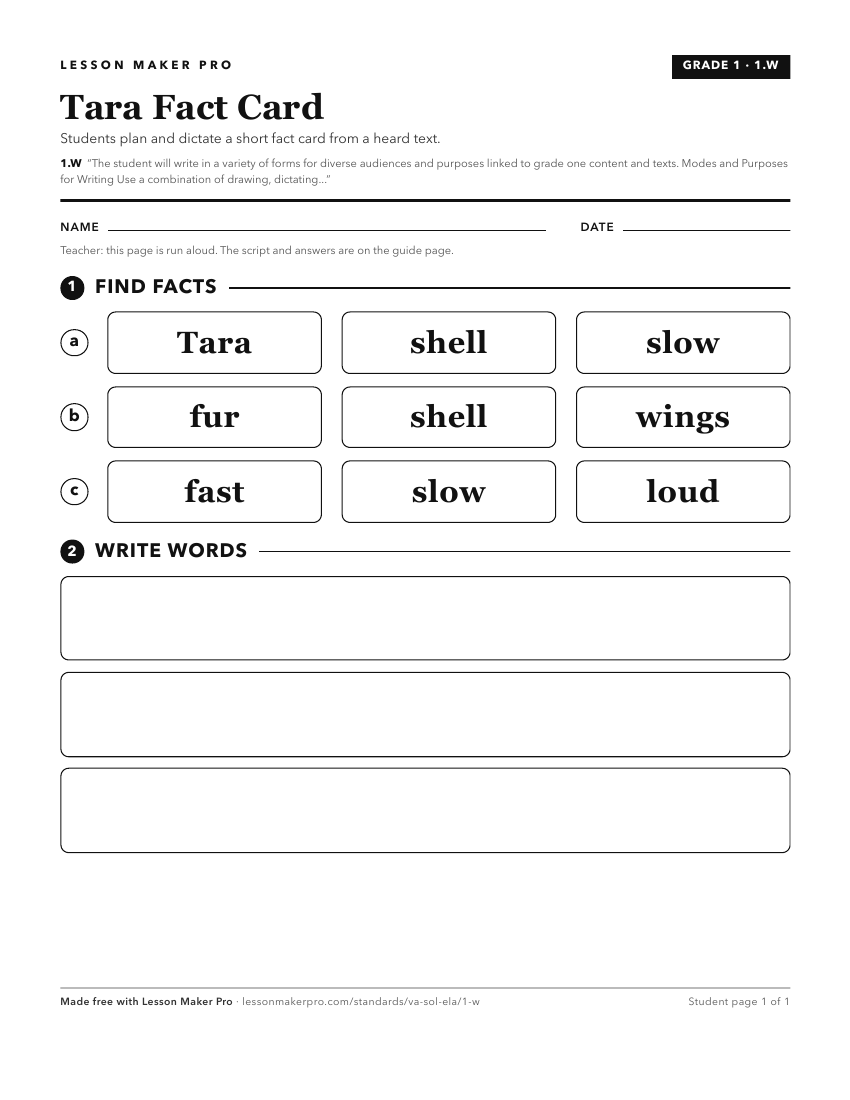
A ready-to-print activity worksheet aligned to 1.W, with an answer key for the teacher on its own page. No account needed.
PDF, US Letter, prints cleanly in black and white.
Download the worksheetKeep exploring
Related Standards
- 2.W
The student will write in a variety of forms for diverse audiences and purposes, linked to grade two content and texts.
- K.W
The student will write in a variety of forms, linked to kindergarten content and texts
- 3.W
The student will compose various works for diverse audiences and purposes, linked to grade three content and texts.
- 6.W
The student will compose various works for diverse audiences and purposes, linked to grade six content and texts.
Turn this cluster into a lesson
Grade, subject, topic, and the complete cluster are prefilled. Create one free, no account needed.
Also for this cluster:Make a WorksheetMake a QuizMake a Sub Lesson