Virginia SOL 10.W
SOL Standard (Knowledge and Skills Cluster)
The student will write in a variety of forms for diverse audiences and purposes linked to grade ten content and texts with an emphasis on argumentative writing. Modes and Purposes for Writing Write extended pieces that: Introduce a topic clearly by providing context, presenting well-defined theses, and previewing what follows. Adopt an organizational structure that clarifies relationships among ideas and concepts. Develop the topic through sustained use of the most significant and relevant facts, concrete details, quotations, or other information from multiple authoritative sources appropriate to the audience’s knowledge. Provide a concluding section that follows from the information or explanation presented. Write arguments that: Develop a thesis that demonstrates knowledgeable judgements. Support well-defined points of view effectively with relevant evidence and clear reasoning in ways that logically advance the claim(s). Address and refute counterclaims. Provide conclusions that follow from and support the argument presented. Write reflectively in response to readings in which students compare two or more texts with details, examples, and other textual evidence to support an idea or position. Develop flexibility in writing by routinely producing shorter and longer pieces that adapt writing content, technique, and voice for a range of tasks, purposes, and audiences, (e.g., summaries, reflections, descriptions, critiques, letters, poetry, narratives, etc.). Organization and Composition Plan and organize writing to address a specific audience and purpose using the writing process (planning, drafting, revising, editing). This includes: Composing a thesis statement that clearly communicates the writer’s position or assertion. Introducing and developing central idea(s), and organizing ideas in a logical sequence to exhibit unity. Defending a position using sufficient reasons with evidence from credible sources as support. Embedding narrative techniques (e.g., anecdotes, dialogue, and description) to develop and enhance writing. Using transitions effectively to connect ideas within and across paragraphs. Elaborating ideas clearly through intentional word choice and varied sentence structure. Usage and Mechanics Revise writing for clarity of content, accuracy, and adequate elaboration. Use peer- and self-evaluation to edit writing for clarity and quality of information, addressing strengths and making suggestions regarding how writing might be improved. Edit writing for appropriate conventions, style, and language (See Language Usage for grade level expectations).
Virginia Standards of Learning for English
Cluster contents
Knowledge and Skills in This Standard
10.W is a Standards of Learning standard. These are the knowledge and skills expectations under it.
- 10.W.1
Modes and Purposes for Writing
- 10.W.1.A.i
Introduce a topic clearly by providing context, presenting well-defined theses, and previewing what follows.
- 10.W.1.A.ii
Adopt an organizational structure that clarifies relationships among ideas and concepts.
- 10.W.1.A.iii
Develop the topic through sustained use of the most significant and relevant facts, concrete details, quotations, or other information from multiple authoritati...
- 10.W.1.A.iv
Provide a concluding section that follows from the information or explanation presented.
- 10.W.1.B.i
Develop a thesis that demonstrates knowledgeable judgements.
- 10.W.1.B.ii
Support well-defined points of view effectively with relevant evidence and clear reasoning in ways that logically advance the claim(s).
- 10.W.1.B.iii
Address and refute counterclaims.
- 10.W.1.B.iv
Provide conclusions that follow from and support the argument presented.
- 10.W.1.C
Write reflectively in response to readings in which students compare two or more texts with details, examples, and other textual evidence to support an idea or ...
- 10.W.1.D
Develop flexibility in writing by routinely producing shorter and longer pieces that adapt writing content, technique, and voice for a range of tasks, purposes,...
- 10.W.2
Organization and Composition
- 10.W.2.A.i
Composing a thesis statement that clearly communicates the writer’s position or assertion.
- 10.W.2.A.ii
Introducing and developing central idea(s), and organizing ideas in a logical sequence to exhibit unity.
- 10.W.2.A.iii
Defending a position using sufficient reasons with evidence from credible sources as support.
- 10.W.2.A.iv
Embedding narrative techniques (e.g., anecdotes, dialogue, and description) to develop and enhance writing.
- 10.W.2.A.v
Using transitions effectively to connect ideas within and across paragraphs.
- 10.W.2.A.vi
Elaborating ideas clearly through intentional word choice and varied sentence structure.
- 10.W.3
Usage and Mechanics
- 10.W.3.A
Revise writing for clarity of content, accuracy, and adequate elaboration.
- 10.W.3.B
Use peer- and self-evaluation to edit writing for clarity and quality of information, addressing strengths and making suggestions regarding how writing might be...
- 10.W.3.C
Edit writing for appropriate conventions, style, and language (See Language Usage for grade level expectations).
Teacher's field guide
What This Cluster Means
What Students Need to Do
- Students plan, draft, revise, and edit writing for different audiences and purposes. They build arguments with a defensible thesis, logical organization, credible evidence, clear reasoning, counterclaims, and conclusions. They also compare texts and adjust voice, detail, and form for shorter and longer tasks.
What Mastery Looks Like
- A student writes a focused thesis, organizes ideas logically, and supports each point with credible evidence from multiple sources. The student explains the evidence, addresses a counterclaim fairly, and ends with a conclusion that follows from the argument. Revisions improve content, sentence flow, word choice, and conventions.
Common Misconceptions
- Students often treat a topic as a thesis or list evidence without explaining how it supports the claim. They may ignore counterclaims, rely on weak sources, or add a conclusion that only repeats the introduction. Some revise only for spelling instead of improving ideas, organization, and clarity.
How to Assess It
- Give students two brief source excerpts and this prompt: “Write a thesis, one supporting point with cited evidence and reasoning, and one counterclaim with a rebuttal.”
Lesson moves
Ways to Teach It
Give groups a claim and evidence cards, then have them sort each card as strong, weak, irrelevant, or counterevidence.
Ask students to compare how two assigned texts treat responsibility, then write a thesis and one paragraph using evidence from both.
Run a transition relay where teams arrange mixed paragraph strips and add transitions that show contrast, cause, and sequence.
Have students write a letter to the principal proposing one school change, using survey data, a counterclaim, and a rebuttal.
Free download
Printable 10.W Worksheet
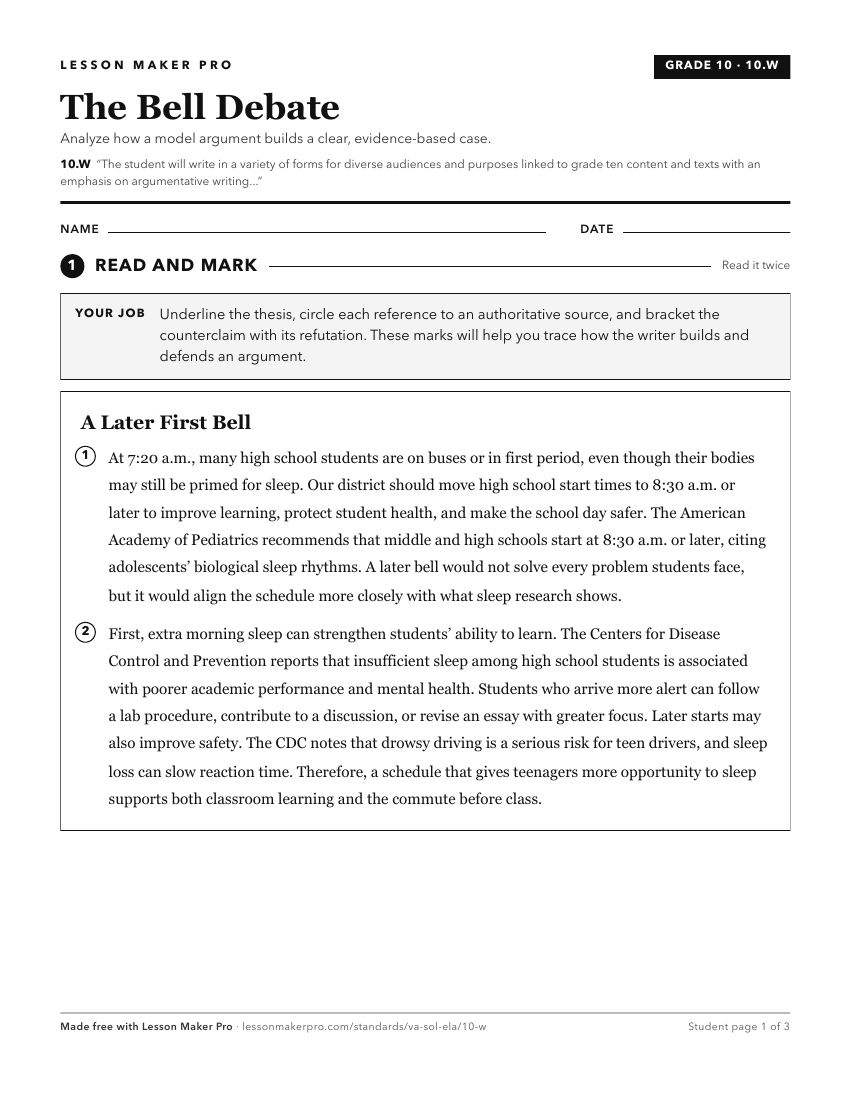
A ready-to-print activity worksheet aligned to 10.W, with an answer key for the teacher on its own page. No account needed.
PDF, US Letter, prints cleanly in black and white.
Download the worksheetKeep exploring
Related Standards
- 11.W
The student will write in a variety of forms for diverse audiences and purposes linked to grade eleven content and text with an emphasis on argumentative and an...
- 9.W
The student will write in various forms for diverse audiences and purposes linked to grade nine content and texts with an emphasis on expository and persuasive ...
- 2.W
The student will write in a variety of forms for diverse audiences and purposes, linked to grade two content and texts.
- 1.W
The student will write in a variety of forms for diverse audiences and purposes linked to grade one content and texts
Turn this cluster into a lesson
Grade, subject, topic, and the complete cluster are prefilled. Create one free, no account needed.
Also for this cluster:Make a WorksheetMake a QuizMake a Sub Lesson