Virginia SOL 10.W.1
SOL Standard (Knowledge and Skills Cluster)
Modes and Purposes for Writing
Virginia Standards of Learning for English
Cluster contents
Knowledge and Skills in This Standard
10.W.1 is a Standards of Learning standard. These are the knowledge and skills expectations under it.
- 10.W.1.A.i
Introduce a topic clearly by providing context, presenting well-defined theses, and previewing what follows.
- 10.W.1.A.ii
Adopt an organizational structure that clarifies relationships among ideas and concepts.
- 10.W.1.A.iii
Develop the topic through sustained use of the most significant and relevant facts, concrete details, quotations, or other information from multiple authoritati...
- 10.W.1.A.iv
Provide a concluding section that follows from the information or explanation presented.
- 10.W.1.B.i
Develop a thesis that demonstrates knowledgeable judgements.
- 10.W.1.B.ii
Support well-defined points of view effectively with relevant evidence and clear reasoning in ways that logically advance the claim(s).
- 10.W.1.B.iii
Address and refute counterclaims.
- 10.W.1.B.iv
Provide conclusions that follow from and support the argument presented.
- 10.W.1.C
Write reflectively in response to readings in which students compare two or more texts with details, examples, and other textual evidence to support an idea or ...
- 10.W.1.D
Develop flexibility in writing by routinely producing shorter and longer pieces that adapt writing content, technique, and voice for a range of tasks, purposes,...
Teacher's field guide
What This Cluster Means
What Students Need to Do
- Students write clear, organized pieces for explanation, argument, reflection, and other purposes. They state a focused thesis, use strong evidence from reliable sources, and explain how each detail supports the point. They adjust voice and length for the audience, answer opposing views, and end with a fitting conclusion.
What Mastery Looks Like
- A student can open with useful context and a focused thesis, then organize ideas in a clear sequence. Evidence comes from reliable sources and is followed by reasoning that advances the explanation or argument. The student handles counterclaims fairly, writes a fitting conclusion, and adjusts voice for different audiences.
Common Misconceptions
- Students often write a broad topic instead of a focused thesis. They may insert quotations without explaining the connection, use weak sources, or mention a counterclaim without answering it. Conclusions may simply repeat the introduction rather than show what the evidence proves.
How to Assess It
- Give students two short sources on school start times. Ask: “Should high schools start later? Write six sentences that include context, a thesis, evidence from both sources, reasoning, a counterclaim and response, and a conclusion.”
Lesson moves
Ways to Teach It
Give groups color-coded sentence strips from a model essay, then have them arrange the introduction, claims, evidence, counterclaim, and conclusion.
After reading two editorials, ask students to write which author is more convincing and cite one detail from each text.
Play Evidence Draft: teams choose the strongest source card for a claim, then earn a point by explaining the logical link.
Have students write a letter to the principal proposing one school change, using survey data and answering a likely objection.
Free download
Printable 10.W.1 Worksheet
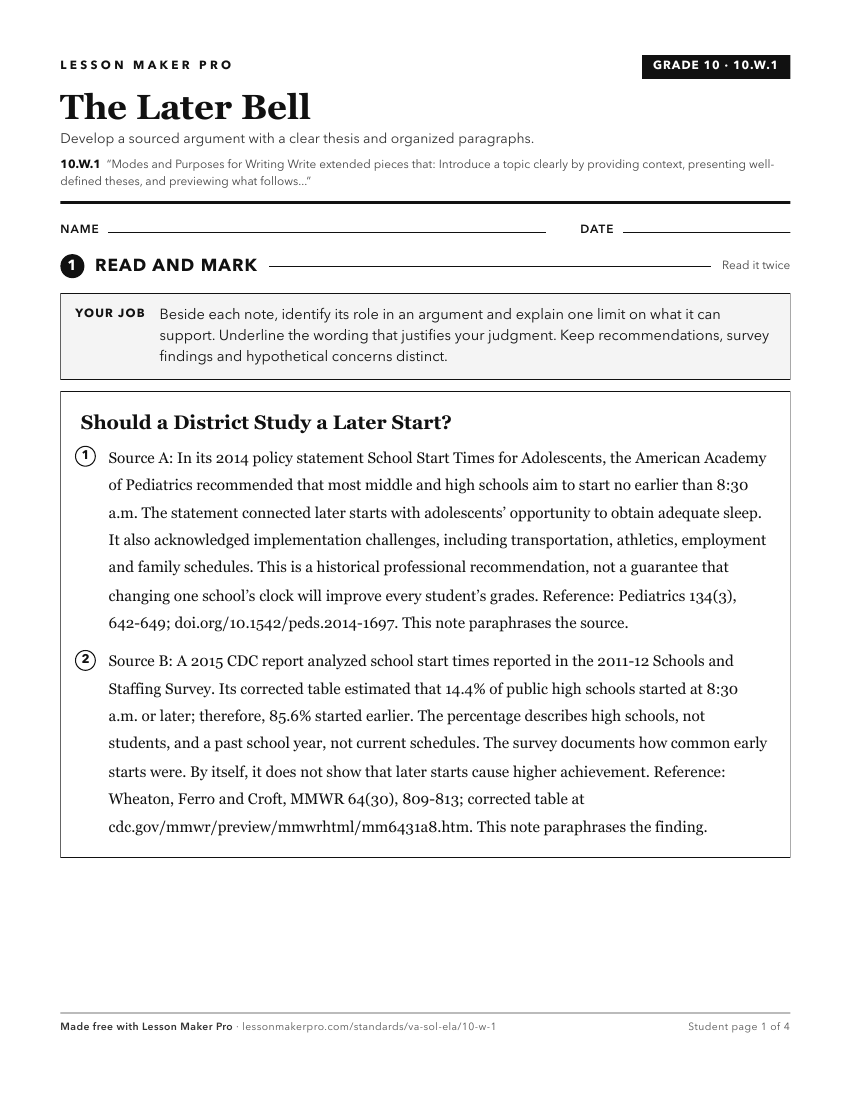
A ready-to-print activity worksheet aligned to 10.W.1, with an answer key for the teacher on its own page. No account needed.
PDF, US Letter, prints cleanly in black and white.
Download the worksheetKeep exploring
Related Standards
Turn this cluster into a lesson
Grade, subject, and topic are prefilled; the lesson picks the standards under this heading. Create one free, no account needed.
Also for this cluster:Make a WorksheetMake a QuizMake a Sub Lesson