Texas TEKS 4.19
TEKS Knowledge Statement (Expectation Cluster)
Social studies skills. The student applies critical-thinking skills to organize and use information acquired from a variety of valid sources, including technology. The student is expected to: differentiate between, locate, and use valid primary and secondary sources such as technology; interviews; biographies; oral, print, and visual material; documents; and artifacts to acquire information about Texas; differentiate and compare the information about a specific issue or event provided in primary and secondary sources; analyze information by applying absolute and relative chronology through sequencing, categorizing, identifying cause-and-effect relationships, comparing, contrasting, finding the main idea, summarizing, making generalizations and predictions, and drawing inferences and conclusions; organize and interpret information in outlines, reports, databases, and visuals, including graphs, charts, timelines, and maps; identify different points of view about an issue, topic, historical event, or current event; identify the central claim in a primary or secondary source; and develop and communicate a claim and supporting evidence visually, orally, or in writing related to a social studies topic.
Texas Essential Knowledge and Skills for Social Studies
Cluster contents
Student Expectations in This Statement
4.19 is a TEKS knowledge and skills statement. These are the student expectations under it.
- 4.19.A
differentiate between, locate, and use valid primary and secondary sources such as technology; interviews; biographies; oral, print, and visual material; docume...
- 4.19.B
differentiate and compare the information about a specific issue or event provided in primary and secondary sources
- 4.19.C
analyze information by applying absolute and relative chronology through sequencing, categorizing, identifying cause-and-effect relationships, comparing, contra...
- 4.19.D
organize and interpret information in outlines, reports, databases, and visuals, including graphs, charts, timelines, and maps
- 4.19.E
identify different points of view about an issue, topic, historical event, or current event
- 4.19.F
identify the central claim in a primary or secondary source
- 4.19.G
develop and communicate a claim and supporting evidence visually, orally, or in writing related to a social studies topic.
Teacher's field guide
What This Cluster Means
What Students Need to Do
- Students find credible information about Texas in firsthand records, later accounts, interviews, images, maps, artifacts, and digital sources. They compare accounts, trace sequence and cause, identify viewpoints and claims, and draw supported conclusions. They organize findings and present their own claim with evidence.
What Mastery Looks Like
- A student can label a source as primary or secondary and explain whether it is trustworthy. The student can compare two accounts of one event, organize key details, and identify each viewpoint. The student can make a clear claim and support it with relevant evidence.
Common Misconceptions
- Students may think every old item is a primary source or every polished website is reliable. They may confuse a source's central claim with an interesting detail. They may list evidence without explaining how it supports their own claim.
How to Assess It
- Give students a firsthand letter and a short textbook passage about the same Texas event. Ask them to label each source, identify one difference, and write a claim supported by one detail from each.
Lesson moves
Ways to Teach It
Set up a source station with artifact photos, diary excerpts, maps, and textbook pages for students to sort and justify.
Ask students to compare a settler's letter with a historian's account and write how the viewpoints differ.
Play a card sort using Texas event cards labeled with dates, causes, effects, claims, and source types.
Have students research a local issue using a news report, city map, and resident interview, then present an evidence-based recommendation.
Free download
Printable 4.19 Worksheet
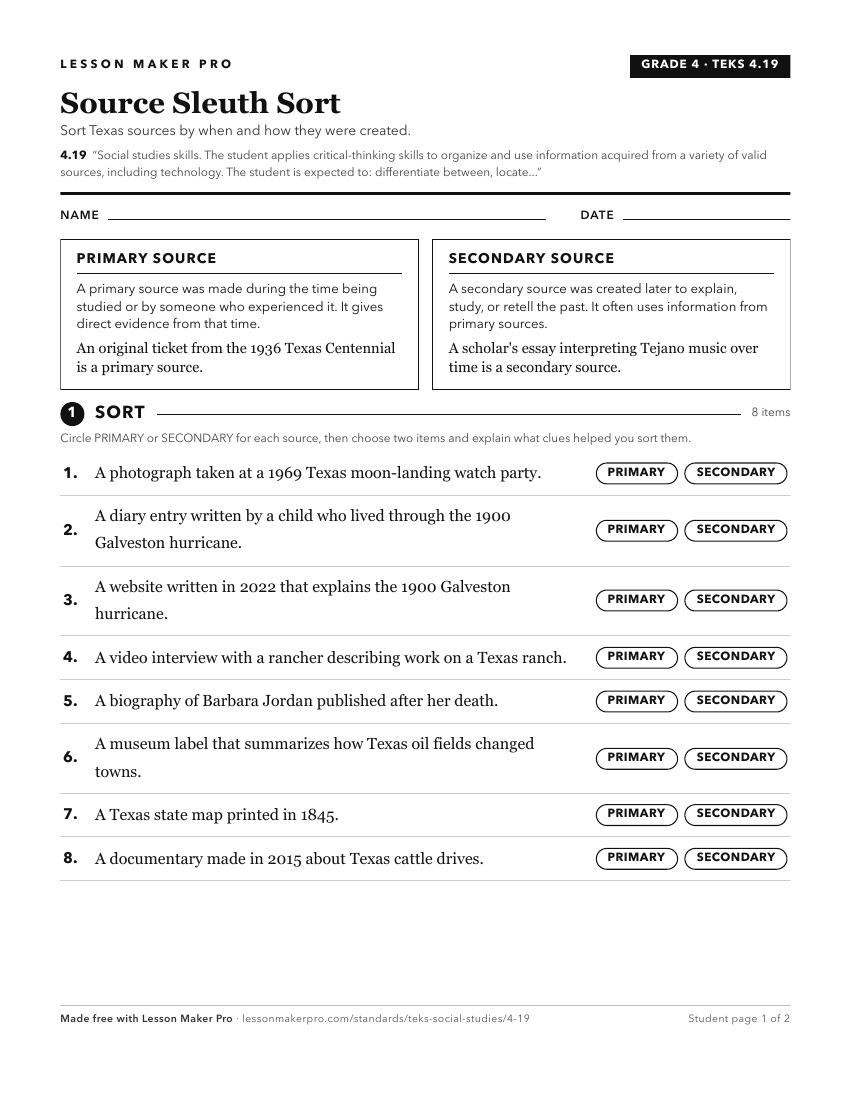
A ready-to-print activity worksheet aligned to 4.19, with an answer key for the teacher on its own page. No account needed.
PDF, US Letter, prints cleanly in black and white.
Download the worksheetKeep exploring
Related Standards
- 5.23
Social studies skills. The student applies critical-thinking skills to organize and use information acquired from a variety of valid sources, including technolo...
- 2.15
Social studies skills. The student applies critical-thinking skills to organize and use information acquired from a variety of valid sources, including technolo...
- 1.16
Social studies skills. The student applies critical-thinking skills to organize and use information acquired from a variety of valid sources, including technolo...
- 3.14
Social studies skills. The student applies critical-thinking skills to organize and use information acquired from a variety of valid sources, including technolo...
Turn this cluster into a lesson
Grade, subject, topic, and the complete cluster are prefilled. Create one free, no account needed.
Also for this cluster:Make a WorksheetMake a QuizMake a Sub Lesson