Texas TEKS 4.19.B
The Standard
- 4.19
- Social studies skills. The student applies critical-thinking skills to organize and use information acquired from a variety of valid sources, including technology. The student is expected to:
differentiate and compare the information about a specific issue or event provided in primary and secondary sources
Texas Essential Knowledge and Skills for Social Studies
Teacher's field guide
What This Standard Means
What Students Need to Do
- Students identify whether an account comes from someone present or from a later author. They compare what agrees, what differs, and which details appear in only one account.
What Mastery Looks Like
- Given a firsthand document and a later account, a student labels each source correctly. The student names one agreement and one difference, then supports both with details from the sources.
Common Misconceptions
- Students may think a primary source is always more accurate because it comes from a witness. They may confuse an old secondary source with a primary source, or treat different details as contradictions.
How to Assess It
- Give students a short excerpt from William B. Travis's Alamo letter and a textbook paragraph about the Alamo. Ask: "Which is primary, which is secondary, and what is one agreement and one difference?"
Lesson moves
Ways to Teach It
Give pairs color-coded sticky notes to mark shared and unique details in a Travis letter and textbook excerpt.
Have students answer, "Which source gives better evidence about life at the Alamo, and why?" using one cited detail.
Play Source Match: students pair event-detail cards from two sources, then label each pair agree, differ, or only in one.
Compare a school newsletter recap with a student's firsthand note about the same event, then list two shared facts and one difference.
Free download
Printable 4.19.B Worksheet
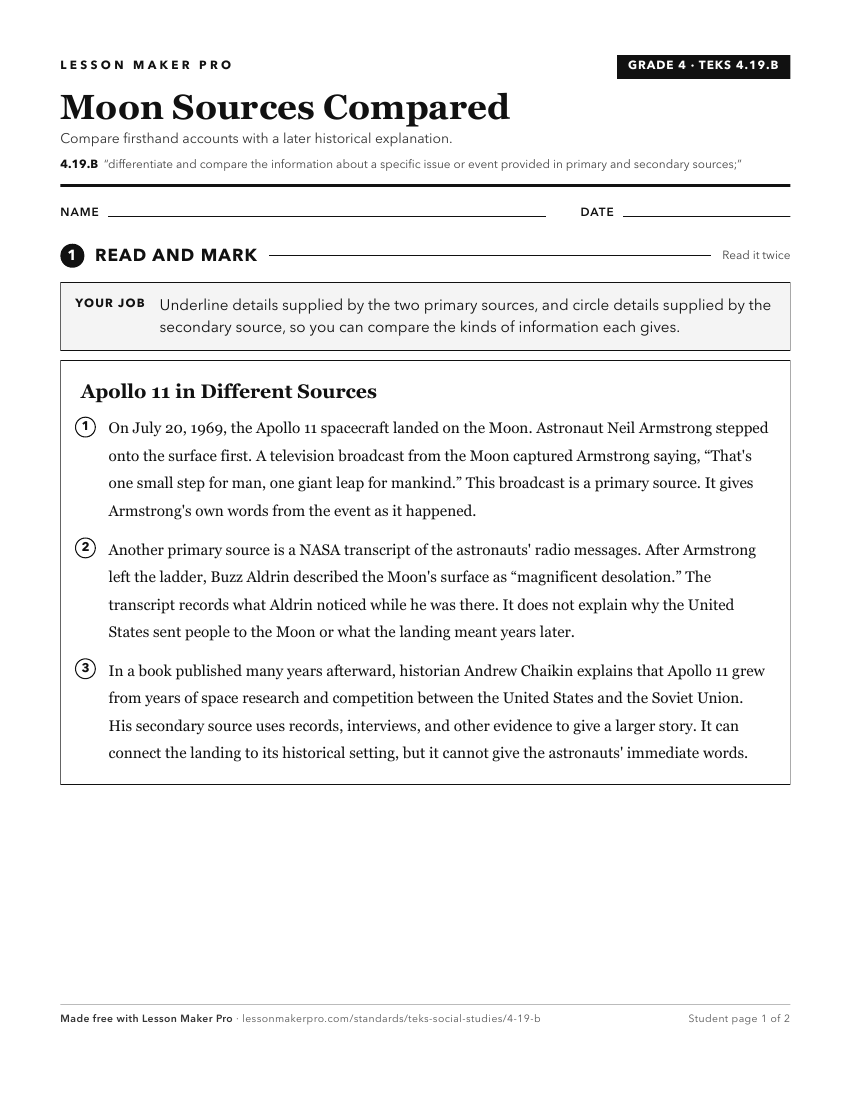
A ready-to-print activity worksheet aligned to 4.19.B, with an answer key for the teacher on its own page. No account needed.
PDF, US Letter, prints cleanly in black and white.
Download the worksheetKeep exploring
Related Standards
- 5.23.B
identify and ask questions about the credibility of different kinds of primary and secondary sources
- 8.29.A
differentiate between, locate, and use valid primary and secondary sources such as media and news services, biographies, interviews, and artifacts to acquire in...
- 5.23.A
differentiate between, locate, and use valid primary and secondary sources such as technology; interviews; biographies; oral, print, and visual material; docume...
- 3.14.B
differentiate and compare the information about a specific issue or event provided in primary and secondary sources
Turn this exact standard into a lesson
Grade, subject, topic, and the complete standard are prefilled. Create one free, no account needed.
Also for this standard:Make a WorksheetMake a QuizMake a Sub Lesson