Texas TEKS K.5
TEKS Knowledge Statement (Expectation Cluster)
Recurring themes and concepts. The student uses recurring themes and concepts to make connections across disciplines. The student is expected to: identify and use patterns to describe phenomena or design solutions; investigate and predict cause-and-effect relationships in science; describe the properties of objects in terms of relative size (scale) and relative quantity; examine the parts of a whole to define or model a system; identify forms of energy and properties of matter; describe the relationship between the structure and function of objects, organisms, and systems; and describe how factors or conditions can cause objects, organisms, and systems to either change or stay the same.
Texas Essential Knowledge and Skills for Science
Cluster contents
Student Expectations in This Statement
K.5 is a TEKS knowledge and skills statement. These are the student expectations under it.
- K.5.A
identify and use patterns to describe phenomena or design solutions
- K.5.B
investigate and predict cause-and-effect relationships in science
- K.5.C
describe the properties of objects in terms of relative size (scale) and relative quantity
- K.5.D
examine the parts of a whole to define or model a system
- K.5.E
identify forms of energy and properties of matter
- K.5.F
describe the relationship between the structure and function of objects, organisms, and systems
- K.5.G
describe how factors or conditions can cause objects, organisms, and systems to either change or stay the same.
Teacher's field guide
What This Cluster Means
What Students Need to Do
- Students notice repeated features and events, then use them to describe what happens and predict what may happen next. They compare objects, identify matter and energy, connect parts to a whole, and explain how a part's shape helps it work. They also tell what causes something to change or remain the same.
What Mastery Looks Like
- A student can sort or compare objects by observable properties, size, and amount, then explain the sorting rule. Given a simple event or system, the student can name its parts, make a pattern-based prediction, and give a reasonable cause for change. The student can also match structures to jobs, such as wings for flying or wheels for rolling.
Common Misconceptions
- Students may describe a sequence without finding a repeating pattern, or assume that events occurring together prove cause and effect. They may confuse size with amount, call one part the whole system, or overlook how shape affects an object's job. They may also believe change always requires a person and overlook light, heat, sound, or motion.
How to Assess It
- Show a picture sequence of an ice cube in the sun: solid cube, melting cube, and puddle. Ask students to circle the cause, draw what comes next, and name one property that changed.
Lesson moves
Ways to Teach It
Give pairs ramps, toy cars, and blocks; students change ramp height, observe motion, and draw what caused each change.
Show a bird, fish, and turtle; ask, "How does each body part help the animal live where it lives?"
Play Pattern Detective with picture cards; students continue each pattern, state the rule, and predict the next card.
Inspect a classroom fan; students name its parts, identify electrical energy and motion, and explain how the parts work together.
Free download
Printable K.5 Worksheet
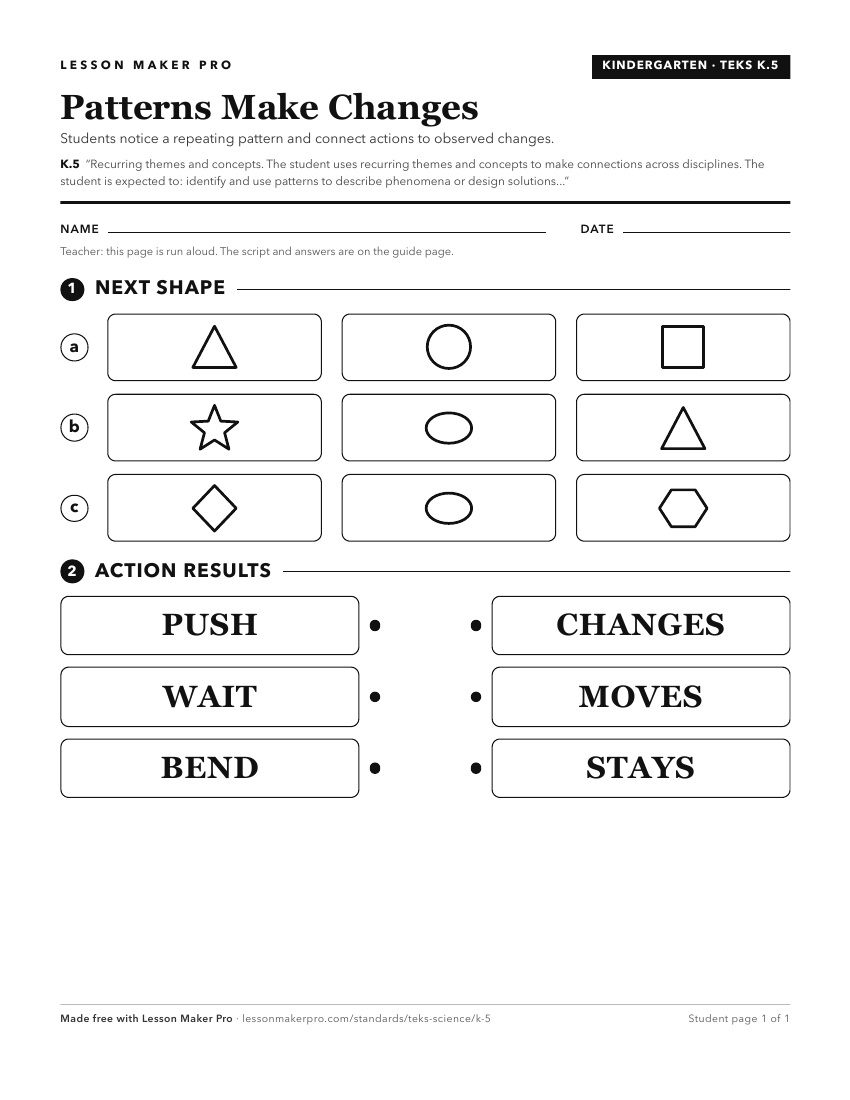
A ready-to-print activity worksheet aligned to K.5, with an answer key for the teacher on its own page. No account needed.
PDF, US Letter, prints cleanly in black and white.
Download the worksheetKeep exploring
Related Standards
- 1.5
The 1st Grade version of this standard.
- 4.5
Recurring themes and concepts. The student understands that recurring themes and concepts provide a framework for making connections across disciplines. The stu...
- 2.5
The 2nd Grade version of this standard.
- 3.5
Recurring themes and concepts. The student understands that recurring themes and concepts provide a framework for making connections across disciplines. The stu...
Turn this cluster into a lesson
Grade, subject, topic, and the complete cluster are prefilled. Create one free, no account needed.
Also for this cluster:Make a WorksheetMake a QuizMake a Sub Lesson