Texas TEKS K.5.B
The Standard
- K.5
- Recurring themes and concepts. The student uses recurring themes and concepts to make connections across disciplines. The student is expected to:
investigate and predict cause-and-effect relationships in science
Texas Essential Knowledge and Skills for Science
Teacher's field guide
What This Standard Means
What Students Need to Do
- Students change or observe one condition and notice what happens next. They make a prediction, test it, and describe the cause and effect.
What Mastery Looks Like
- Students can predict what will happen when an object is pushed, heated, cooled, or placed in light. They can use observations to explain why an outcome happened.
Common Misconceptions
- Students may think that events happening close together always cause each other. They may also focus on the result without naming what caused it.
How to Assess It
- Roll the same toy car down a low ramp and a higher ramp. Ask students to predict which car will travel farther, then explain the result.
Lesson moves
Ways to Teach It
Let pairs roll the same toy car down low and high block ramps, then compare how far it travels.
Ask, “What might happen to an ice cube in the sun, and what makes you think so?”
Play Cause and Effect Match with picture cards showing rain and puddles, sunlight and melting ice, or pushes and moving balls.
Have students predict which classroom plant will dry first, one by a sunny window or one in shade, then check daily.
Free download
Printable K.5.B Worksheet
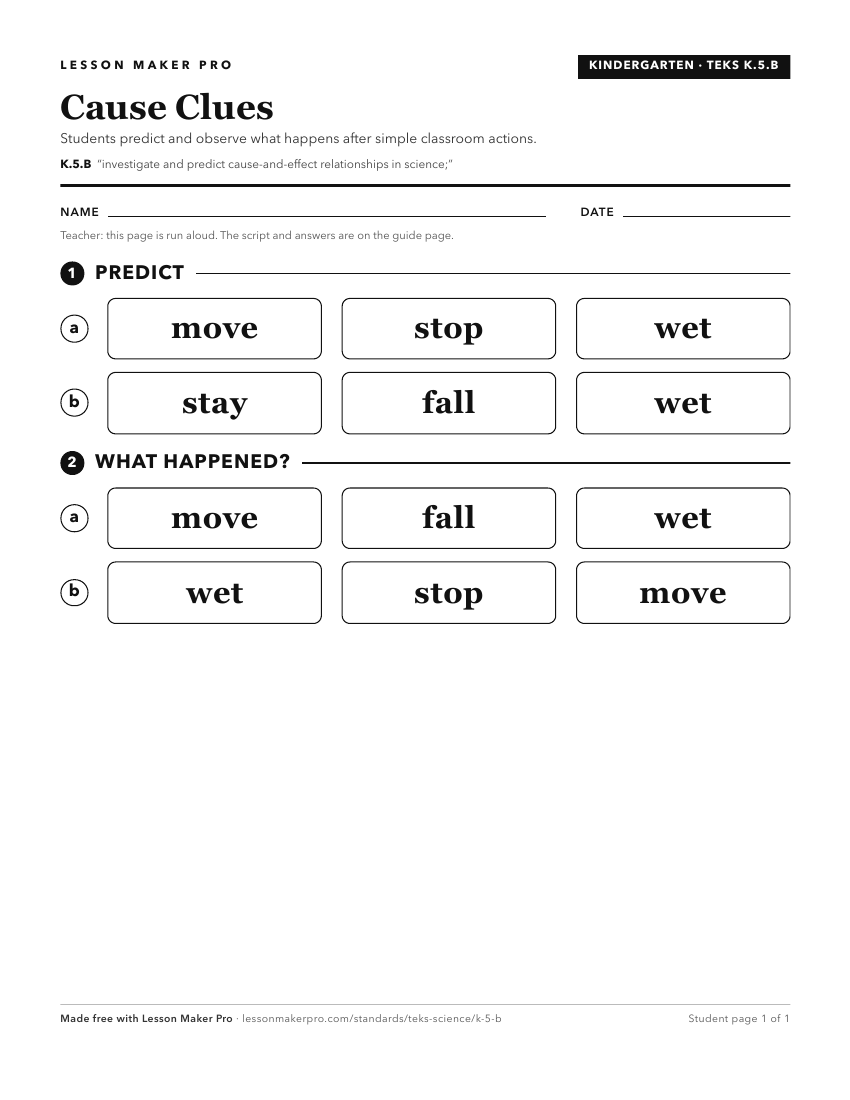
A ready-to-print activity worksheet aligned to K.5.B, with an answer key for the teacher on its own page. No account needed.
PDF, US Letter, prints cleanly in black and white.
Download the worksheetKeep exploring
Related Standards
- 1.5.B
The 1st Grade version of this standard.
- 3.5.B
identify and investigate cause-and-effect relationships to explain scientific phenomena or analyze problems
- 2.5.B
The 2nd Grade version of this standard.
- 6.5.B
identify and investigate cause-and-effect relationships to explain scientific phenomena or analyze problems
Turn this exact standard into a lesson
Grade, subject, topic, and the complete standard are prefilled. Create one free, no account needed.
Also for this standard:Make a WorksheetMake a QuizMake a Sub Lesson