Texas TEKS 4.5
TEKS Knowledge Statement (Expectation Cluster)
Recurring themes and concepts. The student understands that recurring themes and concepts provide a framework for making connections across disciplines. The student is expected to: identify and use patterns to explain scientific phenomena or to design solutions; identify and investigate cause-and-effect relationships to explain scientific phenomena or analyze problems; use scale, proportion, and quantity to describe, compare, or model different systems; examine and model the parts of a system and their interdependence in the function of the system; investigate how energy flows and matter cycles through systems and how matter is conserved; explain the relationship between the structure and function of objects, organisms, and systems; and explain how factors or conditions impact stability and change in objects, organisms, and systems.
Texas Essential Knowledge and Skills for Science
Cluster contents
Student Expectations in This Statement
4.5 is a TEKS knowledge and skills statement. These are the student expectations under it.
- 4.5.A
identify and use patterns to explain scientific phenomena or to design solutions
- 4.5.B
identify and investigate cause-and-effect relationships to explain scientific phenomena or analyze problems
- 4.5.C
use scale, proportion, and quantity to describe, compare, or model different systems
- 4.5.D
examine and model the parts of a system and their interdependence in the function of the system
- 4.5.E
investigate how energy flows and matter cycles through systems and how matter is conserved
- 4.5.F
explain the relationship between the structure and function of objects, organisms, and systems
- 4.5.G
explain how factors or conditions impact stability and change in objects, organisms, and systems.
Teacher's field guide
What This Cluster Means
What Students Need to Do
- Students find patterns and test cause-and-effect links to explain observations or suggest solutions. They use measurements, scale, and models to compare systems, show interacting parts, and connect structures with jobs. They track matter and energy, account for matter as it changes form or location, and predict how conditions affect stability.
What Mastery Looks Like
- Given a pond model, a student labels parts, traces energy and matter, and explains how the parts depend on one another. The student uses measurements or repeated observations to support a pattern or cause-and-effect claim and predict what happens when one condition changes. The student also explains how a plant or animal structure serves a specific function.
Common Misconceptions
- Students may call something a pattern after one or two observations, or assume that events occurring together prove causation. They may think energy gets used up or matter disappears during melting, decay, or evaporation. They may also treat system parts as independent and assume a larger model behaves exactly like the real system.
How to Assess It
- Give students a diagram of a closed terrarium with sunlight, a plant, soil, water, and a worm. Ask: "Trace one matter cycle and one energy path, then predict and explain what changes if sunlight decreases."
Lesson moves
Ways to Teach It
Build a paper-cup water system with holes and tubing, then change one part and record effects on flow and stability.
Write how a bird's beak shape helps it eat and what evidence would show a cause-and-effect link.
Play System Match with cards showing parts, functions, inputs, outputs, patterns, and changes, then have teams justify each completed set.
Compare two local weather reports, identify a pattern, and recommend one school recess plan based on temperature, wind, and rainfall.
Free download
Printable 4.5 Worksheet
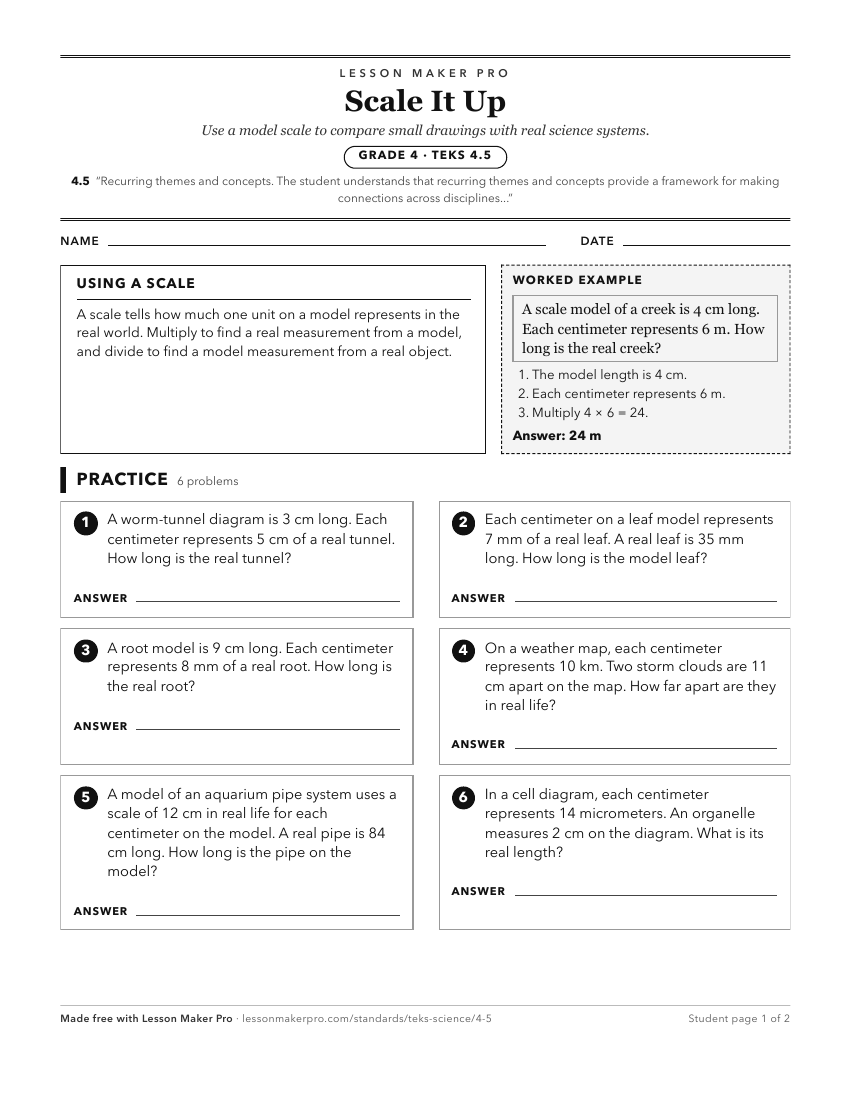
A ready-to-print activity worksheet aligned to 4.5, with an answer key for the teacher on its own page. No account needed.
PDF, US Letter, prints cleanly in black and white.
Download the worksheetKeep exploring
Related Standards
Turn this cluster into a lesson
Grade, subject, topic, and the complete cluster are prefilled. Create one free, no account needed.
Also for this cluster:Make a WorksheetMake a QuizMake a Sub Lesson