Texas TEKS K.5.D
The Standard
- K.5
- Recurring themes and concepts. The student uses recurring themes and concepts to make connections across disciplines. The student is expected to:
examine the parts of a whole to define or model a system
Texas Essential Knowledge and Skills for Science
Teacher's field guide
What This Standard Means
What Students Need to Do
- Students identify the parts that make up a whole. They tell how the parts fit or work together, then use objects or drawings to make a simple model.
What Mastery Looks Like
- Given a familiar object, a student names its main parts and explains what each part does for the whole. The student builds or draws a model with the parts in sensible places.
Common Misconceptions
- Students may call any group of objects a whole, even when the pieces do not work together. They may leave out hidden parts or name a part without explaining how it helps the whole.
How to Assess It
- Show students a picture of a bicycle. Ask them to circle three parts, name each one, and tell how one part helps the bicycle work.
Lesson moves
Ways to Teach It
Give pairs a toy car and building pieces, then have them identify its parts and build a model car.
Show a plant and ask, “What parts do you see, and what might happen if the roots were missing?”
Students match picture cards showing parts, such as wheels or leaves, to cards showing the correct whole.
Visit a classroom sink and identify the faucet, handle, basin, and drain, then discuss how they work together.
Free download
Printable K.5.D Worksheet
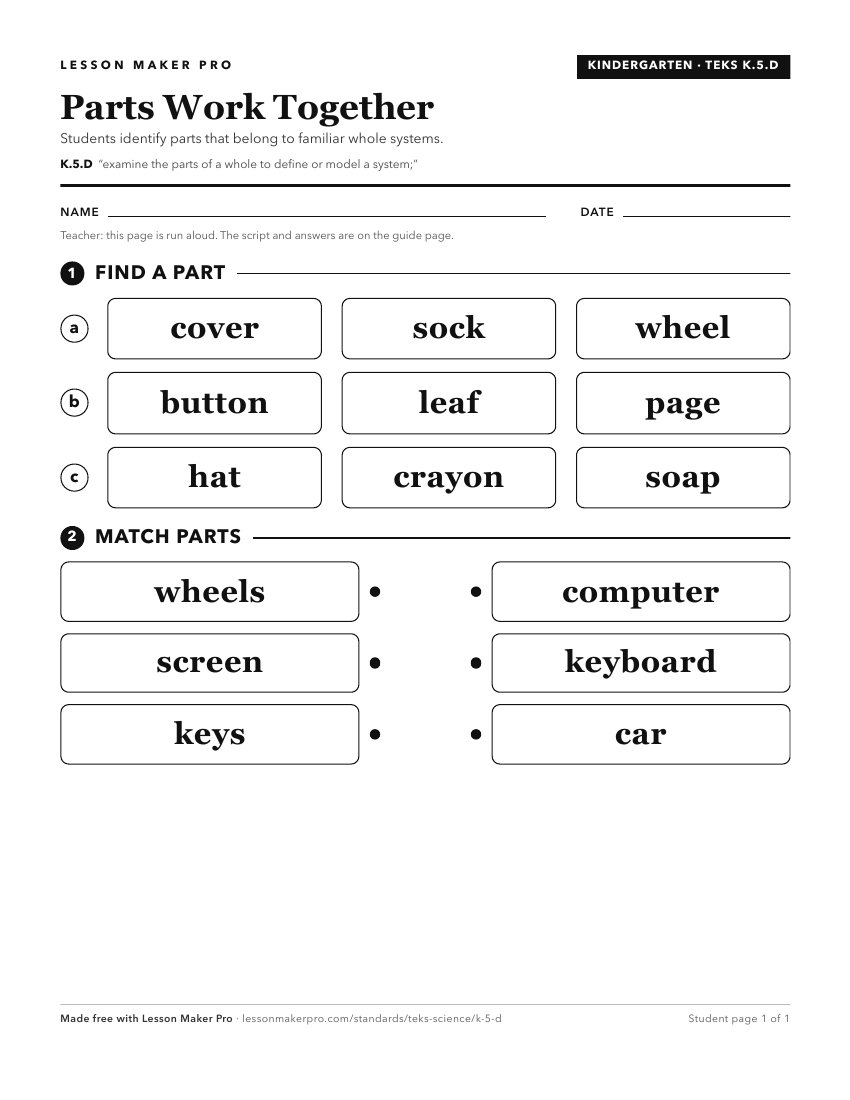
A ready-to-print activity worksheet aligned to K.5.D, with an answer key for the teacher on its own page. No account needed.
PDF, US Letter, prints cleanly in black and white.
Download the worksheetKeep exploring
Related Standards
Turn this exact standard into a lesson
Grade, subject, topic, and the complete standard are prefilled. Create one free, no account needed.
Also for this standard:Make a WorksheetMake a QuizMake a Sub Lesson