Texas TEKS 3.5.D
The Standard
- 3.5
- Recurring themes and concepts. The student understands that recurring themes and concepts provide a framework for making connections across disciplines. The student is expected to:
examine and model the parts of a system and their interdependence in the function of the system
Texas Essential Knowledge and Skills for Science
Teacher's field guide
What This Standard Means
What Students Need to Do
- Students identify the parts of a familiar system and describe each part’s job. They use a drawing or physical model to show how the parts work together and predict what happens when one part changes.
What Mastery Looks Like
- A student can label parts, connect them with arrows, and explain how their actions support one result. The student can predict a specific effect when a part is removed, blocked, or changed.
Common Misconceptions
- Students may think any group of objects is a system or that each part works alone. They may say a missing part makes the system stop without explaining which other parts are affected.
How to Assess It
- Show a bicycle with its chain removed. Ask students to draw arrows between affected parts and explain why the bicycle cannot move when the pedals turn.
Lesson moves
Ways to Teach It
Build cup-and-string telephones, then test tight and loose strings to see how each part affects sound travel.
Ask students to write how a classroom door’s hinges, knob, and latch work together to help the door function.
Give teams flashlight part cards and have them race to arrange the parts, connect their jobs, and explain one missing-part effect.
Inspect a hand-crank pencil sharpener, sketch its visible parts, and explain how the handle, cutter, case, and tray support its use.
Free download
Printable 3.5.D Worksheet
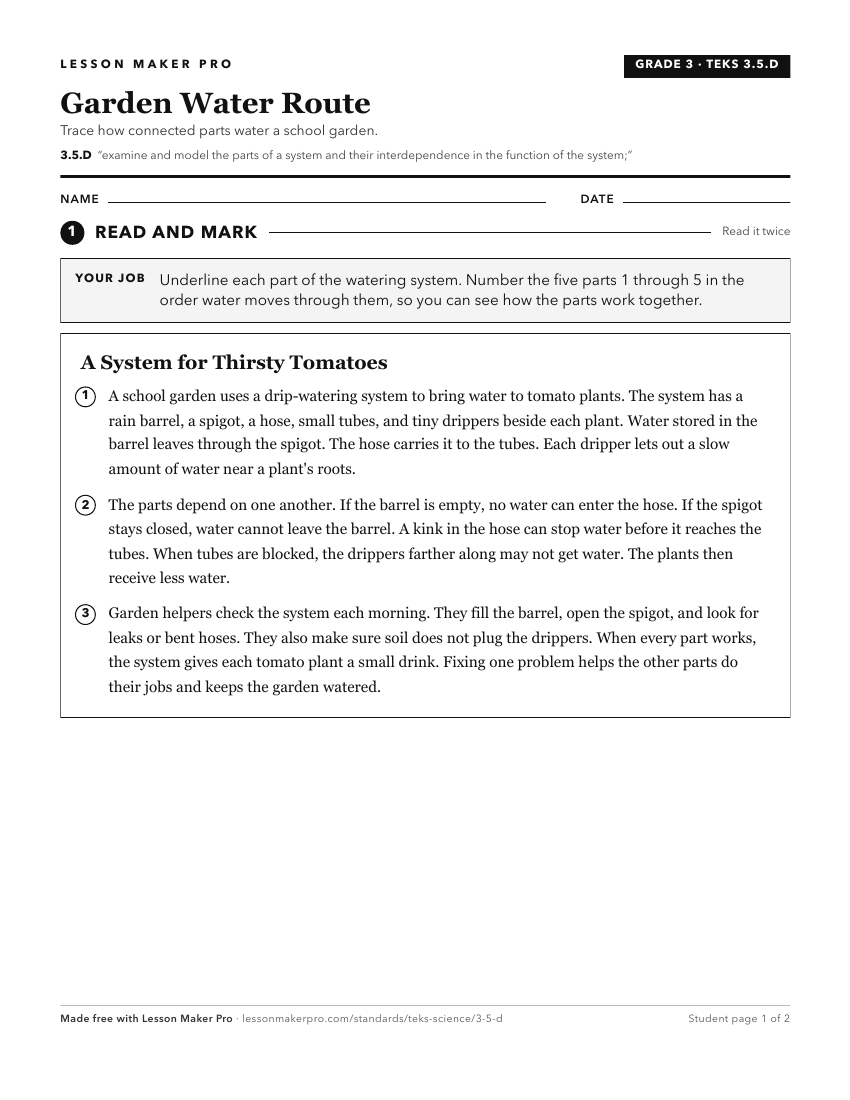
A ready-to-print activity worksheet aligned to 3.5.D, with an answer key for the teacher on its own page. No account needed.
PDF, US Letter, prints cleanly in black and white.
Download the worksheetKeep exploring
Related Standards
Turn this exact standard into a lesson
Grade, subject, topic, and the complete standard are prefilled. Create one free, no account needed.
Also for this standard:Make a WorksheetMake a QuizMake a Sub Lesson