Texas TEKS 7.5.D
The Standard
- 7.5
- Recurring themes and concepts. The student understands that recurring themes and concepts provide a framework for making connections across disciplines. The student is expected to:
examine and model the parts of a system and their interdependence in the function of the system
Texas Essential Knowledge and Skills for Science
Teacher's field guide
What This Standard Means
What Students Need to Do
- Students identify the parts of a system and explain each part's job. They create models showing how parts interact and predict what happens when one part changes or fails.
What Mastery Looks Like
- Students can label system components, trace interactions, and explain how the parts work together. They can use evidence from a model to predict the effects of removing a component.
Common Misconceptions
- Students may treat a system as a list of parts rather than a set of interactions. They may assume every part is equally necessary or that changing one part affects only that part.
How to Assess It
- Show a labeled flashlight diagram and ask: How do three parts work together, and what happens if the switch is removed?
Lesson moves
Ways to Teach It
Build a simple circuit with a battery, wires, bulb, and switch, then remove each part and record the effect.
Write about one school cafeteria component and predict how its failure would affect workers, students, supplies, and cleanup.
Play a system card match, pairing component cards with function, interaction, and failure effect cards.
Diagram a bicycle braking system from a photo and explain how the lever, cable, pads, and wheel interact.
Free download
Printable 7.5.D Worksheet
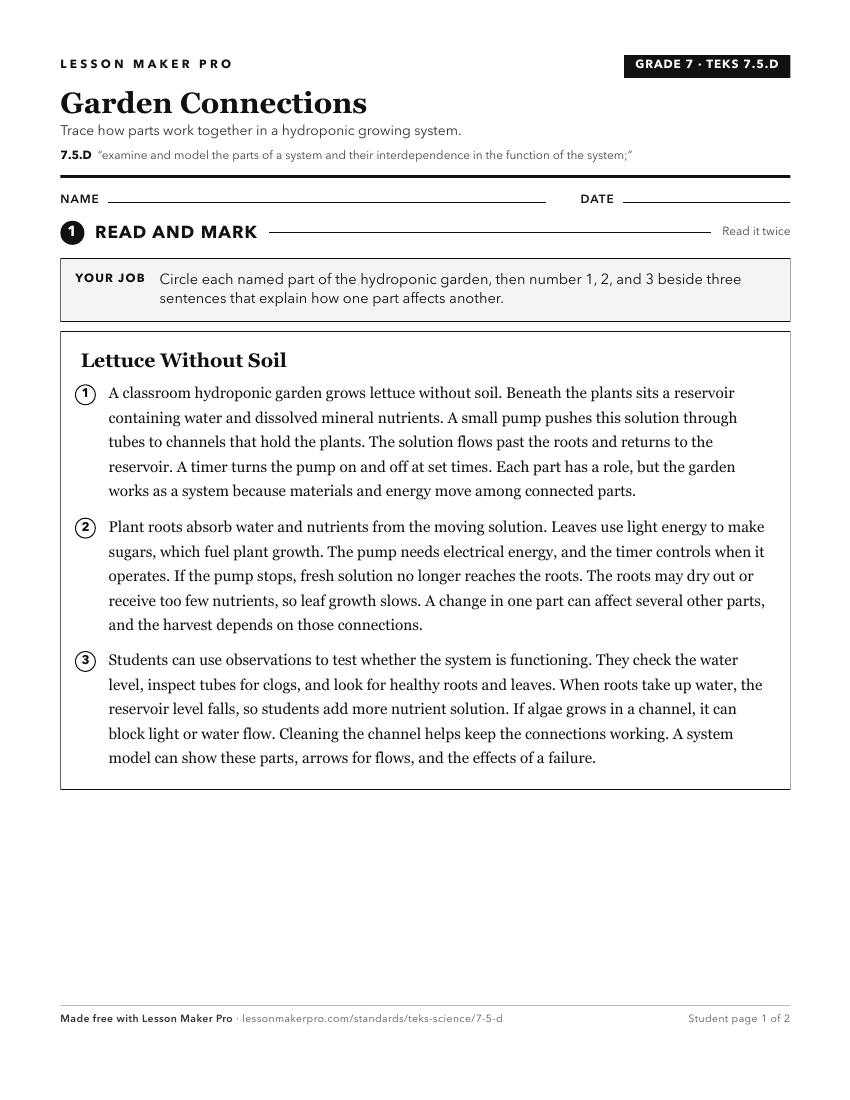
A ready-to-print activity worksheet aligned to 7.5.D, with an answer key for the teacher on its own page. No account needed.
PDF, US Letter, prints cleanly in black and white.
Download the worksheetKeep exploring
Related Standards
Turn this exact standard into a lesson
Grade, subject, topic, and the complete standard are prefilled. Create one free, no account needed.
Also for this standard:Make a WorksheetMake a QuizMake a Sub Lesson