Texas TEKS 2.5.D
The Standard
- 2.5
- Recurring themes and concepts. The student uses recurring themes and concepts to make connections across disciplines. The student is expected to:
examine the parts of a whole to define or model a system
Texas Essential Knowledge and Skills for Science
Teacher's field guide
What This Standard Means
What Students Need to Do
- Students identify the parts that make up a familiar object or living thing. They use labels, arrows, or a model to show how the parts work together.
What Mastery Looks Like
- Given a familiar system, students can name its main parts and explain each part's job. They can build or draw a model that shows how the parts connect.
Common Misconceptions
- Students may think any group of objects is a system, even when the objects do not work together. They may list parts without explaining their jobs or connections.
How to Assess It
- Ask students to draw a plant, label the roots, stem, and leaves, and use arrows and one sentence to show how the parts work together.
Lesson moves
Ways to Teach It
Build a marble run from paper tubes, tape, and a cup, then label how each part helps move or catch the marble.
Ask, "Is a bag of toy car parts a system?" Have students write two sentences defending their answer.
Play a matching game where students pair picture cards of parts, such as wheels and axles, with the whole system.
Inspect the classroom door, sketch the hinges, knob, frame, and door, then explain how they work together.
Free download
Printable 2.5.D Worksheet
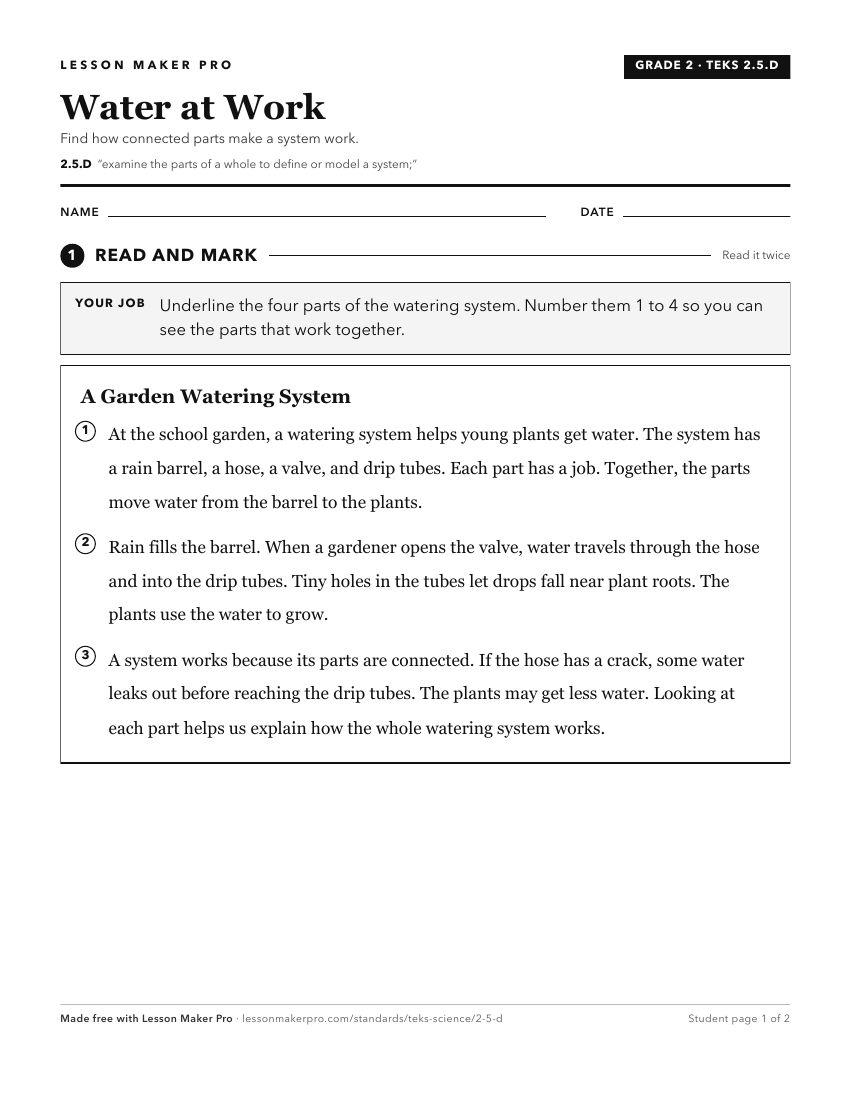
A ready-to-print activity worksheet aligned to 2.5.D, with an answer key for the teacher on its own page. No account needed.
PDF, US Letter, prints cleanly in black and white.
Download the worksheetKeep exploring
Related Standards
Turn this exact standard into a lesson
Grade, subject, topic, and the complete standard are prefilled. Create one free, no account needed.
Also for this standard:Make a WorksheetMake a QuizMake a Sub Lesson