Texas TEKS 2.5
TEKS Knowledge Statement (Expectation Cluster)
Recurring themes and concepts. The student uses recurring themes and concepts to make connections across disciplines. The student is expected to: identify and use patterns to describe phenomena or design solutions; investigate and predict cause-and-effect relationships in science; measure and describe the properties of objects in terms of size and quantity; examine the parts of a whole to define or model a system; identify forms of energy and properties of matter; describe the relationship between structure and function of objects, organisms, and systems; and describe how factors or conditions can cause objects, organisms, and systems to either change or stay the same.
Texas Essential Knowledge and Skills for Science
Cluster contents
Student Expectations in This Statement
2.5 is a TEKS knowledge and skills statement. These are the student expectations under it.
- 2.5.A
identify and use patterns to describe phenomena or design solutions
- 2.5.B
investigate and predict cause-and-effect relationships in science
- 2.5.C
measure and describe the properties of objects in terms of size and quantity
- 2.5.D
examine the parts of a whole to define or model a system
- 2.5.E
identify forms of energy and properties of matter
- 2.5.F
describe the relationship between structure and function of objects, organisms, and systems
- 2.5.G
describe how factors or conditions can cause objects, organisms, and systems to either change or stay the same.
Teacher's field guide
What This Cluster Means
What Students Need to Do
- Students spot patterns and use them to explain observations, make predictions, and improve simple designs. They measure properties, identify matter and energy, and explain how parts work together in a system. They connect causes, structures, and changing conditions to what happens or stays the same.
What Mastery Looks Like
- Given a simple setup, a student records measurements, finds a pattern, and predicts what will happen when one condition changes. The student names a system's parts and purpose, then links a structure to its job. The student identifies the matter, energy, cause, effect, and any change.
Common Misconceptions
- Students may call any group a pattern or assume that two events happening together proves cause and effect. They may list system parts without explaining how those parts work together. They may confuse energy with matter, omit measurement units, or assume all changes are permanent.
How to Assess It
- Give this exit ticket: “A toy car rolls 20 cm from a low ramp, 40 cm from a medium ramp, and 60 cm from a high ramp. State the pattern, predict the next distance, and explain the cause.”
Lesson moves
Ways to Teach It
Build foil boats, add pennies one at a time, record capacity, then change the shape to improve the design.
Write: How does moving a cup of ice from shade to sunlight change it, and what causes the change?
Play System Match by pairing picture cards of parts, wholes, and jobs, such as wheel, bicycle, and movement.
Inspect a classroom fan, identify its matter and energy, and explain how blade shape helps move air.
Free download
Printable 2.5 Worksheet
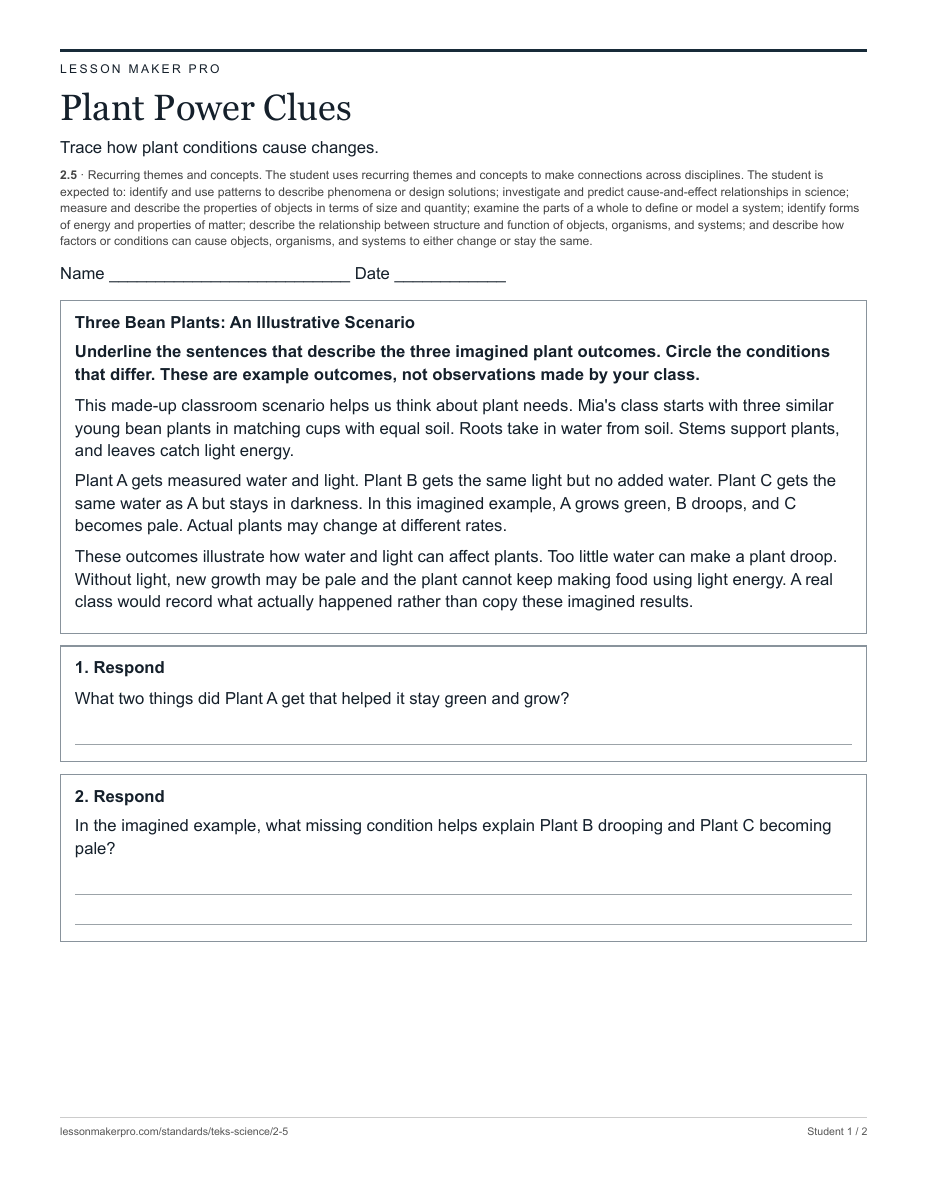
A ready-to-print activity worksheet aligned to 2.5, with an answer key for the teacher on its own page. No account needed.
PDF, US Letter, prints cleanly in black and white.
Download the worksheetKeep exploring
Related Standards
- K.5
The Kindergarten version of this standard.
- 1.5
The 1st Grade version of this standard.
- 4.5
Recurring themes and concepts. The student understands that recurring themes and concepts provide a framework for making connections across disciplines. The stu...
- 3.5
Recurring themes and concepts. The student understands that recurring themes and concepts provide a framework for making connections across disciplines. The stu...
Turn this cluster into a lesson
Grade, subject, topic, and the complete cluster are prefilled. Create one free, no account needed.
Also for this cluster:Make a WorksheetMake a QuizMake a Sub Lesson