Texas TEKS 2.5.C
The Standard
- 2.5
- Recurring themes and concepts. The student uses recurring themes and concepts to make connections across disciplines. The student is expected to:
measure and describe the properties of objects in terms of size and quantity
Texas Essential Knowledge and Skills for Science
Teacher's field guide
What This Standard Means
What Students Need to Do
- Students measure an object’s size and count how many objects are in a group. They record measurements with a number and unit, then describe comparisons using words such as longer, shorter, more, and fewer.
What Mastery Looks Like
- Students choose a suitable tool, measure carefully, and include the correct unit. They count groups accurately and use measurements or counts to support comparisons.
Common Misconceptions
- Students may give a number without a unit or start measuring past the zero mark. They may confuse an object’s size with the number of objects in a group.
How to Assess It
- Give students two pencils and a group of six cubes. Ask them to measure each pencil, count the cubes, and write three comparison statements.
Lesson moves
Ways to Teach It
Give pairs rulers, linking cubes, and classroom objects to measure, count, and sort by length or quantity.
Ask students to write which of two object groups has more items and explain how they know.
Play a measurement match game where students pair object cards with the correct length or quantity card.
Measure and count items in a lunchbox, then compare their sizes and quantities for packing decisions.
Free download
Printable 2.5.C Worksheet
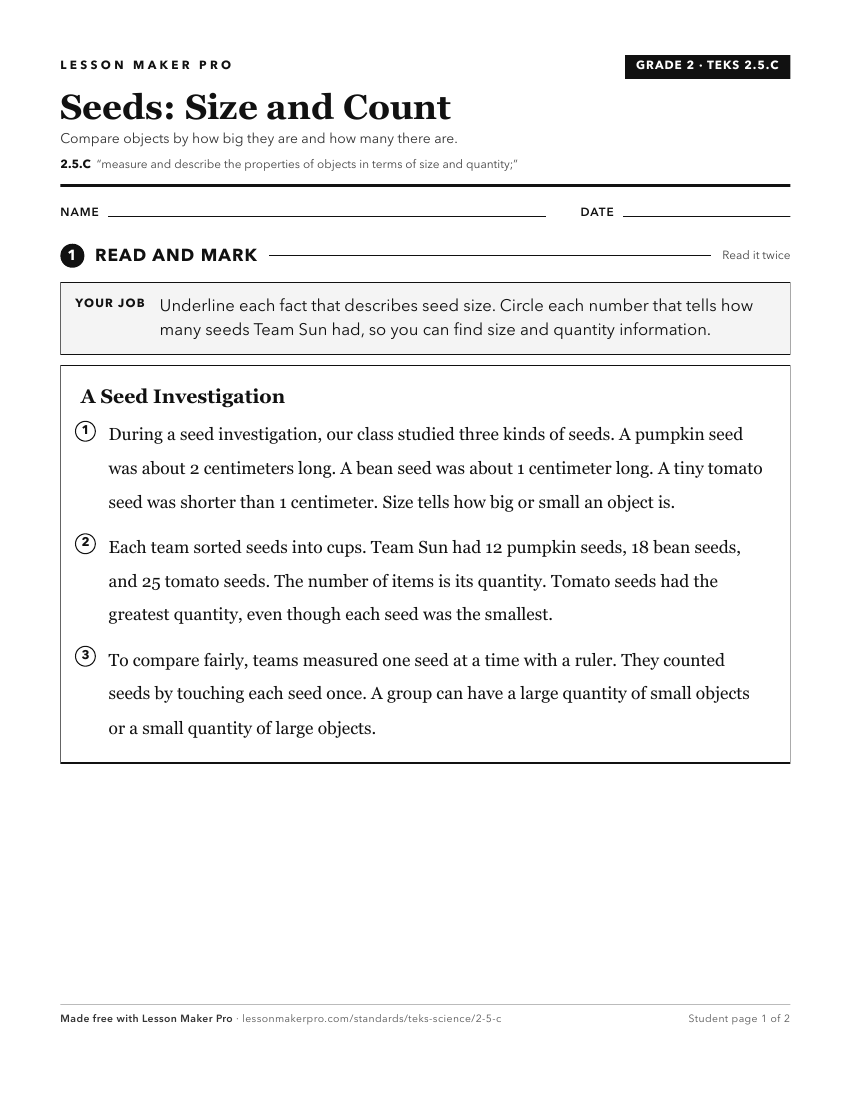
A ready-to-print activity worksheet aligned to 2.5.C, with an answer key for the teacher on its own page. No account needed.
PDF, US Letter, prints cleanly in black and white.
Download the worksheetKeep exploring
Related Standards
- K.5.C
describe the properties of objects in terms of relative size (scale) and relative quantity
- 3.5.C
use scale, proportion, and quantity to describe, compare, or model different systems
- 1.5.C
describe the properties of objects in terms of relative size (scale) and relative quantity
- 4.5.C
use scale, proportion, and quantity to describe, compare, or model different systems
Turn this exact standard into a lesson
Grade, subject, topic, and the complete standard are prefilled. Create one free, no account needed.
Also for this standard:Make a WorksheetMake a QuizMake a Sub Lesson