Texas TEKS 8.1
TEKS Knowledge Statement (Expectation Cluster)
Scientific and engineering practices. The student, for at least 40% of instructional time, asks questions, identifies problems, and plans and safely conducts classroom, laboratory, and field investigations to answer questions, explain phenomena, or design solutions using appropriate tools and models. The student is expected to: ask questions and define problems based on observations or information from text, phenomena, models, or investigations; use scientific practices to plan and conduct descriptive, comparative, and experimental investigations and use engineering practices to design solutions to problems; use appropriate safety equipment and practices during laboratory, classroom, and field investigations as outlined in Texas Education Agency-approved safety standards; use appropriate tools such as graduated cylinders, metric rulers, periodic tables, balances, scales, thermometers, temperature probes, laboratory ware, timing devices, pH indicators, hot plates, models, microscopes, slides, life science models, petri dishes, dissecting kits, magnets, spring scales or force sensors, tools that model wave behavior, satellite images, weather maps, hand lenses, and lab notebooks or journals; collect quantitative data using the International System of Units (SI) and qualitative data as evidence; construct appropriate tables, graphs, maps, and charts using repeated trials and means to organize data; develop and use models to represent phenomena, systems, processes, or solutions to engineering problems; and distinguish between scientific hypotheses, theories, and laws.
Texas Essential Knowledge and Skills for Science
Cluster contents
Student Expectations in This Statement
8.1 is a TEKS knowledge and skills statement. These are the student expectations under it.
- 8.1.A
ask questions and define problems based on observations or information from text, phenomena, models, or investigations
- 8.1.B
use scientific practices to plan and conduct descriptive, comparative, and experimental investigations and use engineering practices to design solutions to prob...
- 8.1.C
use appropriate safety equipment and practices during laboratory, classroom, and field investigations as outlined in Texas Education Agency-approved safety stan...
- 8.1.D
use appropriate tools such as graduated cylinders, metric rulers, periodic tables, balances, scales, thermometers, temperature probes, laboratory ware, timing d...
- 8.1.E
collect quantitative data using the International System of Units (SI) and qualitative data as evidence
- 8.1.F
construct appropriate tables, graphs, maps, and charts using repeated trials and means to organize data
- 8.1.G
develop and use models to represent phenomena, systems, processes, or solutions to engineering problems
- 8.1.H
distinguish between scientific hypotheses, theories, and laws
Teacher's field guide
What This Cluster Means
What Students Need to Do
- Students ask testable questions, define problems, and plan safe descriptive, comparative, or experimental investigations. They choose suitable tools, collect SI and qualitative data, repeat trials, calculate means, and display results. They also use models, design solutions, and distinguish hypotheses, theories, and laws.
What Mastery Looks Like
- Students can write a clear investigation plan with variables, tools, safety steps, measurements, and repeated trials. They can organize evidence in a suitable table or graph and use it to explain a result or improve a design.
Common Misconceptions
- Students may call every investigation an experiment or confuse repeated measurements with repeated trials. They may choose an unsuitable graph, omit units, or treat qualitative observations as opinions. Some think theories become laws after enough evidence or that a hypothesis is a guess.
How to Assess It
- Give students a scenario about testing how water temperature affects dissolving time. Ask them to name the investigation type, variables, SI measurements, safety step, repeated trials, and suitable graph.
Lesson moves
Ways to Teach It
Test how water temperature affects dissolving time, using safe procedures, timing devices, repeated trials, means, and a line graph.
Write a claim explaining how a hypothesis, theory, and law differ, then support each distinction with a science example.
Play investigation sort cards, matching scenarios with descriptive, comparative, experimental, or engineering work and the correct tools and safety steps.
Design and test a low-cost device that keeps a cold drink cool, then use temperature data to revise the design.
Free download
Printable 8.1 Worksheet
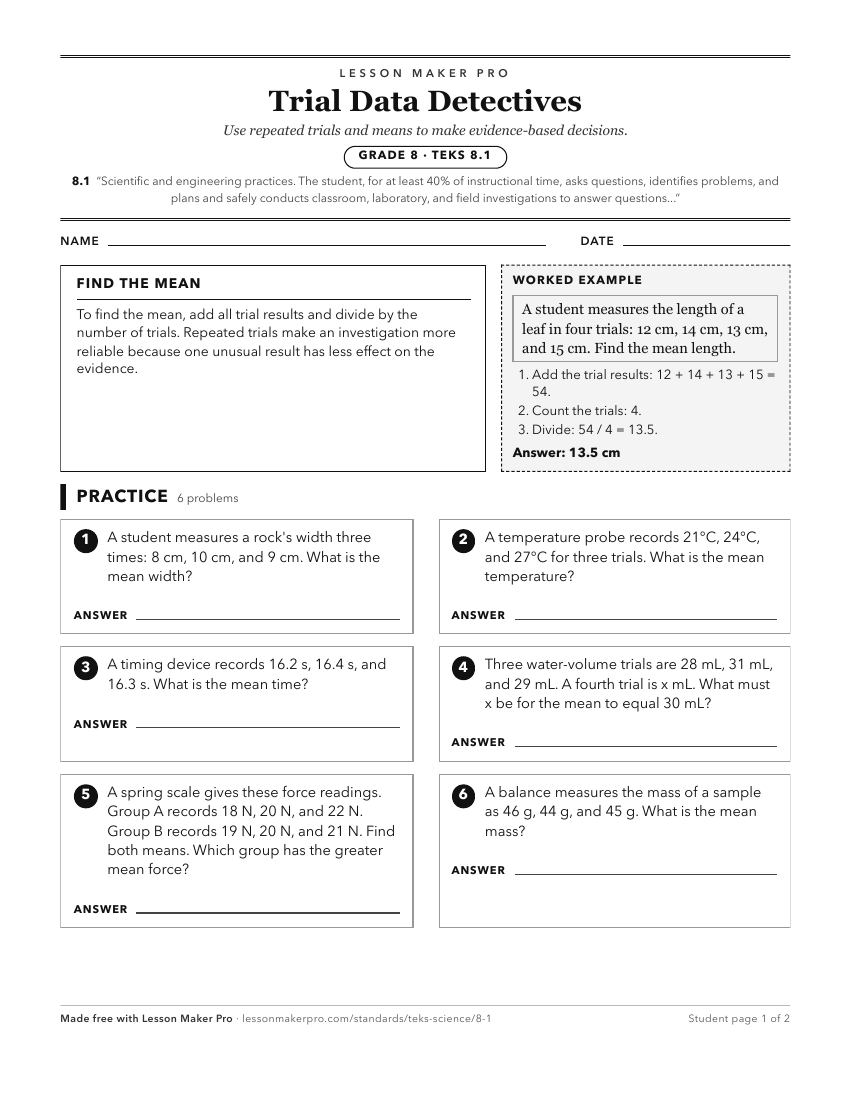
A ready-to-print activity worksheet aligned to 8.1, with an answer key for the teacher on its own page. No account needed.
PDF, US Letter, prints cleanly in black and white.
Download the worksheetKeep exploring
Related Standards
- 1.1
Scientific and engineering practices. The student asks questions, identifies problems, and plans and safely conducts classroom, laboratory, and field investigat...
- 2.1
Scientific and engineering practices. The student asks questions, identifies problems, and plans and safely conducts classroom, laboratory, and field investigat...
- 7.1
Scientific and engineering practices. The student, for at least 40% of instructional time, asks questions, identifies problems, and plans and safely conducts cl...
- 6.1
Scientific and engineering practices. The student, for at least 40% of instructional time, asks questions, identifies problems, and plans and safely conducts cl...
Turn this cluster into a lesson
Grade, subject, topic, and the complete cluster are prefilled. Create one free, no account needed.
Also for this cluster:Make a WorksheetMake a QuizMake a Sub Lesson